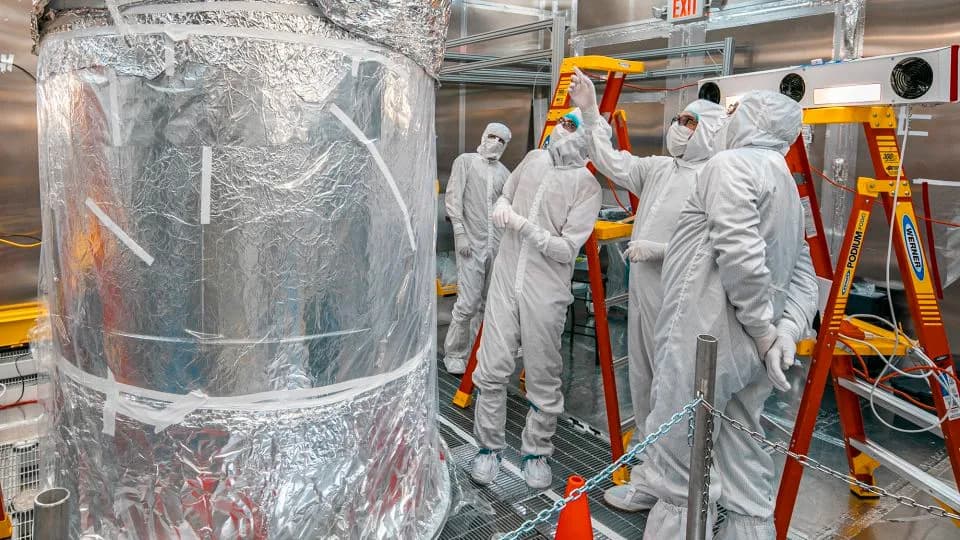
JUNO, a large neutrino detector sited about 2,297 feet (≈700 m) underground in Jiangmen, China, has published early, high-precision measurements showing neutrinos oscillating among three flavors. The results — based on just two months of data and reported in Nature — refine key oscillation parameters and move the field closer to resolving the neutrino mass hierarchy. JUNO's findings complement future efforts by Hyper-Kamiokande and DUNE.
Deep Underground Breakthrough: JUNO Records Neutrinos 'Changing Flavors' With High Precision
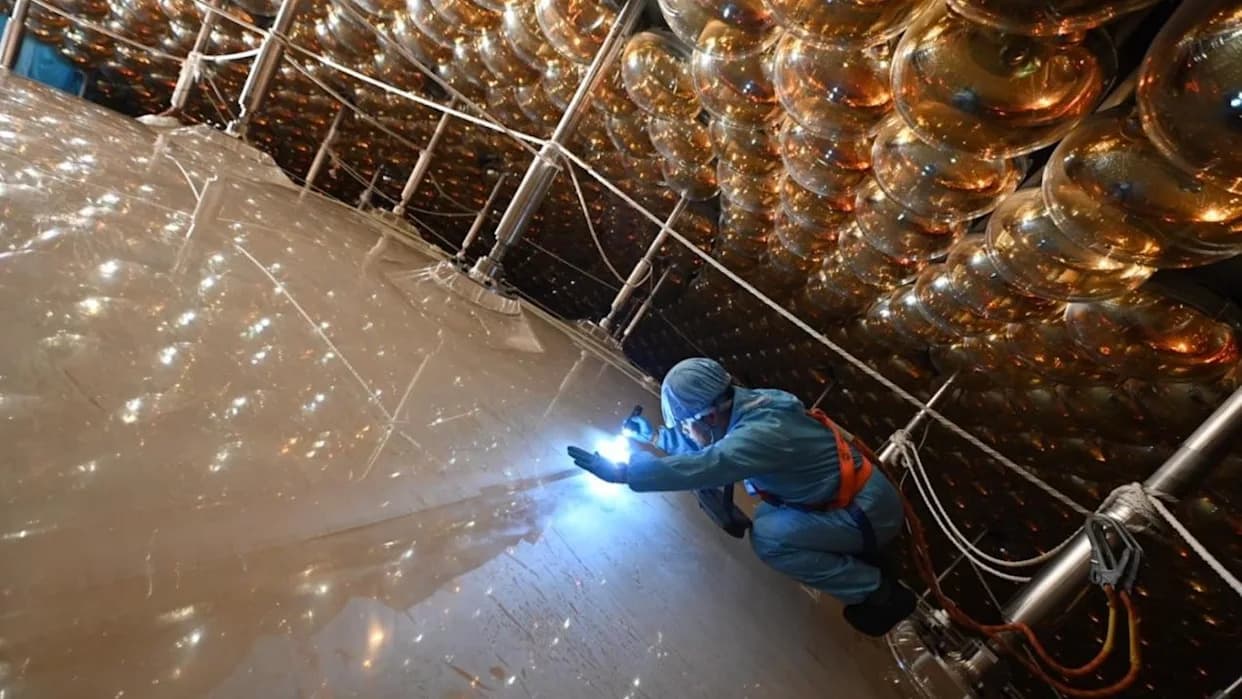
Photo Credit: Chinese Academy of Sciences
The Jiangmen Underground Neutrino Observatory (JUNO), located 2,297 feet (≈700 m) beneath Jiangmen in Guangdong, China, has released early results showing unusually precise measurements of neutrinos oscillating among three distinct "flavors." Built to detect neutrinos and antineutrinos, JUNO began taking data in August and reported its first findings after only two months of observation in a paper published in Nature.
What JUNO Saw
Neutrinos are tiny, nearly massless particles that rarely interact with matter — earning them the nickname "ghost particles." Inside JUNO's vast spherical detector, antineutrinos (primarily from nearby nuclear reactors) occasionally collide with other particles and produce faint flashes of light. Sensitive photodetectors capture those flashes, allowing researchers to reconstruct how neutrinos change identity — or "oscillate" — among the three flavors: electron, muon and tau.
Why This Matters
Even with a limited two-month dataset, JUNO achieved remarkably sharp measurements of oscillation patterns. Those measurements improve constraints on neutrino mixing parameters and bring physicists closer to resolving the neutrino mass hierarchy — the ordering of neutrino mass states, i.e., which are heavier and which are lighter. Determining the hierarchy is a key step toward understanding fundamental particle behavior and the role neutrinos played in the evolution of the universe.
Broader Impact and Next Steps
JUNO showcases advances in detector design, data acquisition, and international scientific collaboration. The observatory's technological developments will benefit other fields that rely on detecting extremely faint signals. Complementary large-scale experiments — Japan's Hyper-Kamiokande and the U.S.-based Deep Underground Neutrino Experiment (DUNE) — are expected to begin operations within the next decade, giving scientists multiple, independent ways to probe the same cosmic questions.
Kate Scholberg, a Duke physicist not involved in the research, said: "It really makes me look forward to more exciting results in the future."
Liangjian Wen, a study co-author, emphasized JUNO's potential: "It will be able to test the finer ripples that distinguish neutrino flavors and masses."
As JUNO continues to collect data, longer runs and combined analyses with other experiments should sharpen answers about neutrino properties and deepen our understanding of the subatomic processes that shaped the cosmos.
Help us improve.