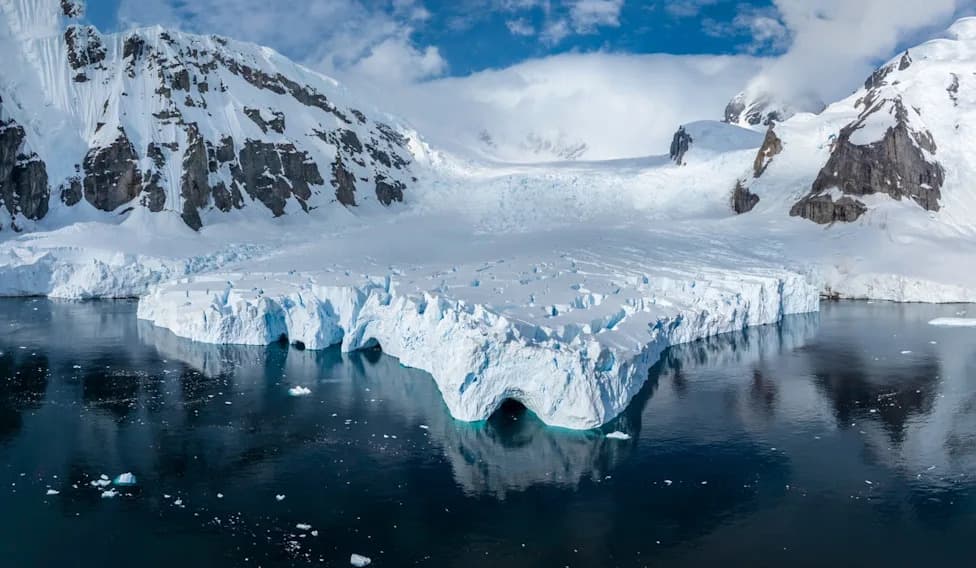
Researchers reanalyzed seismic records with deep-learning methods and found hundreds of small earthquakes beneath the David Glacier region of Antarctica. The events, magnitude 1.6–3.5, originated deeper than about 70 km (≈43 miles) — below the crust–mantle boundary — and occurred within tectonic plates rather than at plate edges. Scientists attribute the quakes to contrasting lithospheric conditions beneath West and East Antarctica and recommend AI-driven detection to search for similar intraplate events globally.
Deep-Learning Reveals Hundreds of Hidden Earthquakes Beneath Antarctica’s Ice

Illustration by Tag Hartman-Simkins / Futurism. Source: Shutterstock
Scientists using deep-learning algorithms have detected hundreds of previously unreported small earthquakes beneath the David Glacier region of Antarctica, suggesting the frozen continent is more seismically active than long assumed.
The research team reanalyzed archived seismic records from two periods (2001–2004 and 2012–2015) and identified tremors with magnitudes between 1.6 and 3.5. Crucially, these events originated at depths greater than about 70 km (≈43 miles), well below the crust–mantle boundary.
Unusual Intraplate, Intermediate-Depth Quakes
Unlike typical earthquakes that occur at plate boundaries, these events are intraplate — they happen within the interior of a tectonic plate rather than where plates meet. The paper describes them as "intraplate intermediate-depth earthquakes" (IDEs) and notes that their occurrence is difficult to reconcile with standard plate-tectonic expectations.
What Might Be Causing the Quakes?
The authors propose that contrasting lithospheric conditions beneath West and East Antarctica create bending stresses that can trigger these deep events. A relatively warmer, thicker lithosphere beneath West Antarctica appears to meet a colder, thinner lithosphere beneath East Antarctica; that abrupt change in thermal and mechanical properties may concentrate stresses and enable seismicity at unusual depths.
"The earthquakes occur where the cold, rigid crust and upper mantle beneath East Antarctica meets warmer, softer rock beneath West Antarctica, and this contrast creates an abrupt change in tectonic strength," said Long Ho, a University of Alabama geologist and the study’s first author, in comments to Live Science.
Ho and colleagues were surprised by the sheer number of detected events and suggest similar intraplate IDEs may exist in other regions worldwide. They recommend applying advanced, AI-driven seismic detection methods to reveal additional hidden seismicity.
"Advanced seismic detection capabilities, such as those used here, could reveal that intraplate IDEs are more common globally than currently recognized," the paper states.
Independent experts note that Antarctica was long considered unusually quiet seismically, but that perceived calm may have reflected limitations in detection rather than a true absence of earthquakes. The discovery echoes other recent findings of deep continental mantle earthquakes and highlights how improved data analysis and machine-learning tools can expose previously hidden geologic processes.
Help us improve.