The Venus flytrap snaps shut not by moving water between cells but by rapidly softening the cell walls of its outer epidermal layer. Researchers measured a 30–40% decrease in cell-wall stiffness that develops within about one second and releases stored stress to trigger snap-buckling. Using high-speed imaging, mechanical indentation and modeling, the team ruled out water redistribution and identified a novel, fast biomechanical mechanism that could inspire soft robotics and smart materials.
How the Venus Flytrap Snaps: Rapid Cell-Wall Softening Triggers Lightning-Fast Closure
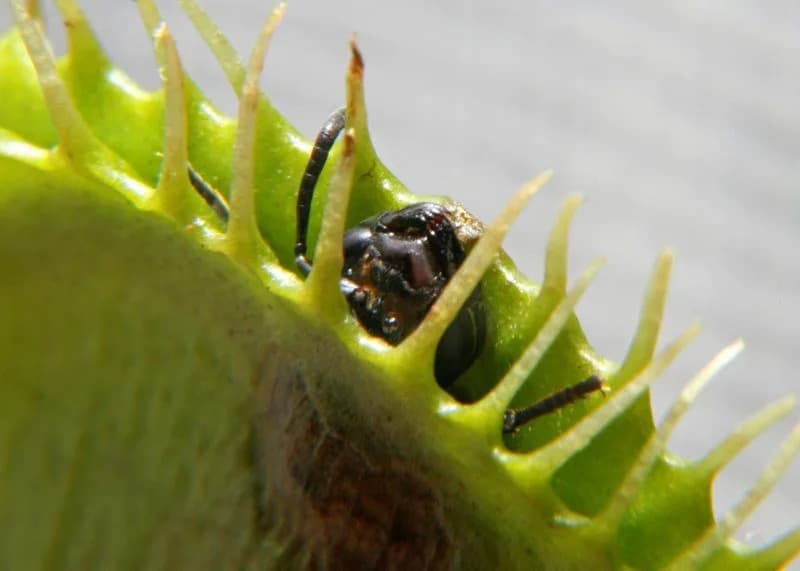
FILE PHOTO: An ant dies after an unsuccessful attempt to escape a Venus flytrap in Singapore June 23, 2009. REUTERS/David Loh/File Photo
By Will Dunham
Pity the unlucky insect that lands on a Venus flytrap: a double touch to the plant’s sensitive trigger hairs can set off a dramatic, lightning-fast closure that traps and digests the prey. New experiments published in Science identify the physical mechanism that initiates that snap—an abrupt softening of the cell walls in the trap’s outer epidermal layer.
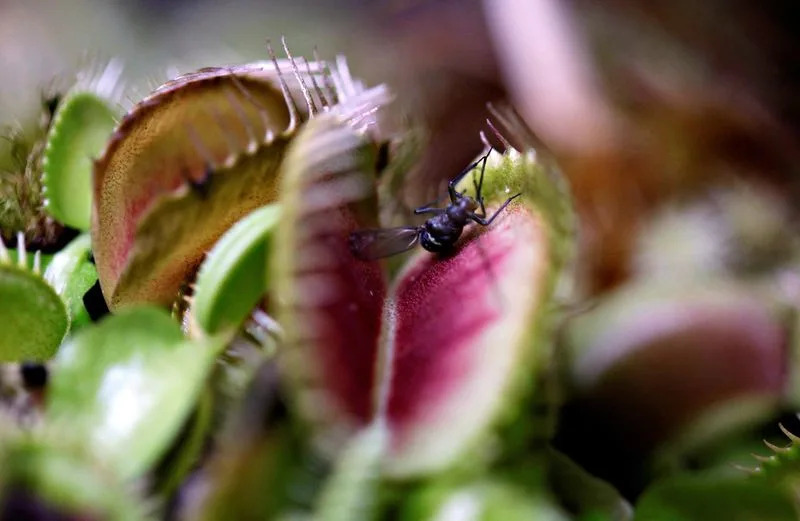
FILE PHOTO: An insect lands on a Venus flytrap, a meat-eating plant on display at the carnivorous plant fair "Dejate Atrapar" (Let Yourself Get Caught), in Bogota, Colombia July 19, 2018. REUTERS/Luisa Gonzalez/File Photo
What the Researchers Found
The Venus flytrap’s trap is a highly modified leaf made of two hinged lobes that resemble toothed jaws. For more than a century scientists thought closure was driven by a rapid redistribution of water within the leaf, with cells on one side swelling. The new study shows a different process: the cell walls of the outer epidermis soften suddenly by roughly 30–40% within about one second. That softening releases stored mechanical stress and triggers snap-buckling, allowing the lobes to bend and close. In some cases the final snap completes in as little as one tenth of a second after the trigger hairs are stimulated twice in quick succession.
Methods
In Marseille the team combined high-speed imaging, mechanical indentation of the living tissue and mechanical modeling. They also measured water transport in the trap to exclude fluid redistribution as the driver of closure. By directly measuring the trap’s mechanics as it responded, the researchers identified the internal “motor” that pushes the leaf past an instability threshold and produces the rapid snap.
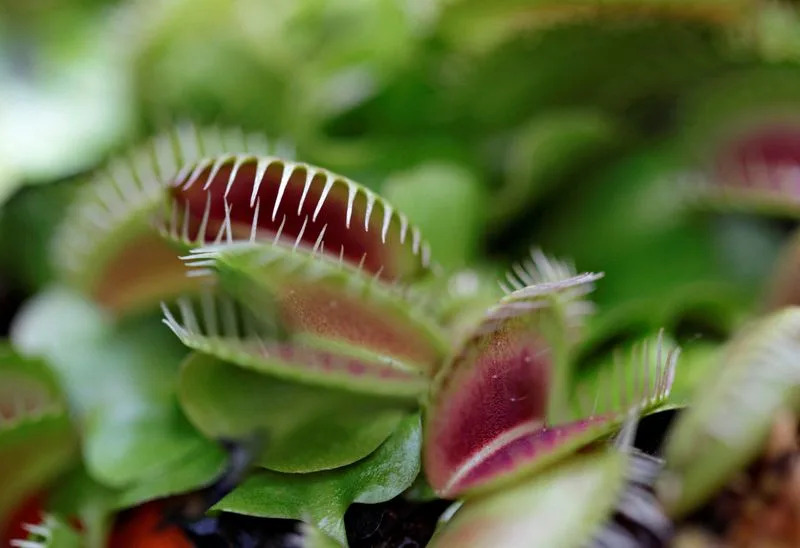
FILE PHOTO: A Venus flytrap is seen at the meat-eating plant exhibition "Dejate Atrapar" (Let Yourself Get Caught), in Bogota, Colombia July 19, 2018. REUTERS/Luisa Gonzalez/File Photo
"One of the most iconic plants in the world can still surprise us. After more than a century of research, we are still discovering fundamentally new things about how the Venus flytrap works," said physicist Yoël Forterre of CNRS and Aix-Marseille University, the study’s senior author.
Biological and Practical Significance
The Venus flytrap is native to a restricted area of North Carolina and South Carolina in the United States and—like many carnivorous plants—grows in nutrient-poor habitats, supplementing its diet by capturing insects. The findings show that the plant achieves rapid motion not by pumping fluid or collapsing tissue but by actively tuning the stiffness of its own cell walls on a very short timescale. As lead author Jeongeun Ryu noted, this is the first reported observation of such a rapid change in plant cell-wall mechanics.
Evolution appears to have repurposed a common biological mechanism—modulating cell-wall stiffness during growth—and pushed it to an extreme to produce one of the fastest movements in the plant kingdom. The authors suggest this principle could inspire future designs for soft robots and smart materials, though such applications remain a longer-term prospect.
Broader Context
There are roughly 800 known species of carnivorous plants, many of which are not closely related, indicating carnivory evolved multiple times independently. The Venus flytrap’s snapping motion has intrigued naturalists since Charles Darwin; this work settles a long-standing question about what drives that rapid movement and points to new ways that living materials can generate motion.
Study: Published in Science. Lead authors include Yoël Forterre and Jeongeun Ryu. Reporting by Will Dunham; editing by Daniel Wallis.
Help us improve.