NWA 12593, a lunar breccia discovered in Mali in 2017 and studied for nearly a decade, records three separate impacts on the Moon. The oldest event — about 3.5 billion years ago — melted portions of the lunar surface and produced traces of high-temperature cubic zirconia. A later collision welded rock fragments into the breccia, and a more recent impact ejected the fragment toward Earth. The meteorite helps link lunar events to impacts on Earth and asteroid 4 Vesta, illuminating early solar-system chaos.
Rare Lunar Meteorite Records Three Giant Moon Impacts Over 3.5 Billion Years
NWA 12593 was discovered in Mali in 2017.
A rare meteorite recovered in Mali is yielding a multibillion-year record of violent collisions on the Moon. With an unusual composition and a complex history preserved in its rocks, the specimen NWA 12593 is helping scientists piece together events that shaped the Moon, Earth and the broader solar system.
The new study, published in Geology after nearly a decade of analysis, examines NWA 12593, which was found in West Africa in 2017. This specimen is one of only 53 known lunar breccias — rocks made when many fragments of lunar crust were welded together by successive impact events billions of years ago.
Carolyn Crow, a planetary scientist at the University of Colorado Boulder and a co-author of the study, describes breccias as similar to chipped concrete: many small rock fragments fused together by an impact process.
Using radiometric dating and detailed chemical analysis, the research team identified evidence for three distinct major impacts recorded in NWA 12593. The oldest of these events dates to roughly 3.5 billion years ago and was energetic enough to partly melt the lunar surface, producing molten flows across the crust.
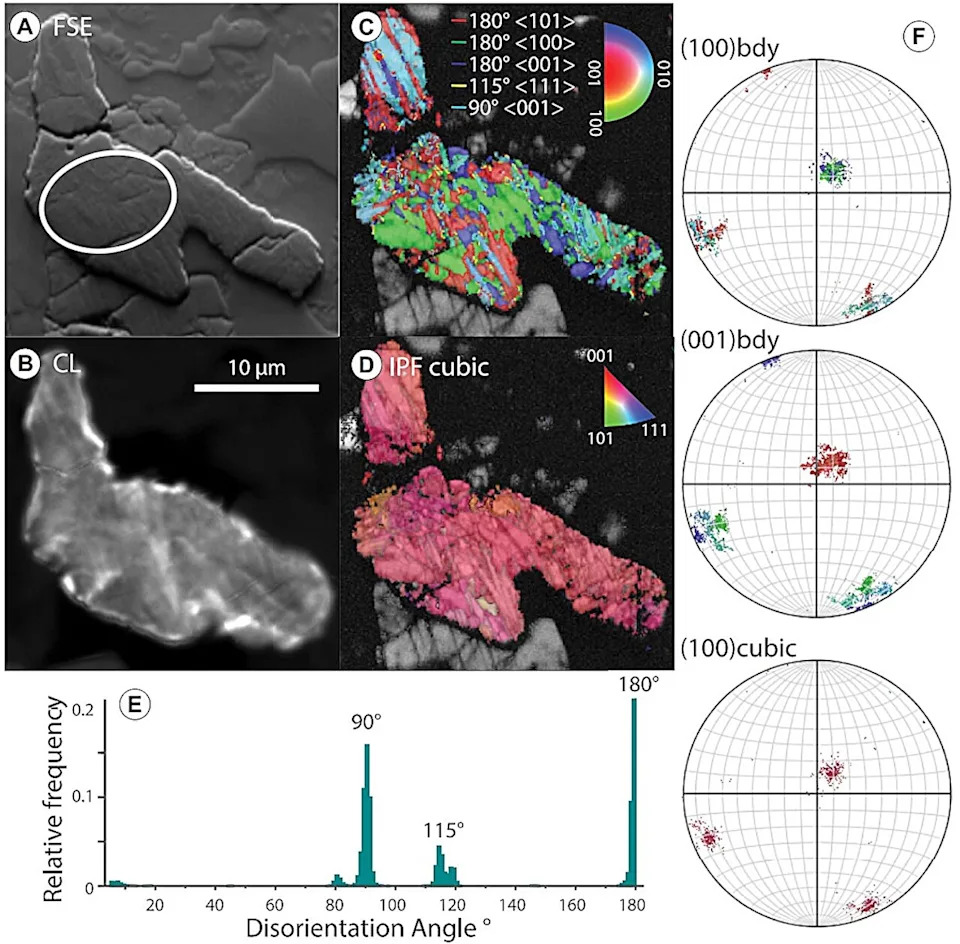
Electron backscatter diffraction data of NWA 12593. Credit:Geology
That ancient collision also produced traces of cubic zirconia — a high-temperature form of zirconium oxide that forms only under extremely hot conditions. Although unstable in cold, exposed environments and rare on planetary surfaces, microscopic remnants of this mineral survive within the breccia and serve as a fingerprint of the peak temperatures reached during the event.
A later impact crushed and fused slabs of lunar rock to form the breccia itself. The resulting meteorite is a mosaic of different rock fragments, glued together by the heat and pressure of impacts.
The study notes that the meteorite’s mixture of clasts and matrices records how successive collisions shattered and reassembled the lunar crust before a final ejection sent this fragment toward Earth.
The most recent of the three impacts detached a piece of the Moon and launched it onto a trajectory that eventually brought it to Earth. Because this object was preserved in a dry, cold environment on Earth after landing in Mali, scientists were able to perform the analyses that revealed its layered history.
Importantly, the ~3.5-billion-year event recorded in NWA 12593 coincides with a turbulent era across the inner solar system, matching evidence for contemporaneous impacts on Earth and on asteroid 4 Vesta. Researchers say that further study of this rare breccia will help place the histories of Earth and the Moon into a broader solar-system context and improve understanding of early planetary evolution.
Help us improve.