A 99-million-year-old fly preserved in Burmese amber shows fungal growth emerging from its head, and researchers at NIGPAS interpret the specimen as evidence that Ophiocordyceps-like parasitism existed in the Cretaceous. The discovery suggests behavior‑altering fungal relationships with insects are ancient rather than recent. Experts say modern Cordyceps are highly host‑specific and mammalian body temperature usually prevents such fungi from thriving in humans, though climate change could alter fungal tolerances.
99-Million-Year-Old Fly in Burmese Amber Reveals ‘Zombie’ Fungus From the Age of Dinosaurs
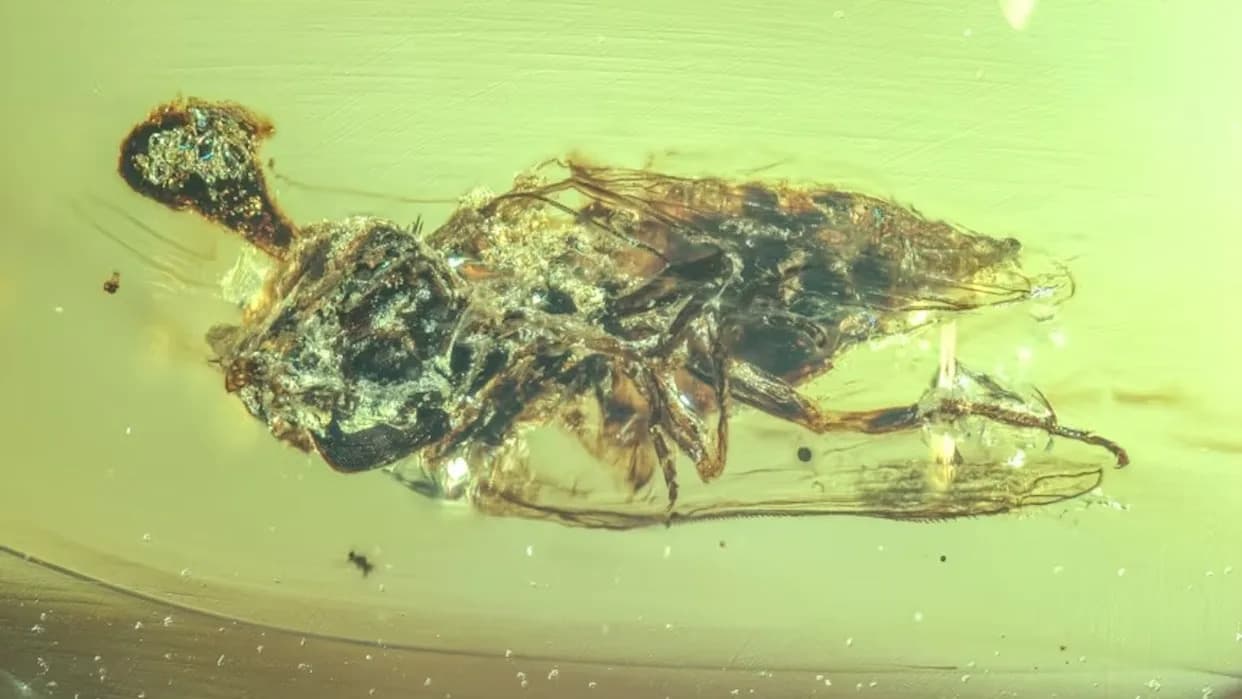
Photo Credit: NIGPAS
A 99-million-year-old fly trapped in Burmese amber and bearing a fungus protruding from its head has captured online attention and renewed interest in ancient host–parasite interactions. Researchers at the Nanjing Institute of Geology and Paleontology (NIGPAS) describe the specimen as showing Ophiocordyceps-like parasitism, indicating that behavior‑altering fungal relationships with insects already existed in the mid‑Cretaceous.
What the Fossil Suggests
The fossil, preserved in exceptionally clear amber, displays fungal growth emerging from the fly’s head—an arrangement reminiscent of modern Cordyceps and related fungi that infect and sometimes manipulate insect hosts. While fossil preservation makes precise species-level identification difficult, the researchers interpret the morphology as consistent with Ophiocordyceps‑type parasitism, pushing the documented age of this ecological interaction back to at least 99 million years.
Why It Matters Today
Beyond the inevitable shock value, the finding highlights a long evolutionary history of fungi that influence animal behavior. Modern Cordyceps and related fungi already affect agriculture (crop diseases), wildlife (infections), and commerce (products marketed as Cordyceps supplements). These fungi are typically highly host‑specific, evolving in close association with particular insect hosts rather than across broad animal groups.
Risk To Humans — Why It’s Unlikely
Experts emphasize two main barriers that make the leap from insects to humans unlikely: specialization and temperature. Many insect‑infecting fungi are adapted to insect physiology and nervous systems, and mammalian body heat usually exceeds the tolerance of fungi that invade insect tissues. That said, scientists note that environmental change — including climate warming — can alter species’ tolerances and distributions, so surveillance and research remain important.
Online Reaction
The fossil went viral after being shared in a Reddit thread and covered by mainstream outlets. Responses ranged from scientific clarification to dark humor. Typical comments included reminders that Cordyceps species still exist today and reassurances that the fungi are unlikely to target humans:
"It's not extinct, Cordyceps exists right now!"
"The likelihood of it forcing the same behaviour in humans is vanishingly small. But it'd probably kill you."
While the imagery is striking, paleontologists and mycologists stress that the find is primarily important as evidence of a deep evolutionary relationship between fungi and insects rather than an immediate human health threat.
Bottom line: The amber fossil offers a rare window into ancient parasitism and reinforces how long fungi have shaped animal life — a story that continues to have ecological and scientific relevance today.
Help us improve.