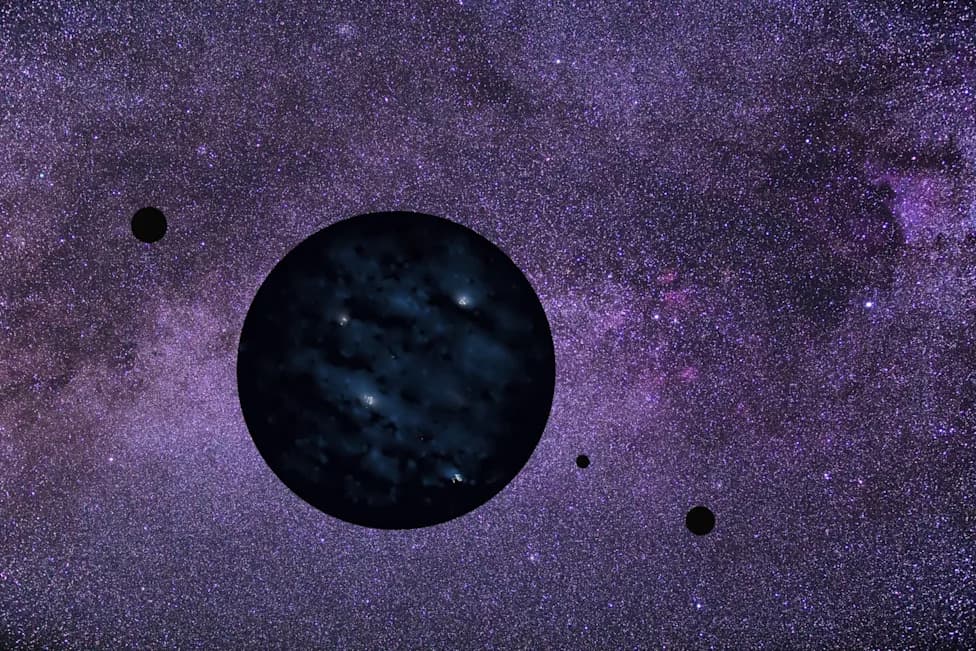
New simulations suggest the early outer Solar System may have included five or six giant planets, with two additional ice giants later ejected into interstellar space. The study finds that typical ejection scenarios leave Uranus’s moons catastrophically disrupted, even though they appear intact today. To resolve the mismatch, researchers propose either that Uranus’s moons re-formed after collisions, that the Nice model needs revision, or that the Solar System followed an unusually lucky evolutionary path.
Did the Solar System Eject Two Giant Planets? Uranus’s Moons May Hold the Answer
Research models suggest two giant planets may have been ejected during Solar System formation. | ©Image Credit: Zelch Csaba / Pexels
We think of the Solar System as a stable, well-ordered clockwork, but new research suggests its youth may have been far messier. Simulations led by Matthew Clement of Johns Hopkins University indicate the outer Solar System could once have contained five or six giant planets — with two extra “ice giants” later hurled into interstellar space.
Why this matters: these violent planetary rearrangements would have left gravitational fingerprints on the moons that orbit the giant planets. Clement’s team tested whether Jupiter and Uranus could have kept their present-day, orderly satellite systems through such chaos.
Simulating a chaotic past
The team ran extensive numerical simulations based on modern variants of the Nice model, a widely used framework for planetary migration. In many realizations, additional ice giants interact strongly with the known giants (Jupiter, Saturn, Uranus, and Neptune), exchanging energy and angular momentum until some planets are ejected to interstellar space.
Uranus’s moons: the stubborn anomaly
Results published in Icarus show a clear pattern: Jupiter’s regular satellites often survive these instabilities intact, but Uranus’s moon system is almost always catastrophically disturbed. In most simulated scenarios that eject extra planets, Uranus’s major moons collide, are scattered into irregular orbits, or are lost entirely — yet today Uranus’s largest moons remain neatly aligned in a single equatorial plane.
“Reproducing both Jupiter’s and Uranus’s orderly satellite systems after violent planetary encounters proved nearly impossible in the simulations,” the authors note.
Three possible explanations
Clement and colleagues outline three ways to reconcile the mismatch:
- Second-Generation Satellites: Uranus’s current moons could have re-formed from debris after an earlier generation was destroyed during instability.
- Model Revisions: The Nice model or its parameters may need updating to include encounter sequences that preserve Uranus’s satellites.
- Unlikely, Lucky Evolution: The real Solar System followed a very low-probability path in which close encounters with Uranus were avoided.
If the first option is correct, Uranus might have suffered multiple cataclysms — including the giant impact that likely tilted the planet onto its side and later interactions that demolished its original moons.
What this means for planetary science
Far from closing the case, the study deepens a longstanding puzzle about the Solar System’s early dynamical history. It suggests scientists must either refine existing dynamical models or consider more complex, violent sequences of events to fully explain how the Solar System acquired its present architecture.
Sources: Icarus; ScienceAlert. Research led by Matthew Clement (Johns Hopkins University).
Help us improve.