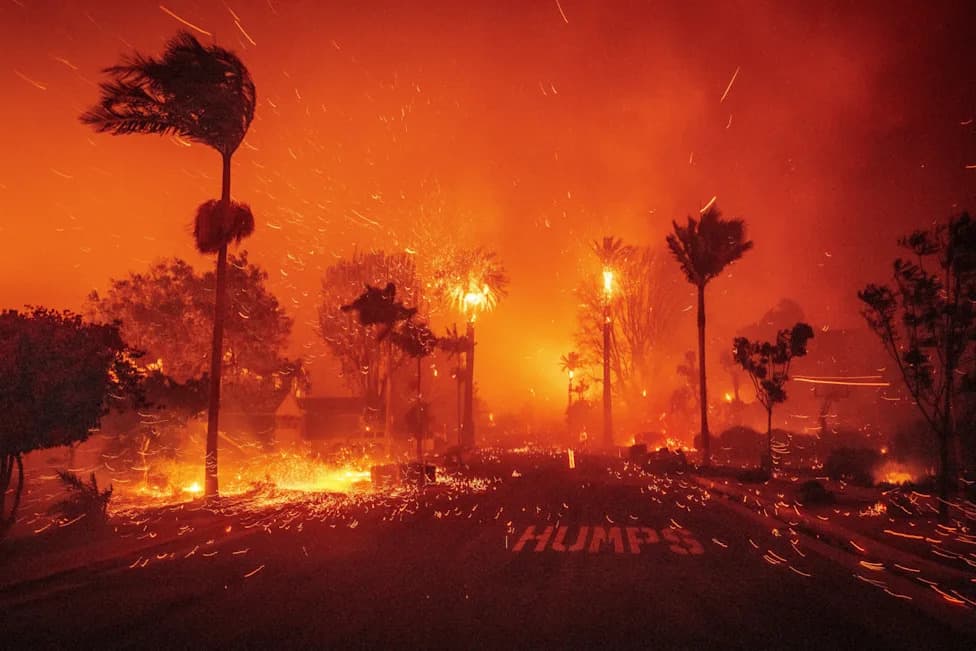
Spencer Pratt, whose Palisades home burned in last year’s wildfire, has made outrage over the fire response the center of his mayoral campaign and appears likely to advance to a November runoff with Mayor Karen Bass, though votes are still being tallied. His rise illustrates how poorly managed climate disasters can erode trust in institutions and elevate anti‑establishment figures. Researchers warn this dynamic can slow rebuilding, unsettle insurers and undermine long‑term resilience—risks that are often omitted from climate planning.
Spencer Pratt’s Mayoral Bid Shows How Wildfires Can Fuel Anti‑Establishment Politics
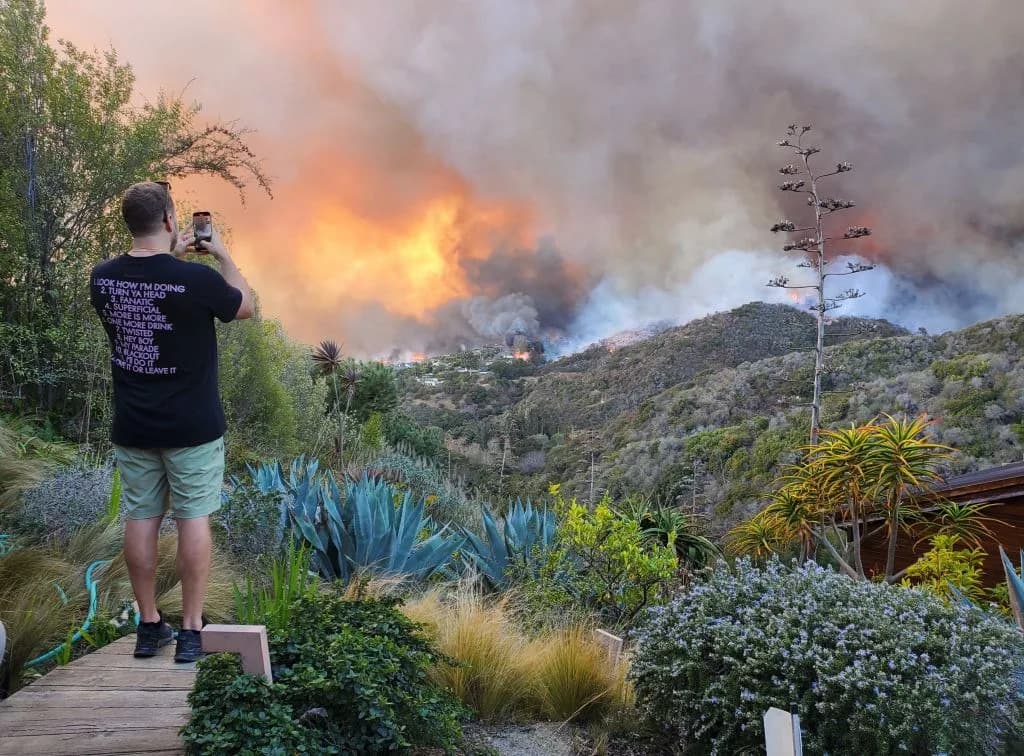
Spencer Pratt is seen in watching the wildfire as it approaches his house on Jan. 7, 2025 in Pacific Palisades, Calif. —MEGA/GC Images
After I published a TIME cover story last year about the aftermath of the Los Angeles wildfires, Spencer Pratt erupted on social media, disputing my account and denouncing the piece for invoking climate change. He called the reporting “lazy” and “impotent,” and for months has publicly blasted Los Angeles Mayor Karen Bass and California Governor Gavin Newsom for their responses to the fires and perceived lack of preparedness.
Votes are still being counted, but following this week’s election Pratt — a former reality‑TV personality whose home burned in the Palisades Fire — appears poised to advance to a likely general election showdown with Bass later this year, though the final outcome remains uncertain. He has made anger over the fire and its slow aftermath the centerpiece of his campaign, tapping into genuine frustration about delayed rebuilding and recovery.
Why Pratt Resonates
There is an obvious emotional appeal to Pratt’s message. It has been roughly 18 months since the fires and many residents remain displaced or waiting on permits, insurance payouts and reconstruction. In one campaign ad Pratt and his family camp on the lot where their house once stood and he walks past a well‑kept neighborhood to dramatize a contrast between affected residents and perceived political elites.
Policy Claims and Practical Limits
On the surface, Pratt’s platform—demanding accountability, pushing for insurance reform and calling for changes to emergency management—addresses real problems. But his campaign rests on a deep skepticism of political institutions and technical experts. That stance poses a dilemma: expertise and coordinated governance are precisely the tools needed to prepare for, respond to and adapt to climate‑driven disasters. How Pratt would translate his critiques into durable, expert‑driven policy remains unclear. (I was not able to reach Pratt for comment on this story.)
What the Research Shows
Scholars who study disaster aftermaths say Pratt’s rise is familiar: poorly managed catastrophes often erode public trust and create openings for anti‑establishment figures. A 2023 analysis by Italian researchers linked inadequate earthquake response to the growth of authoritarian tendencies; a study from the Inter‑American Development Bank traced how a Mexican earthquake weakened political trust and showed that competent disaster response can blunt that effect. Reporting has also documented efforts by far‑right groups in the U.S. to recruit amid disaster aftermaths.
Governance And Climate Planning Blind Spots
These political dynamics are seldom incorporated into climate models, risk assessments or emergency tabletop exercises, yet their consequences are concrete. Political dysfunction can slow reconstruction as government offices and permitting processes stall, unsettle insurers who reassess local exposure and resilience, and enable anti‑establishment officials to weaken agencies critical to public safety and economic activity. The result can be a feedback loop that compounds climate risk.
A Broader Lesson
Some in the climate community assume that worsening extreme weather will inevitably push politics toward stronger climate policy. Pratt’s campaign is a reminder that the political fallout from disasters is not uniformly progressive: it can also strengthen populists who oppose expertise and established institutions. The irony of his critique of my reporting is that engaging with the piece’s substantive criticisms—about recovery failures and the need for better adaptation—would point directly to the kind of mayoral leadership that reduces future harm.
Help us improve.