Rachel Moyer recounts the night her 15-year-old son Greg collapsed from sudden cardiac arrest during a high school basketball game, where no AED was available. She explains that most cardiac arrests occur outside hospitals and that every minute without CPR and AED use cuts survival odds significantly. Pennsylvania recently passed the Greg Moyer AED Law to require stronger cardiac preparedness, and Moyer urges families and communities to ensure AEDs, plans and training are in place.
My 15-Year-Old Son Collapsed. The Missing AED and a Law That Could Save Other Kids
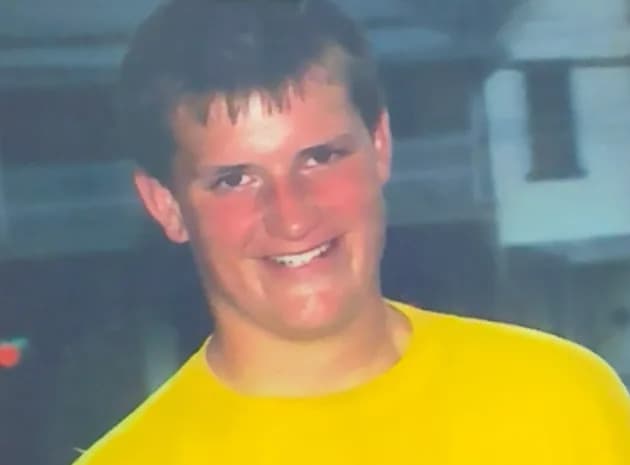
The author's son Greg.Courtesy of Rachel Moyer
For nearly 25 years I've replayed a single night: my 15-year-old son, Greg, collapsed from sudden cardiac arrest during a high school basketball game in rural Pennsylvania. The gym was full of coaches, parents, teachers and teammates racing to help — but the one device that might have saved him, an automated external defibrillator (AED), was not in the building.
Greg never came home.
That reality is what many people misunderstand about sudden cardiac arrest: most episodes happen outside hospitals, often in places where others are present and desperate to act. Too often, the people nearby lack the training and the tools to save a life.
Why Time and Tools Matter
What bystanders do in the minutes before emergency responders arrive usually decides whether someone lives or dies. AEDs, when available, walk untrained rescuers through a crisis with clear, spoken instructions the moment they are turned on — transforming panic into lifesaving action.
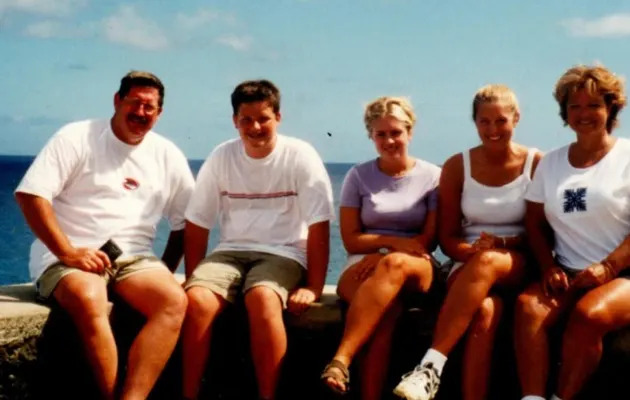
The author (far right) with her family, including her son Greg (second from left).Courtesy of Rachel Moyer
According to the American Red Cross, survival chances decrease by about 10% for every minute that immediate CPR and use of an AED are delayed.
A recent Harris Poll for AnyoneCanHelp.com found that many parents assume AEDs and trained responders are already present at youth sports facilities. In far too many communities, that assumption is wrong.
A Law With Personal Meaning
There is currently no federal requirement for AEDs in schools or youth sports facilities. That is why Pennsylvania's recent Greg Moyer AED Law — which strengthens cardiac emergency preparedness and requires AEDs at practices and games — means so much to our family. It also offers a model other states should consider.
We passed this law in the middle of National CPR and AED Awareness Week, a timely reminder that preparation saves lives. The difference between the outcome my family experienced and the survival stories you see on TV often comes down to coordinated responders, a practiced emergency plan and lifesaving devices already on site — all things we now require in Pennsylvania.
From Grief to Action
Since Greg's death I founded the Greg W. Moyer Defibrillator Fund to help place AEDs in schools, athletic fields and community sites. My family has donated thousands of AEDs across the United States, and I've stood with grieving parents as well as families who later told me their loved one survived because someone nearby had an AED and the confidence to use it.
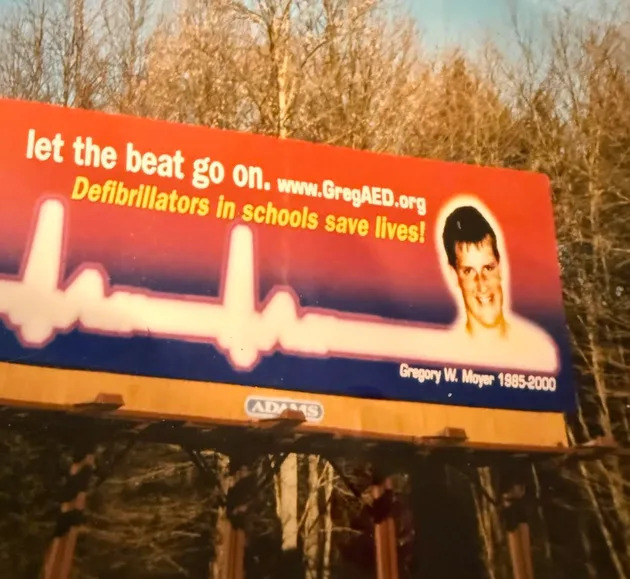
A billboard featuring Greg on it.Courtesy of Rachel Moyer
The national moment when Buffalo Bills player Damar Hamlin survived an on-field cardiac arrest showed exactly why preparation matters: prompt care, trained responders and equipment on hand saved a life. But countless families never get that chance because their communities are not ready.
What You Can Do
Legislation like Pennsylvania's is a critical step, but laws alone won't save every life. Schools and youth programs must implement emergency plans, maintain equipment, and ensure people know how to respond. Families can help by asking simple questions: Does the school or sports facility have an AED onsite? Is there a clear emergency response plan? Who is trained to use the device?
Sudden cardiac arrest does not discriminate. It can strike athletes, students in classrooms, musicians on stage or grandparents in the audience. When it happens, the first few minutes matter most.
Greg's Legacy
June remains a reflective month for our family. Graduation season makes me imagine the milestones Greg might have reached — college, marriage, children, more golf. Those are moments we will never see. But because of the law that bears his name and the work to put AEDs in communities, other families may get to witness those milestones with their children.
This is Greg's legacy: the possibility that another child gets to come home.
About the author: Rachel Moyer is the founder of the Greg W. Moyer Defibrillator Fund and a longtime advocate for AED access and cardiac emergency preparedness in schools. She lives in Shawnee on Delaware, Pennsylvania, and her family has helped donate AEDs to police departments, schools and playing fields across the United States.
Help us improve.