The Mauna Loa Observatory endured three distinct threats: the November 2022 eruption that severed road access, a proposed cancellation of a support-office lease in 2025, and a White House budget plan that would have cut NOAA’s climate research. Backup instruments, rooftop solar and a temporary 1.2-mile road restored many operations; as of 2026, 62 of 91 daily programs are running. Congress funded NOAA in January 2026 (H.R. 6938) and a multi-year modernization — including a 130-foot sampling tower, new power and fiber, and expanded labs — is now underway.
Saved by Science and Scrutiny: How Mauna Loa’s Keeling Curve Survived Lava, Budget Cuts and Politics
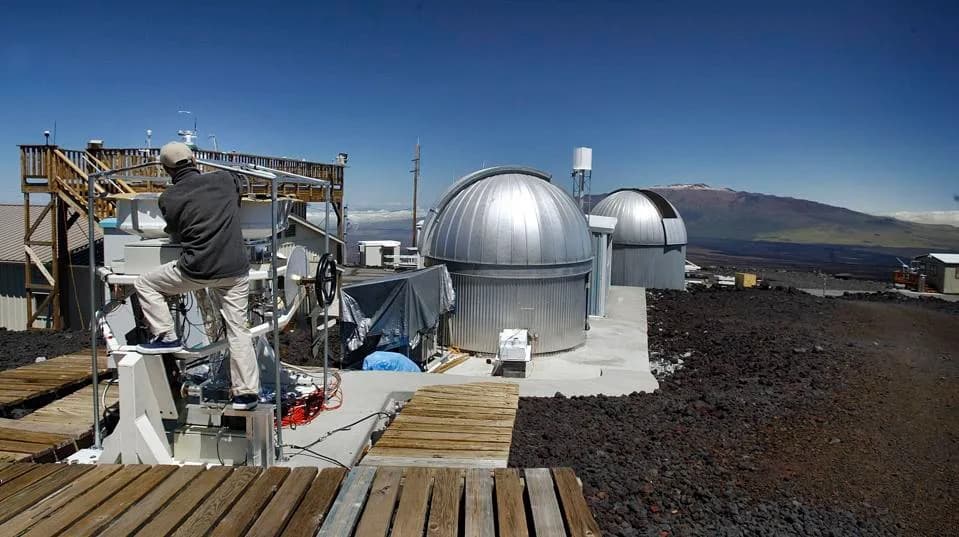
A scientist works at Hawaii's Mauna Loa Observatory at 3396 meters (11,141 feet) (AP Photo/Richard Vogel, file)AP
The Mauna Loa Observatory — perched at 3,396 meters (11,141 feet) on Hawaii’s largest volcano — endured a chain of threats that tested the resilience of one of the world’s most important climate records: the Keeling Curve. A 2022 eruption that severed road access, a proposed administrative lease cancellation in 2025, and a White House budget plan that would have gutted federal climate research together exposed how fragile long-term observation networks can be when routine support systems face natural and political shocks.
Why Mauna Loa Matters
Since 1958, continuous measurements from Mauna Loa have produced the Keeling Curve, the longest-running direct record of atmospheric carbon dioxide. Its clarity — steady year-to-year CO2 increases with seasonal oscillation — turned an abstract idea about greenhouse gases into an unmistakable measurement. What makes Mauna Loa uniquely valuable is not just the instruments on the summit, but the uninterrupted thread of data connecting nearly seven decades of science.
The First Threat: Lava and Loss of Access
On November 28, 2022, Mauna Loa erupted from its Northeast Rift Zone in a 14-day event that, among other impacts, buried roughly 6,000 feet of the access road under an average of about 30 feet of lava, cut new canyons through main channels, and destroyed the power lines serving the summit facilities. For more than three years technicians could reach the observatory only by helicopter.
NOAA and University of Hawaiʻi staff improvised quickly: within ten days, backup CO2 instruments were installed on neighboring Mauna Kea to preserve continuity. By mid-2023 rooftop solar and battery systems restored partial power to several buildings, allowing roughly one-third of the observatory’s measurements to resume. As of 2026, NOAA reports 62 of 91 daily measurement programs are back online. Road crews carved a temporary 1.2-mile route across hardened lava and on March 26, 2026, the road reopened. “The reopening of the road to MLO is a monumental win,” said Vanda Grubisic, director of NOAA’s Global Monitoring Laboratory.
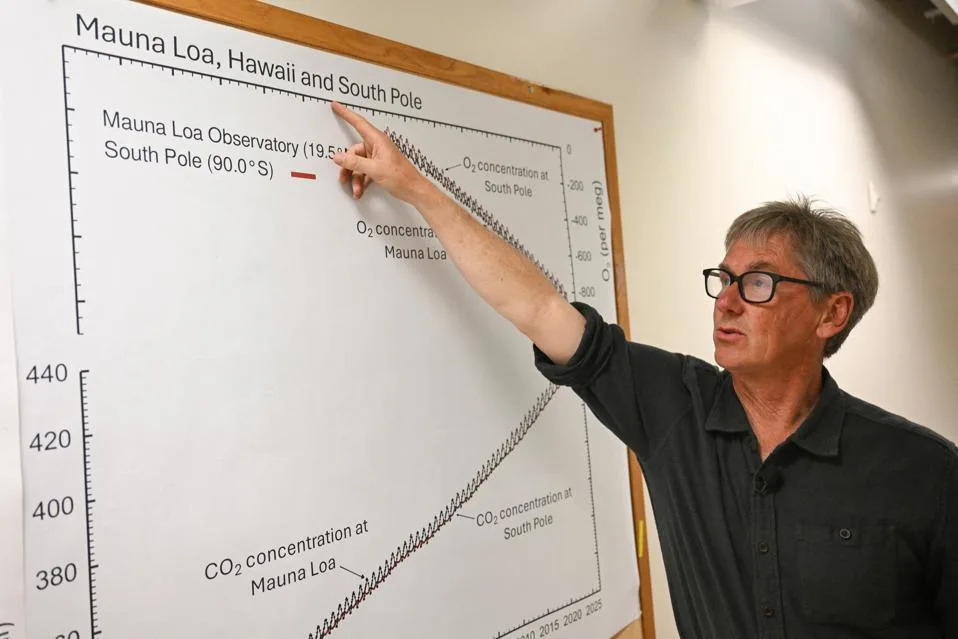
Professor Ralph Keeling discusses the importance of measuring oxygen and carbon dioxide in air samples from Mauna Loa, Hawaii, and the South Pole for the Keeling Curve long-term monitoring study at UC San Diego's Scripps Institution of Oceanography on April 11, 2025. Keeling's father, Charles David Keeling, decided in 1958 to measure atmospheric CO2 concentrations at the summit of the Mauna Loa volcano in Hawaii. This gave rise to the Keeling curve, which today represents the oldest continuous measurement of this greenhouse gas, which is produced by the burning of fossil fuels. After 67 years, the fate of this "major indicator of climate change" is uncertain under President Donald Trump's administration. The United States "needs this information, there's no doubt about it," the geochemistry professor at the Scripps Institution of Oceanography in San Diego told AFP. (Photo by Patrick T. Fallon / AFP) (Photo by PATRICK T. FALLON/AFP via Getty Images)AFP via Getty Images
The Second Threat: A Small Lease, Big Consequences
In early 2025 the Department of Government Efficiency placed the lease for NOAA’s Hilo support office on a list of more than twenty agency leases proposed for termination, citing roughly $150,692 in annual savings. The Hilo facility is not the summit observatory; it is the modest logistics hub where an eight-person staff runs the program, processes data, and stages trips to the mountain. Long-term science depends on these support systems: people, calibration, and logistics — not just real estate.
NOAA says the lease issue was resolved in July 2025, though public concern persisted: on August 28, 2025, Hawaii’s congressional delegation introduced a resolution honoring the observatory’s decades of work and specifically reaffirming support for the Hilo office. The episode highlights how low-visibility administrative decisions can create prolonged alarm when they touch world-famous scientific infrastructure.
The Third Threat: A Broader Budget Fight
For fiscal year 2026 the administration proposed a roughly 25% cut to NOAA and sought to eliminate the Office of Oceanic and Atmospheric Research — the division that houses much of NOAA’s climate work. Had Congress adopted that proposal, the stakes would have far exceeded one auxiliary lease; the federal climate research enterprise itself would have been at risk.
Congress rejected that approach. The appropriations package signed into law in January 2026 funded NOAA at about $6 billion, preserved the research office, and directed the agency not to close its laboratories. A NOAA spokesperson confirmed that operations at Mauna Loa were funded under the Commerce, Justice, Science appropriations act (H.R. 6938).
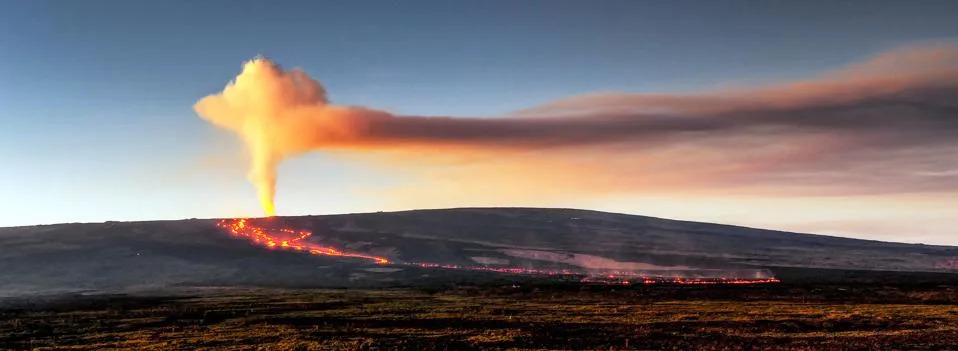
In 2022 Mauna Loa, the world's largest volcano, erupted for 14 days from November 27 to December 10. The eruption occurred from the Northeast Rift Zone. A view of the lava flow and volcanic plume taken during morning twilight from the Saddle Road region of the Big Island of Hawaii.getty
Redevelopment Resumes
The May 2026 redevelopment announcement is not a sudden reversal of priorities but the resumption of a previously planned modernization that had been paused by the eruption and loss of road access. NOAA’s Global Monitoring Laboratory had planned significant site upgrades for the eight-acre campus in 2023, and with temporary road access now established the lab has launched a multi-year reconstitution.
The work includes upgrades to the historic Keeling Building, a new 130-foot instrumented sampling tower, expanded laboratory space, campus-wide fiber connectivity, upgraded power and battery systems, and a dedicated outreach area. In short: Mauna Loa is being modernized and enlarged, not abandoned.
Lessons About Coverage, Funding and Fragility
The Mauna Loa episode illustrates a broader pattern in how we cover and support long-term science. Threats — whether natural, administrative, or budgetary — attract attention; resolutions and recoveries rarely receive the same coverage. Scientists explained why the Hilo office mattered; journalists amplified the warnings; lawmakers publicly defended the observatory; funding and access were ultimately preserved. Whether public scrutiny changed the outcome cannot be proven definitively, but the chain of reporting, concern, and legislative action is hard to ignore.
One unanswered question remains stark: why could a $150,692 line item briefly imperil a global climate record? If such a small administrative saving can put essential monitoring at risk, how many similar vulnerabilities exist elsewhere? The road is open, measurements are resuming, and reconstruction has begun — but the structural fragility that made the observatory dependent on narrow budgetary choices remains.
The Keeling Curve measures CO2 regardless of politics; the institutions that protect it do not. The curve survived this time because scientists spoke, journalists reported, lawmakers acted, and citizens paid attention. To ensure future continuity, long-term climate monitoring needs protections and funding structures robust enough to outlast political cycles.
Originally published on Forbes.com.
Help us improve.