The temporary height gain astronauts experience after long ISS stays — up to about two inches — results from intervertebral disc expansion and relaxation of paraspinal muscles in microgravity. More concerning are the associated bone density losses (~1–1.5% per month in weight-bearing regions) and fatty changes in spinal muscles that can persist long after landing. Longer missions, such as to Mars, would likely magnify these effects and complicate recovery, and they also create engineering challenges for suit and habitat design.
Why Astronauts Come Back a Few Inches Taller — And Why That Isn’t The Biggest Risk
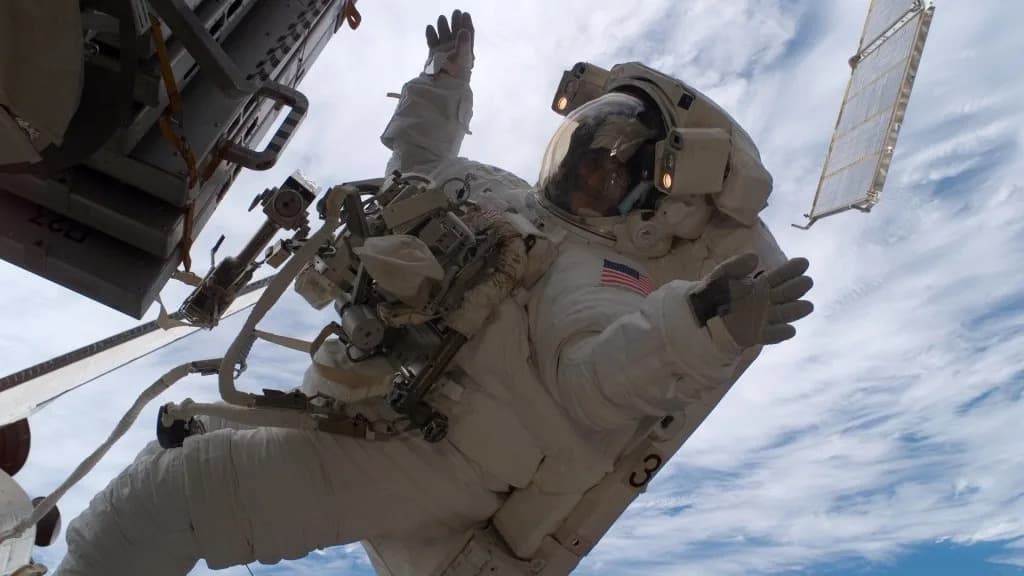
Every astronaut who spends months aboard the International Space Station often returns measurably taller — as much as about two inches for a six-foot person. That temporary height gain is a vivid, easy-to-measure sign of how life in microgravity alters the spine, but the deeper concern is what these changes reveal about bone and muscle health over long missions.
Why Astronauts Grow Taller
On Earth, gravity continuously compresses the spinal column: vertebrae and the soft intervertebral discs are under constant load, which is why most people are slightly shorter in the evening than in the morning. In orbit, astronauts are in near-continuous free fall and body weight no longer presses the spine downward. Freed from that compressive load, the spine lengthens and an astronaut can gain up to ~2 inches in height for a typical six-foot person.
More Than Disc Swelling
The common explanation — that intervertebral discs absorb more fluid and push vertebrae apart — is correct but incomplete. Ultrasound and other in-flight imaging have shown that paraspinal muscles (the deep muscles that run alongside the spine and constantly resist gravity on Earth) also relax and change in microgravity. That relaxation, together with disc expansion, produces the measurable elongation.
Longer-Term Physiological Effects
The temporary height gain itself usually reverses within days or weeks after landing, but other changes can be longer lasting. Astronauts can lose roughly 1% to 1.5% of bone density per month in weight-bearing regions such as the hips and legs. NASA has documented cases where some bone loss had not fully recovered a year after return. Paraspinal muscles often show fatty infiltration after extended missions, and symptoms such as lower-back pain (reported by astronauts returning from long flights) reflect a spine and musculature unaccustomed to supporting posture continuously.
Why This Matters For Deep-Space Missions
Longer missions—for example, a Mars transit—mean longer exposure to reduced or zero gravity, so spinal, bone, and muscle changes would likely be larger and recovery could take proportionally longer. It is not guaranteed that full recovery will occur on the same schedule as the temporary height change; some effects may persist for a year or more.
Countermeasures And Engineering Implications
Space agencies use countermeasures such as daily aerobic and resistive exercise (treadmills, cycle ergometers, and resistance devices) to reduce bone and muscle loss, and these help but do not completely eliminate the effects. From an engineering perspective, crews who become taller or whose body shapes change in flight affect spacesuit sizing, seat and restraint design, and the fit of tight habitats. Spacecraft and suits must therefore include margins or adjustable accommodations for in-flight anthropometric changes.
Takeaway
The visible increase in height is a useful indicator of deeper musculoskeletal adaptation to microgravity. It signals a body engaged in a prolonged physiological negotiation with an environment it never evolved to inhabit — and returning to Earth is the start of a second negotiation, one that can take a year or more to complete.
Help us improve.