A new Walton Family Foundation and Gallup poll finds only 18% of K-12 teachers have formal guidance from administrators on using AI, while nearly half receive informal advice and 34% receive no guidance. The shortfall is most pronounced for tutoring, where nearly seven-in-ten reported no direction, even though 60% used AI tools for work last year and 30% use them weekly. Younger Americans use AI more often but report more negative attitudes toward the technology.
Most K‑12 Teachers Lack Formal Guidance On Classroom AI, Poll Finds
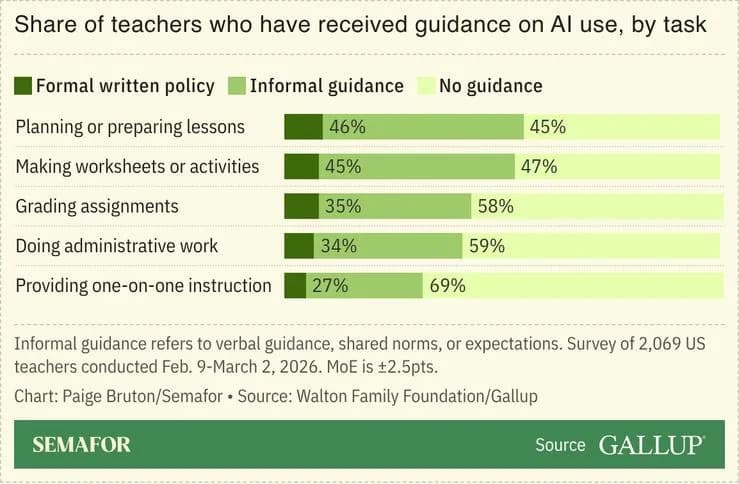
A chart showing a poll of teachers of how much AI guidance they received.
Artificial intelligence is rapidly reshaping classrooms, but most K-12 teachers report receiving little formal direction on how to use it effectively.
According to a new poll by the Walton Family Foundation and Gallup, just 18% of K-12 teachers said their school administrators provided formal guidance on applying AI across classroom tasks. Almost half reported some informal guidance—such as conversations or ad-hoc tips—while 34% said they received no guidance at all.
The gap is even wider for particular uses: nearly seven-in-ten teachers said they had no guidance on using AI for tutoring, despite six-in-ten reporting they used AI tools for work last year and three-in-ten saying they use them weekly. Younger Americans are adopting AI more frequently, but they also express more negative views about the technology.
Why It Matters
Without clear policies and training, teachers may be left to experiment on their own, creating inconsistent classroom practices and potential equity and accuracy concerns for students. Education leaders and policymakers may need to prioritize formal guidance, professional development, and concrete rules about when and how AI should be used for instruction, assessment and tutoring.
Bottom line: Schools are integrating AI in practice faster than administrators are issuing guidance—leaving many teachers without the support they need to use the tools safely and effectively.
Help us improve.