New zircon dating of more than 1,250 crystals reveals that Greece’s Methana volcano, quiet at the surface for over 100,000 years, has been steadily accumulating magma beneath the crust for hundreds of thousands of years. The team found two eruptive cycles separated by a long pause during which zircon growth peaked, driven by "superhydrous" (very water-rich) magmas that crystallize rapidly and stall in the crust. The results imply many long-dormant subduction-zone volcanoes worldwide may need renewed monitoring for subtle signs of recharge.
Quiet for 100,000 Years, Greece’s Methana Volcano Hid a Growing Magma System
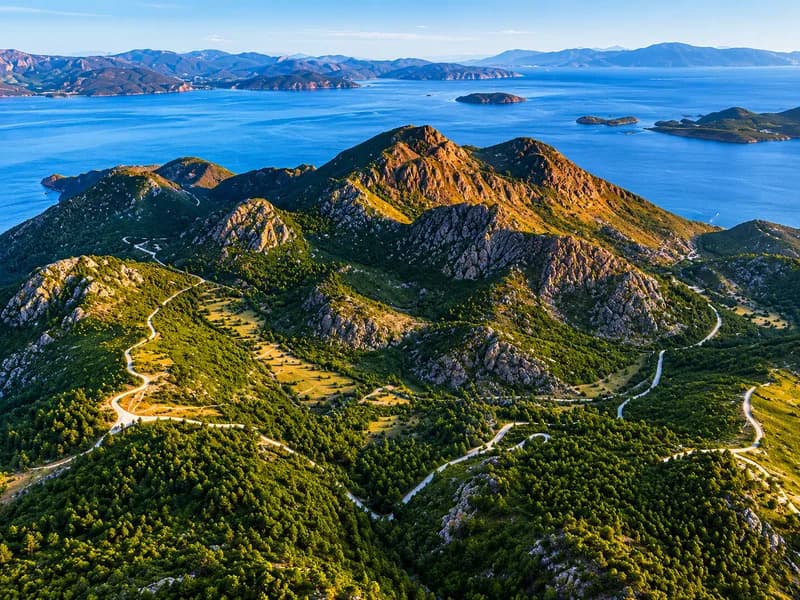
A new study reveals the Methana volcano quietly accumulated huge magma reservoirs underground during a 100,000-year dormant period. (CREDIT: Wikimedia / CC BY-SA 4.0)
Seen from the surface, Methana on Greece’s Peloponnese peninsula looked long dead: no recent lava flows, no ash clouds, and no recorded eruptions for more than 100,000 years. A new international study led by ETH Zurich shows that this apparent calm masked an active, slowly growing magma system far below the crust.
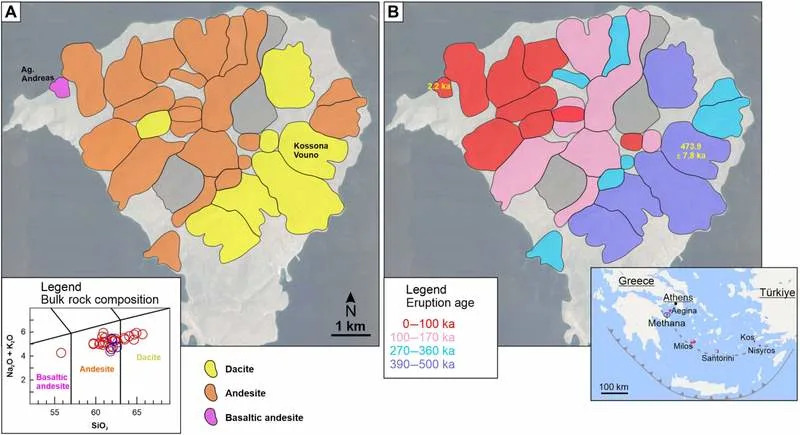
Overview of compositions and eruption ages of Methana. (CREDIT: Science Advances)
Hidden magma revealed by tiny crystals
Researchers analyzed more than 1,250 zircon crystals and combined high-precision U–Pb and trace-element dating with isotope measurements and bulk-rock chemistry. Zircon grains capture chemical and timing information when they form, acting like microscopic "flight recorders" that preserve a volcano’s internal history. The team reconstructed roughly 700,000 years of volcanic activity beneath Methana and found that magma generation was nearly continuous for hundreds of thousands of years.
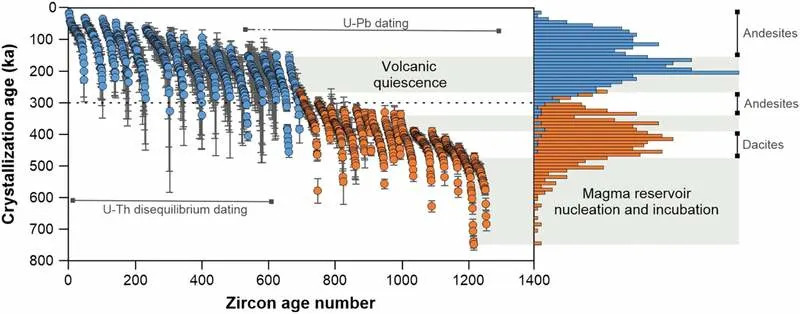
Snake plot depicting an overview of zircon crystallization ages obtained by in situ U-Pb and U-Th disequilibrium dating. (CREDIT: Science Advances)
Two eruptive cycles—and a deep pause
The zircon chronology points to two main eruptive cycles separated by a surprisingly long pause: the first cycle produced multiple eruptions over tens of thousands of years, then >100,000 years of surface silence followed—even though zircon growth was most intense during that interval. Volcanic activity resumed about 168,000 years ago, and the youngest recorded eruption occurred approximately 2,250 years ago (noted by the geographer Strabo). Overall the field has produced at least 31 eruptions in the last 700,000 years.
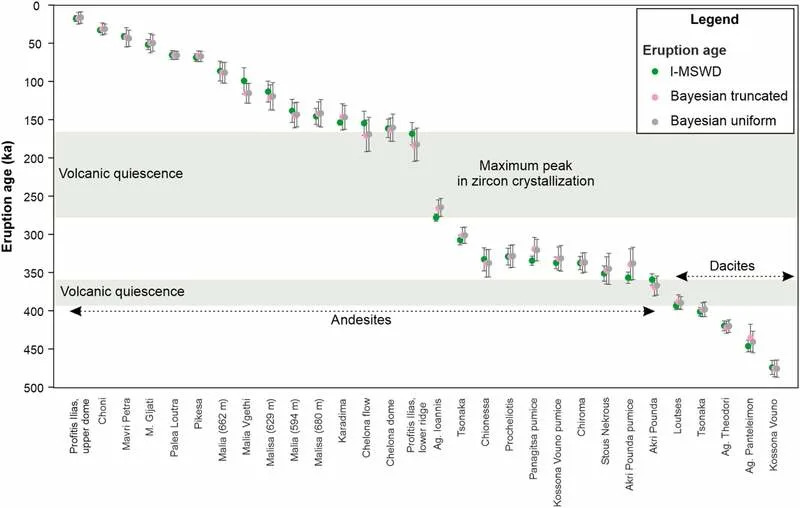
Overview of zircon-based eruption ages. (CREDIT: Science Advances)
Why the system stayed quiet at the surface
The team links this hidden growth to unusually water-rich (“superhydrous”) magmas sourced from the subduction-modified mantle beneath the South Aegean Volcanic Arc. Methana’s melts sometimes contained >6% dissolved water by weight. As such magmas rise and pressure drops, water exsolves into bubbles and triggers rapid crystallization. When crystal fractions exceed roughly 30%, the magma becomes much more viscous and can slow or stall in the crust. Numerical models in the study show ascent rates can drop by factors of 100–1,000, favoring reservoir growth rather than eruption.
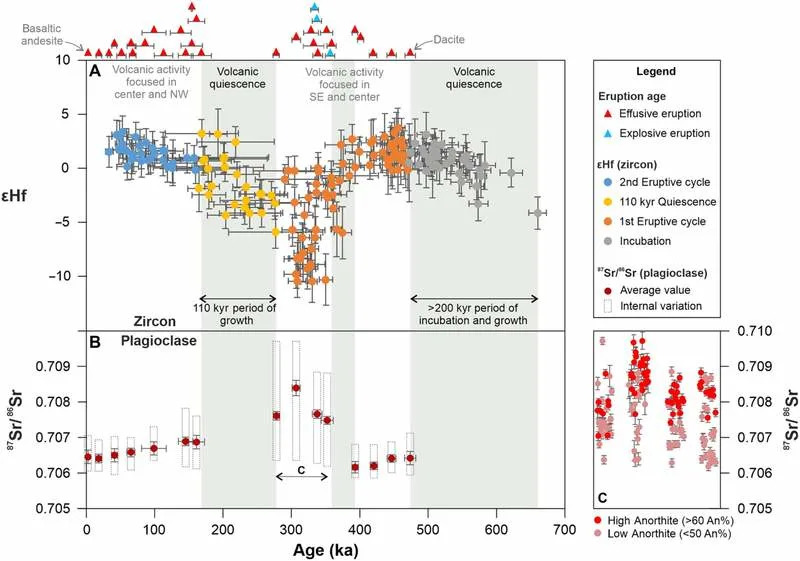
Zircon and plagioclase isotopic variability as a function of age and eruption frequency. (CREDIT: Science Advances)
Broader implications for volcanic hazards
Methana demonstrates that long surface quiescence does not always mean a magmatic system has shut down. Volcanoes classified as "extinct" after tens of thousands of years may still be accumulating magma and therefore deserve reconsideration in hazard assessments—especially in subduction-zone settings. The authors suggest similar hidden accumulation could occur across Greece, Italy, Japan, Indonesia, the Philippines and parts of the Americas.
What monitoring can and should detect
Even during prolonged dormancy, measurable signs of recharge can appear: seismic swarms, ground deformation (inflation), changes in gas emissions, and subtle gravity anomalies. Modern geophysical networks and targeted mineral dating (like zircon U–Pb) together provide complementary lines of evidence to detect and track such hidden processes before they become hazardous.
The study, led by Olivier Bachmann and Răzvan‑Gabriel Popa of ETH Zurich, is published in Science Advances. For millions of people near volcanic regions, the takeaway is clear: a quiet volcano is not always a safe volcano.
Help us improve.