Researchers found living bacterial communities inside fog droplets, with densities comparable to seawater. The fog microbiome was dominated by Methylobacterium, and microscopy showed cells growing and dividing within droplets. Incubations revealed rapid removal of volatile compounds like formaldehyde—about 200× faster than in cloud water—suggesting both metabolic consumption and detoxification. These findings imply fogborne microbes could help reduce airborne pollutants, though the overall environmental impact needs further study.
Fog Teems With Living Bacteria — And They Might Help Clean The Air

(Daniel Garrido/Moment/Getty Images)
Researchers from Arizona State University and Susquehanna University report that tiny droplets in morning radiation fog host living, growing bacterial communities — and those microbes may help remove airborne pollutants.
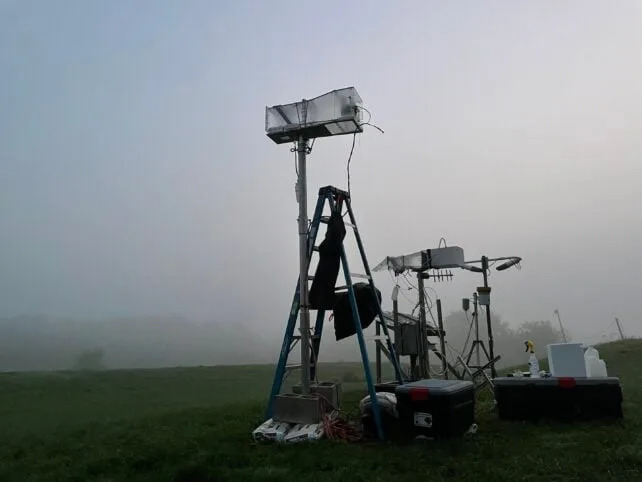
The research team's experimental setup for capturing fog samples. (Thi Thuong Thuong Cao)
Study Design And Key Findings
The team collected air and fog-water samples before, during and after 32 fog events over two years, focusing on radiation fog that forms overnight in calm conditions to minimize wind-driven contamination. Although bacteria were present in fewer than 1% of individual droplets, measurements using 16S rRNA gene copies—a standard proxy for bacterial abundance—averaged roughly 1 million copies per milliliter of fog water, comparable to concentrations found in ocean water.
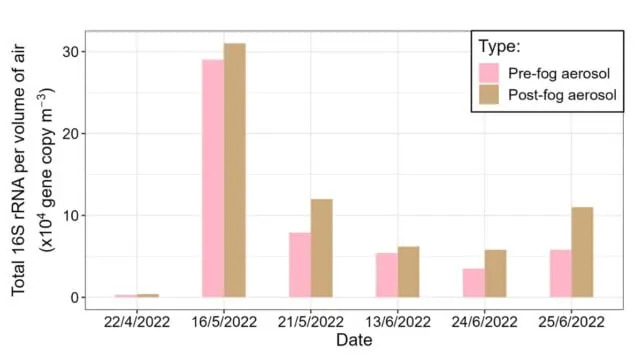
Concentration of bacterial 16S rRNA gene copies in air samples collected before and after six fog events in 2022. (Cao et al.,mBio, 2026)
Genetic sequencing showed the fog microbiome was dominated by members of the Methylobacterium genus. Microscopy and follow-up observations indicated active growth: cells increased in size and divided while suspended in droplets. In a focused subset of six fog events, air sampled after fog dissipation contained about 45% more bacteria than air sampled at the same location before the fog formed, suggesting fog conditions promote bacterial proliferation.

Subscribe to ScienceAlert's free fact-checked newsletter
Pollutant Removal And Possible Detoxification
Methylobacteria can consume volatile carbon compounds such as formaldehyde, so the researchers incubated fog-water samples and tracked these chemicals over time. Formaldehyde present at the start of incubations was consumed to undetectable levels at rates roughly 200 times faster than previously measured in cloud water. The authors argue this speed is too fast to be explained solely by nutritional uptake; detoxification mechanisms—removing harmful concentrations of formaldehyde to protect the cells—are likely also at play.

A foggy Pennsylvania field has a secret: Its droplets are home to 'pollutant-eating' bacteria. (Thi Thuong Thuong Cao)
"If they are growing, then the droplets are a habitat. That's a mindset change," — Ferran Garcia-Pichel, ASU.
Implications And Next Steps
Because formaldehyde and related volatile compounds are pollutants that affect human health and air quality, an active fog microbiome could contribute to scrubbing some airborne contaminants. How significant or consistent that benefit is in real-world conditions remains uncertain and will require further field and laboratory work. The study was published in the journal mBio.
What To Watch For: broader geographic sampling, seasonal comparisons, and quantifying how much pollutant removal fog microbes accomplish at landscape scales.
Help us improve.