Recent observations and models show Jupiter's more than 20 east–west jet streams extend thousands of kilometers below the cloud tops, reaching pressures far higher than Earth's surface pressure. Juno gravity data indicate a dilute core and deep, cylindrically penetrating jets, while ohmic-dissipation arguments provide independent limits on wind depth. Turbulence likely drives midlatitude jets, but equatorial superrotation still requires a net momentum source; deep overturning cells and possible stacked circulations above and below the clouds highlight complex coupling between atmosphere and interior.
Jupiter's Jet Streams Plunge Deep — New Data Reveal Hidden Interior Dynamics
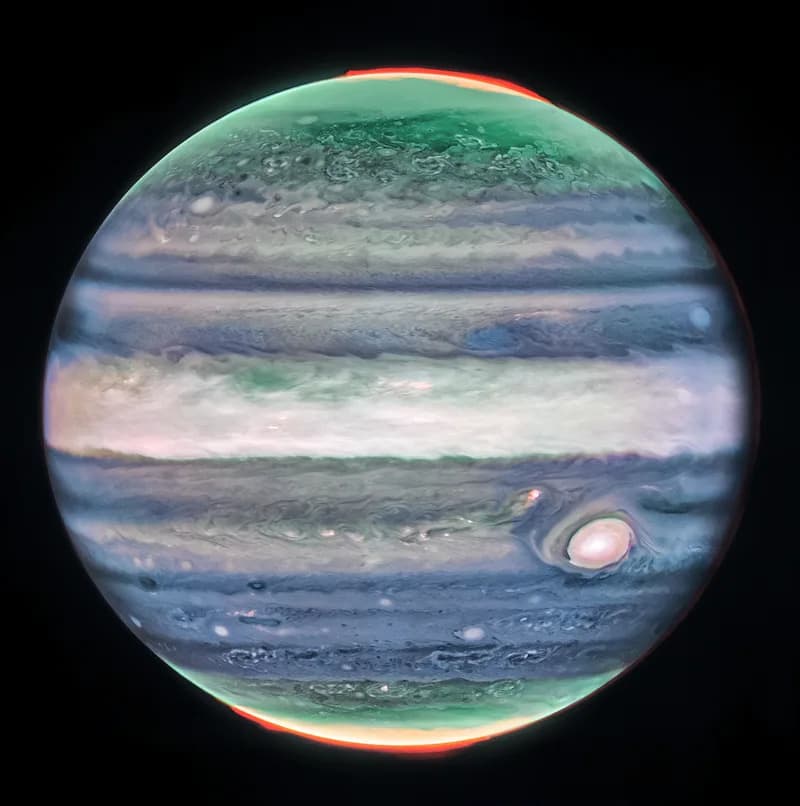
This image of Jupiter from NASA’s James Webb Space Telescope’s NIRCam (Near-Infrared Camera) shows stunning details of the majestic planet in infrared light. In this image, brightness indicates high altitude. (CREDIT: NASA, ESA, CSA, STScI, Ricardo Hueso (UPV), Imke de Pater (UC Berkeley), Thierry Fouchet (Observatory of Paris), Leigh Fletcher (University of Leicester), Michael Wong (UC Berkeley), Joseph DePasquale (STScI))
Jupiter is far from still. Its atmosphere races around the planet in more than 20 east–west jet streams, with peak winds near 100 m/s — over three times the speed of Earth's strongest jet stream. These bands, visible as Jupiter's familiar stripes and turbulent storms, have been observed for centuries. Only recently have measurements and models begun to reveal how far those winds penetrate and what sustains them inside the solar system's largest planet.
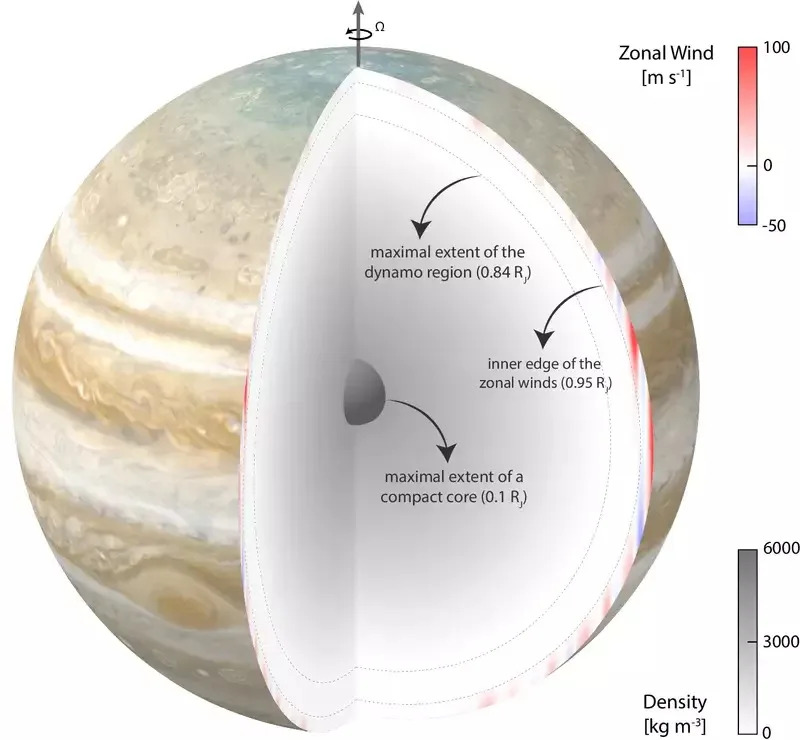
Graphic representation of Jupiter’s winds and internal structure. (CREDIT: Nature Communications)
Deep Jets and a Dilute Core
New gravity measurements from NASA's Juno spacecraft, combined with numerical models and other observations, point to a surprising picture. The zonal jets do not remain confined to the visible cloud tops; instead they plunge thousands of kilometers into the interior, reaching pressures many orders of magnitude higher than Earth's surface pressure. Juno's gravity field data also support a "dilute core" model in which heavy elements are distributed through a broad inner envelope rather than concentrated in a compact center.
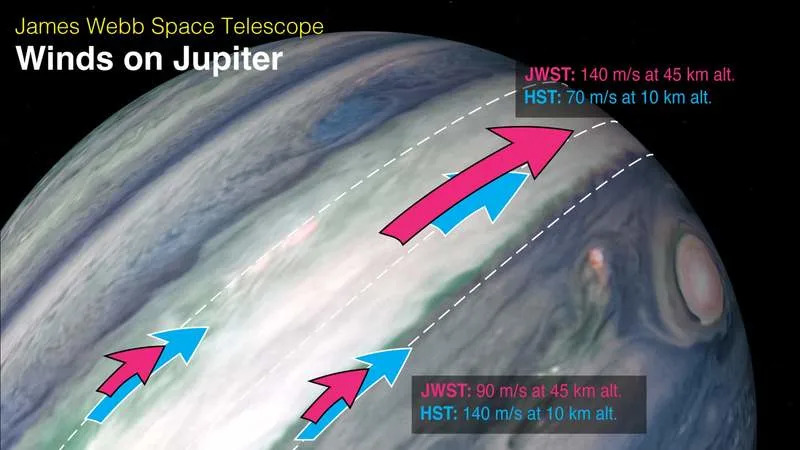
Details of the wind speeds (in meters per second) measured by the Webb telescope and the Hubble Space Telescope. (CREDIT: M.H. Wong, UC Berkeley; R. Hueso, University of the Basque Country; NASA; ESA; CSA; STScI; I. de Pater, UC Berkeley; T. Fouchet, Observatory of Paris; L. Fletcher, University of Leicester)
How Deep? Limits from Gravity and Electrodynamics
Higher-order gravity harmonics reveal that much of the gravity signal arises from jets near roughly 20 degrees north and south latitude and that these jets penetrate the interior in a cylindrical fashion — a behaviour shaped by Jupiter's rapid rotation. Independent constraints from ohmic dissipation (currents induced when conductive gas moves through the planet's magnetic field) place complementary limits on how deep fast winds can extend before magnetic interactions would generate excess heating. The depth suggested by these independent lines of evidence is consistent with a transition where electrical conductivity becomes significant.
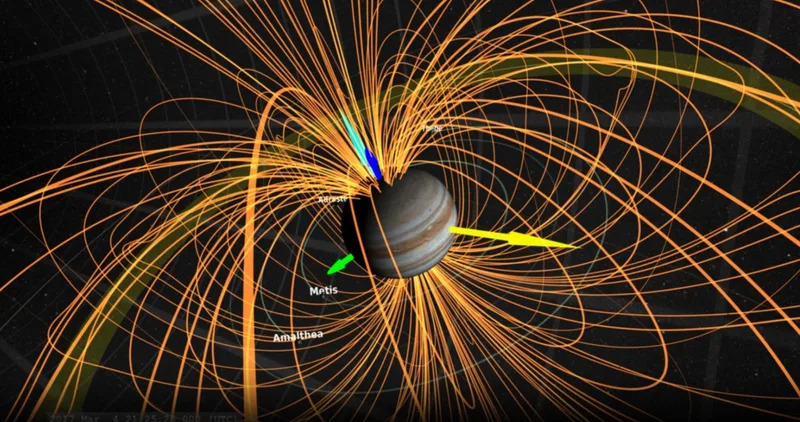
Jupiter’s magnetosphere – a basic view. (CREDIT: NASA)
Drivers, Brakes, and Latitudinal Differences
Scientists still debate what drives and what ultimately brakes the deep flows. Outside the tropics (poleward of ~17 degrees), turbulent eddies are the leading candidate for driving jets: small-scale turbulence can transfer momentum into the larger zonal flows. The key uncertainty is whether that turbulence is confined to a relatively shallow weather layer or originates from deep convective plumes rising from the interior.
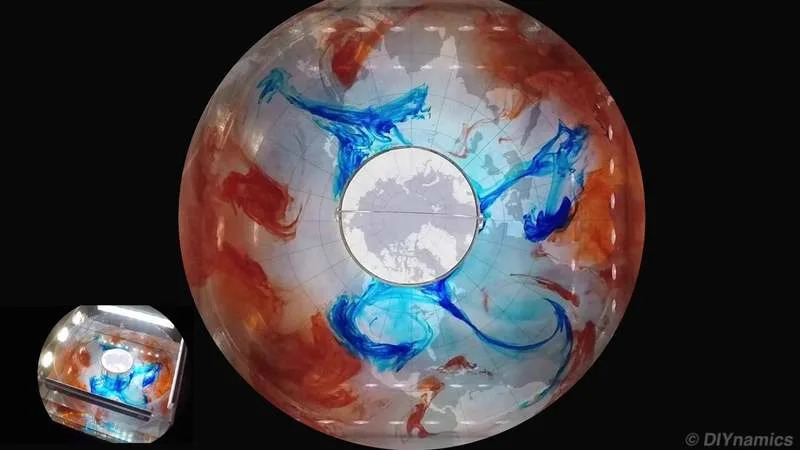
Formation of baroclinic eddies in a rotating tank experiment. (CREDIT: DIYnamics Team)
The equatorial jet presents an even tougher problem. Its eastward superrotation requires a net transport of momentum into the equator. Proposed mechanisms include latent heat release from water condensation, wave convergence, parameterized convective transports, and organized deep convection. Evidence for strong deep heat fluxes supports the possibility of interior-driven processes, but no single mechanism is yet confirmed as dominant.
Circulation Cells and Stacked Patterns
Juno's Microwave Radiometer has detected signs of deep meridional overturning at midlatitudes: alternating cells of rising and sinking motion that extend far deeper than analogous terrestrial cells. Above the clouds, temperature measurements imply a reversed circulation in the stably stratified upper atmosphere. This raises the intriguing prospect of stacked meridional circulation, where the same eastward jet is associated with opposite flow directions above and below the clouds — a pattern not seen on Earth.
Open Questions and Next Steps
Proposed braking mechanisms include magnetic drag, large density gradients, and stable stratified layers that inhibit vertical mixing. Hypotheses for such layers range from helium-rain regions near the dynamo to deep radiative zones, but observational constraints so far leave the issue unresolved. Addressing these questions will require long-term, multiwavelength monitoring, additional targeted atmospheric probes to sample different locations and depths, and next-generation global circulation models that couple radiative transfer, cloud microphysics, condensate processes, and deep internal heating.
Jupiter's jet streams are therefore more than surface weather: they are a window into interactions among gravity, rotation, magnetic fields, chemistry, and deep heat transport. Continued analysis of Juno data and future missions will be key to resolving how giant-planet atmospheres connect to their hidden interiors.
Research sources: Results discussed here are presented in peer-reviewed literature, including a recent paper in Nature Communications, and in mission data from NASA's Juno, Galileo, Cassini, Voyager, Hubble, and JWST observations.
Help us improve.