Researchers re-evaluated the fate of 20 probes, landers and balloons that reached Venus and conclude that at least seven may still be visible on the surface. Lab experiments at NASA’s GEER facility and a case study of the 1978 Pioneer Venus Day Probe show that titanium and aluminum structures can resist Venus’s ~460°C heat and ~90-bar pressure, while seals and gaskets would likely fail. The team also factored in local geology and sedimentation, and notes that upcoming missions such as NASA’s DAVINCI could finally image these artifacts.
Buried, Not Destroyed? Study Finds Several Probes May Still Be On Venus
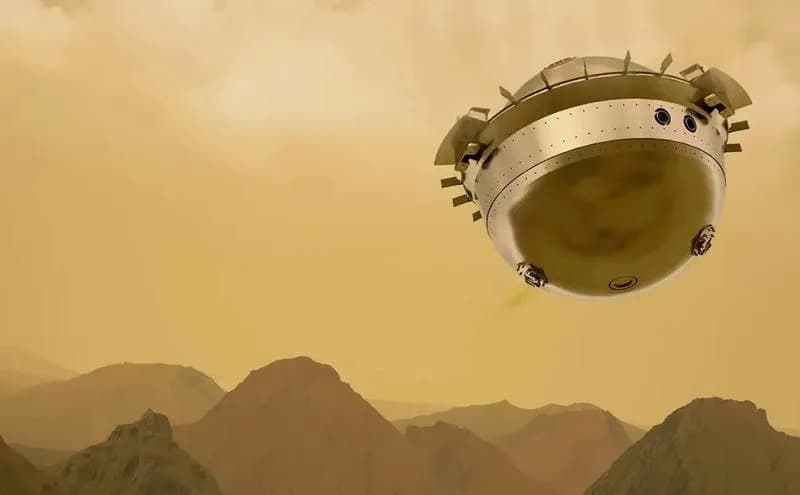
An artist's impression of NASA's DAVINCI probe descending toward the surface of Venus.(NASA)
New research suggests that a number of robotic probes and landers sent to Venus over the past six decades may still lie on the planet’s surface, partially intact and potentially identifiable by future missions. Long assumed to be erased by Venus’s extreme heat, pressure and corrosive atmosphere, some craft may actually survive in recognisable form—especially those built from robust materials such as titanium and aluminum.
How the Study Reached Its Conclusion
The authors reviewed 20 objects (probes, landers and balloons) sent to Venus by the United States and the Soviet Union, then combined laboratory experiments, archival data and site-by-site environmental assessments to estimate survival odds. Experiments from NASA’s Glenn Extreme Environments Rig (GEER) reproduced Venusian temperatures, pressures and chemistry to test how spacecraft materials behave under those conditions.
Case Study: Pioneer Venus Day Probe
As a detailed example, the team modelled the fate of the 1978 Pioneer Venus Day Probe. The probe’s outer shell was largely titanium, with internal aluminum equipment boxes and beryllium shelving. GEER tests indicate that titanium and many aluminum components exhibit strong resistance to the planet’s ~460°C temperature and ~90-bar pressure, so the probe’s general shape likely would be preserved.
However, GEER data show vulnerabilities in non-structural parts: O-rings, gaskets and other seals would likely fail after exposure to sulfuric acid droplets and sustained heat, causing internal pressurization loss and deformation rather than total disintegration.
Landing-Site Factors and Long-Term Survival
The researchers also evaluated landing-site conditions—local volcanism and seismicity, sedimentation rates, radiation and meteorite impacts. Their synthesis suggests that at least seven of the 20 objects likely landed in locations where they are not in immediate danger of burial or destruction, and that Venus’s geological turnover is slow enough to increase the chances these artifacts remain visible for long periods.
Why This Matters
Discovering preserved human-made objects on Venus would expand space archaeology beyond the Moon, Mars and asteroids and add to our catalog of space heritage. It would also offer practical lessons for spacecraft design and for planning retrieval or imaging missions.
Looking Ahead
Interest in Venus is rising: NASA’s DAVINCI mission (targeting ~2030) aims to deliver a surface probe with imaging capability, and private and academic teams—including an MIT and Rocket Lab collaboration—have discussed Venus-bound hardware on shorter timelines. These missions could finally locate and photograph long-lost artifacts.
Quotes: Luca Forassiepi, a co-author and independent space archaeologist, cautions that not every craft will be preserved but says, “for those seven ... I don’t find any reason to not think that they are still there.” Beth O’Leary, a space archaeologist not involved in the paper, adds that the study “extends the range of space archaeology.”
Bottom line: While seals and internal systems likely failed, many structural elements—especially titanium and aluminum—may have survived Venus’s hellish conditions, making the planet a surprising repository of early space history.
Help us improve.