MIT researchers released FINGERS-7B, an open-source AI foundation model designed to detect preclinical Alzheimer’s by jointly analyzing lifestyle, clinical, genomic and proteomic data. Tested on WW-FINGERS datasets, the team reports 4× better diagnostic accuracy and a 130% improvement in responder stratification versus prior methods. Deployed via the secure AD Workbench, the model aims to enable earlier prevention trials and broader, collaborative validation.
MIT Unveils FINGERS-7B: An Open-Source AI Model to Spot Preclinical Alzheimer’s

MIT-led FINGERS-7B uses multi-omic data to predict Alzheimer’s risk earlier and improve responder stratification. (CREDIT: AI-generated image / The Brighter Side of News)
Alzheimer’s disease can begin changing the brain years—sometimes a decade or more—before memory problems appear. An MIT-led team says it has built an AI foundation model designed to detect those early signs by integrating multiple layers of data. The model, FINGERS-7B, is part of a broader platform called FINGERPRINT and is being positioned as a tool to accelerate prevention research.
What FINGERS-7B Does
FINGERS-7B was trained on lifestyle, clinical, genomic and proteomic data from tens of thousands of participants. Unlike analyses that treat each data type separately, the model learns patterns across all these "omics" and behavioral layers simultaneously to identify multi-omic biomarkers associated with preclinical Alzheimer’s disease.
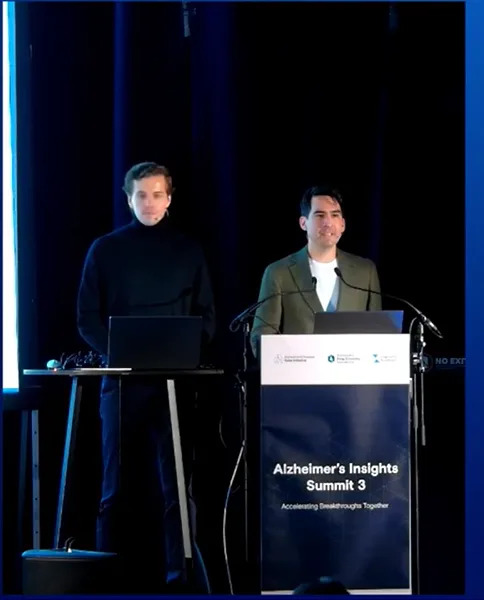
Arvid Gollwitzer and Adrian Noriega present Fingerprint at a conference in Copenhagen in March 2026. (CREDIT: MIT)
Integrated Multi-Omic Approach
The core idea behind the project is simple: disease risk may be easier to spot when genetic, proteomic, clinical and lifestyle signals are read together rather than in isolation. According to the team, that integrated view improves sensitivity for detecting risk at the preclinical stage—when interventions are most likely to be effective.
“Each of us carries a biological fingerprint, basically a unique combination of signals that reveal disease risk and, if properly understood, could enable prevention and treatment of Alzheimer’s disease,” said Adrian Noriega, MIT–Novo Nordisk AI Fellow and FINGERPRINT co-lead.
Reported Performance And Use Cases
On datasets from the WW-FINGERS network, the researchers report FINGERS-7B achieved four times the preclinical diagnostic accuracy of prior methods and a 130% improvement in responder stratification—metrics that could help identify who is likely to benefit from specific prevention strategies or treatments. The model is also designed to generate individualized risk assessments, forecast likely cognitive trajectories, and estimate potential effects of interventions from lifestyle changes to drug therapies.

Among all modifiable dementia risk factors, none carries more global weight, nor more preventable potential, than hypertension. (CREDIT: Fingerprint)
Deployment, Openness, And Security
The team released FINGERS-7B as open source, publishing model weights, training code and evaluation pipelines so other researchers can validate and extend the work. It is deployed within the AD Workbench, a secure cloud environment run by the Alzheimer’s Disease Data Initiative (ADDI), enabling external groups to apply the model to sensitive cohorts without moving patient data off their platforms.
Collaboration, Timeline, And Partners
The work builds on the FINGER study and the global WW-FINGERS network, which spans roughly 40 countries and about 30,000 participants. MIT’s Aging Brain Initiative provided an initial $100,000 launch grant, and the team says it trained and deployed FINGERS-7B within about 10 months. Institutional and industry partners include the Broad Institute, Yale University, Imperial College London, Brigham and Women’s Hospital, Alamar Biosciences and Novo Nordisk.
What Comes Next
Early reports are promising, but broader validation is essential. The open-source release and AD Workbench deployment are intended to accelerate independent testing, increase cohort diversity, and help researchers determine whether FINGERS-7B generalizes across populations and clinical settings. If validated, the model could make it easier to enroll the right people in prevention trials and to design more targeted interventions.
Note: Performance figures are reported by the research team and should be interpreted as preliminary until peer-reviewed publication and independent replication are available.
Help us improve.