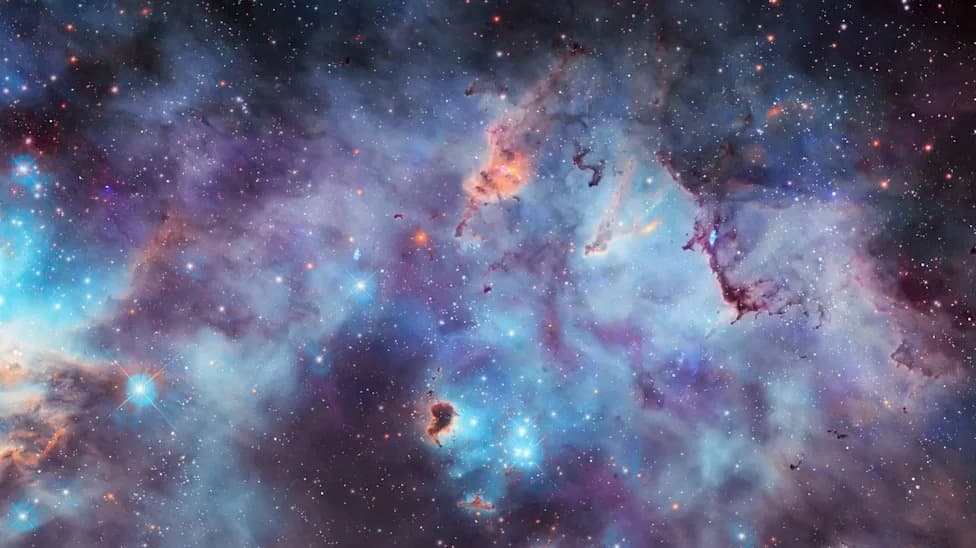
NASA has released a new Hubble composite of the spiral galaxy NGC 3137, located about 53 million light-years away in Antlia. The image, built from six color bands, reveals a central black hole of roughly 60 million solar masses, dusty central lanes, and numerous blue star clusters embedded in red nebulae. Seen at a high inclination and part of the NGC 3175 group, NGC 3137 offers a nearby laboratory for studying stellar birth and galactic structure.
Hubble’s Stunning New Image of NGC 3137 — A Glittering Spiral 53 Million Light-Years Away
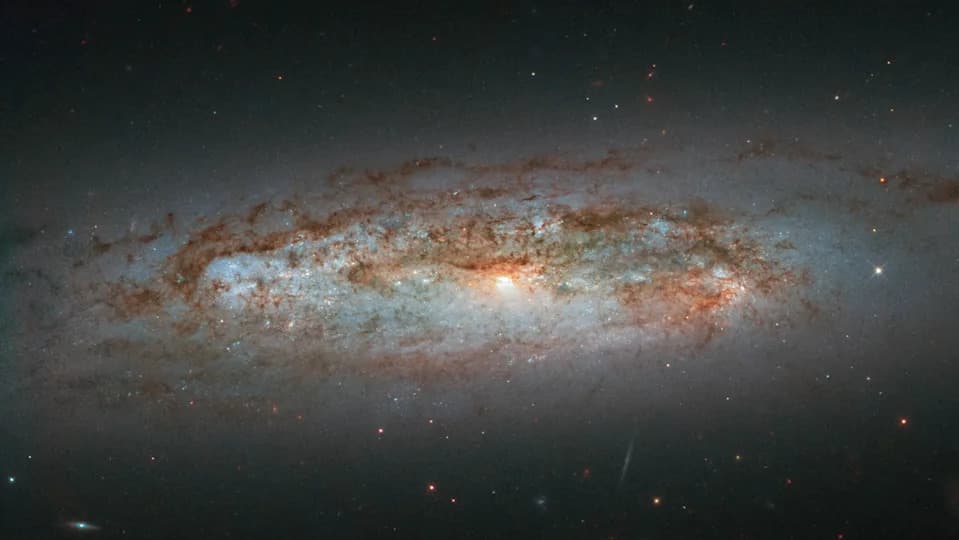
NGC 3175 is also located within the constellation of Antlia, albeit slightly closer to Earth than NGC 3137, roughly 50 million light-years away | Credit: ESA/Hubble & NASA, D. Rosario et al.
Few images from space inspire the same sense of wonder as those captured by the Hubble Space Telescope. NASA’s latest release — a richly detailed view of the spiral galaxy NGC 3137 — reveals a system described by the agency as glittering with star clusters and threaded with vast clouds of cosmic gas.
NGC 3137 sits about 53 million light-years away in the southern constellation Antlia (the Air Pump). The new Hubble image was assembled from observations across six different color bands, producing a composite that highlights both the galaxy’s young star clusters and its glowing nebulae in striking detail.
At the galaxy’s core lies a supermassive black hole with an estimated mass of roughly 60 million times that of the Sun, surrounded by fine lanes of dust. Scattered throughout the spiral arms are dense concentrations of bright blue stars and red, emission-line gas clouds — signs of hot, newly formed stars still partially shrouded in their natal nebulae.
Why Astronomers Care
NGC 3137 is part of the NGC 3175 galaxy group, a nearby collection of galaxies that astronomers think resembles our own Local Group. Alongside its companion NGC 3175, NGC 3137 provides a useful local laboratory for studying how stars form, evolve, and die on galactic scales.
Viewed from Earth at a high inclination, we see NGC 3137’s loose, feathery spiral structure from a distinctive angle, which helps researchers trace patterns of star formation across its disks and arms. Its relative proximity makes it an especially attractive target for follow-up observations across multiple wavelengths.
Launched in 1990, Hubble continues to deliver visually stunning images and scientifically valuable data. This new portrait of NGC 3137 is another reminder that decades in orbit have not diminished the telescope’s ability to illuminate the life cycles of stars and the structure of nearby galaxies.
Quick Take: A six-band Hubble composite highlights young blue star clusters, red emission nebulae, dusty lanes around a ~60-million-solar-mass black hole, and a feathery spiral structure in the nearby galaxy NGC 3137.
Help us improve.