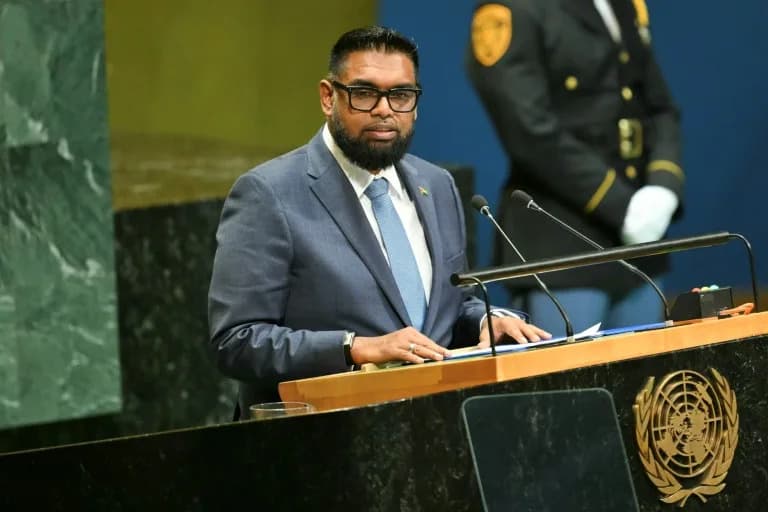
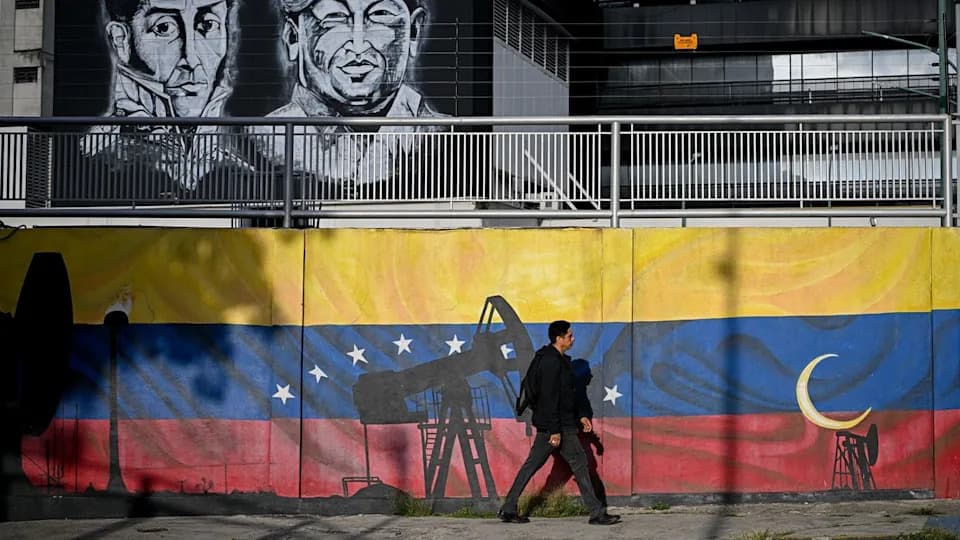
Guyana told the International Court of Justice that Venezuela has no legitimate claim to the oil- and gas-rich Esequibo region and asked the court to uphold the 1899 arbitration boundary that awards the territory to Guyana. The disputed area covers about 160,000 sq km including major offshore discoveries; Guyana says Venezuela's claim affects over 70% of its territory. Venezuela rejects ICJ jurisdiction and insists on direct negotiations. A final ICJ ruling is expected in months, but enforcement would depend on the U.N. Security Council.
Guyana Asks ICJ To Reject Venezuela's Claim Over Oil-Rich Esequibo
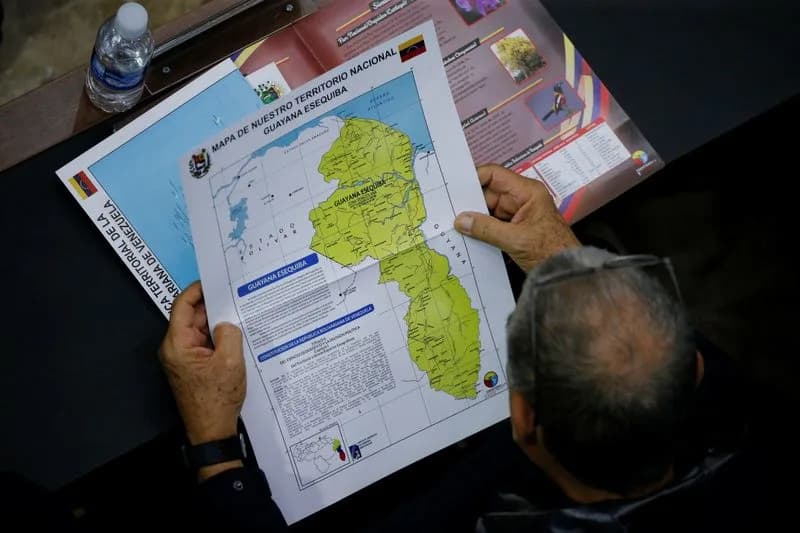
FILE PHOTO: A member of the National Assembly of the Assembly holds a map showing the disputed Esequibo region as part of Venezuela, as tensions between the Venezuela and Guyana have ratcheted up in recent weeks over a long-running territorial dispute, in Caracas, Venezuela, December 6, 2023. REUTERS/Leonardo Fernandez Viloria/File Photo
Guyana has asked the International Court of Justice (ICJ) in The Hague to rule that Venezuela has no lawful claim to the resource-rich territory around the Esequibo River, saying Caracas' claim threatens the country's peace, security and development.
Case at a Glance
The dispute centers on roughly 160,000 square kilometres (62,000 square miles) of largely jungle territory and an adjacent offshore area where significant oil and gas reserves have been discovered. Guyana says Venezuela's claim covers more than 70% of its territory.
Hugh Hilton Todd, Guyana's Foreign Minister: "Facing a larger and more powerful neighbour's designs on our territory has not only threatened our peace and security, it has held back our development."
Procedural Background
Guyana filed the case at the ICJ in 2018, asking the court to confirm the boundary set by an 1899 arbitration between Venezuela and then‑British Guiana, under which the contested area belongs to Guyana. Venezuela has repeatedly rejected ICJ jurisdiction in the dispute and argues the matter must be settled through direct negotiations.
Venezuela's Foreign Minister, Yvan Gil, told state television after the court session that Caracas considers its claim "indisputable" and reiterated that negotiations are the only acceptable route. Venezuela is due to present its arguments later in the week.
Political Context And Timeline
In a 2023 referendum, Venezuelan voters rejected the ICJ's jurisdiction over the dispute and backed measures related to the Esequibo region; Venezuelan authorities later announced administrative measures affecting the area. The case at the ICJ may lead to a final judgment within months.
What A Ruling Would Mean
ICJ judgments between states are final and without appeal, but the court has no independent enforcement mechanism; implementation would depend on political processes and, if required, action by the U.N. Security Council.
Reporting note: This article corrects earlier transcription errors and clarifies the legal and political context. All facts in this version have been reviewed for clarity and accuracy.
Help us improve.