NASA released a two-minute timelapse compiled from Curiosity images spanning six years at Gale Crater. Scientists use the footage—captured by Curiosity’s right navigation camera—to track sand and dust movement on the rover’s deck and in its treads, helping distinguish vehicle-disturbed material from wind-driven shifts and revealing seasonal atmospheric behavior. Curiosity landed on Aug. 5, 2012, confirmed early evidence of past habitable chemistry, and recently helped identify 21 organic molecules in Martian rock. Engineers continue to manage wheel wear and dust hazards so the rover can keep exploring; it has driven about 23 miles.
NASA Timelapse Tracks Six Years of Curiosity’s Climb — And the Sand It Leaves Behind
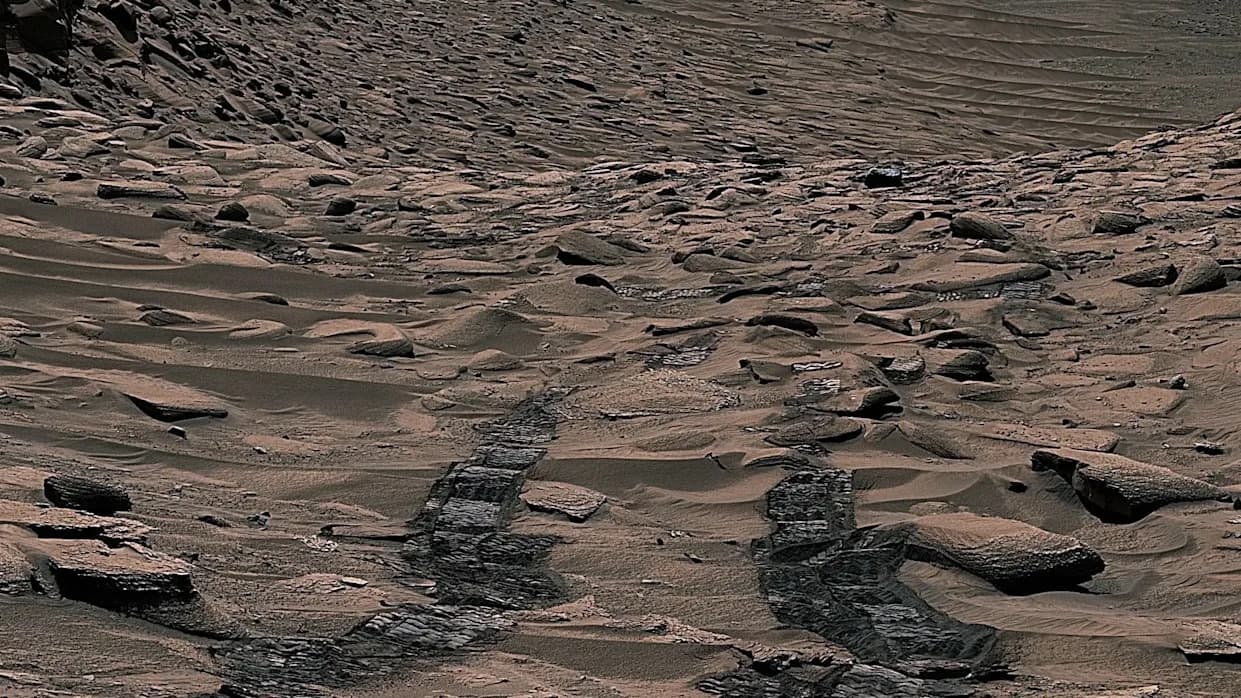
NASA's Curiosity rover leaves tracks at Gale Crater on Mars on April 20, 2023. - NASA / JPL-Caltech / MSSS
NASA recently compiled a two-minute timelapse from the Curiosity rover that does more than offer a nostalgic look back—it serves a scientific purpose. The montage stitches together images spanning six years of exploration at Gale Crater, showing Curiosity moving across fractured rock fields as it slowly ascends Mount Sharp, which rises roughly three miles above the crater floor.
Using a Timelapse as a Scientific Tool
The footage is drawn from Curiosity’s right navigation camera, mounted on the rover’s mast. By studying successive frames, scientists can track how sand grains and dust shift on the rover’s deck and within its treads. That lets researchers distinguish sand displaced by the rover’s own drives from material moved by gusts of wind—data that can reveal seasonal changes in Mars’ thin atmosphere.
"Distinguishing between sand jostled by each drive and wind gusts can provide new information about seasonal changes in the atmosphere," NASA said.
Observers can even see fine dust churning in the rover’s tracks in clips shared on social platforms, where a Lenny Kravitz soundtrack accompanied the montage to boost its appeal for the public.
Mission Context and Scientific Findings
Curiosity captured the images used in the montage between Jan. 2, 2020, and March 8 (dates provided by the agency). The rover’s mission began after an eight-month, roughly 352-million-mile cruise; Curiosity landed on Mars on Aug. 5, 2012, with the primary goal of determining whether Gale Crater once hosted environments capable of supporting life.
Engineers inspect damage to Curiosity's wheels on Mars on April 18, 2016.
That question was answered relatively early. Within a year of landing, Curiosity drilled into rock in an ancient lakebed and confirmed that the region once had the right chemistry and potential nutrients to support microbial life. The rover’s onboard chemistry lab has continued to examine Martian samples; a recent study reported detection of 21 different organic molecules in a small rock sample—the largest suite of organics identified on Mars to date. Among these findings, researchers identified preserved complex carbon material, which could be consistent with past life but might also result from abiotic reactions between water and rock.
Engineering Challenges and Workarounds
As scientists use the timelapse to study shifting sand and atmospheric behavior, engineers monitor how dust and sharp terrain wear the vehicle. Since early in its mission the Curiosity team has observed jagged rocks causing punctures and other damage to the rover’s aluminum wheels.
To mitigate similar issues on the next rover, engineers designed Perseverance with thicker, more robust aluminum wheels; each wheel is independently motorized and can rotate fully to help the vehicle avoid hazards. For Curiosity, the team has implemented operational workarounds—such as strategic reversing—and software upgrades that give finer control over individual wheel speeds to reduce stress from rough ground. Those measures have allowed Curiosity to keep exploring, with about 23 miles driven on Mars so far.
Wheel damage is not the only hazard. Past missions such as Spirit and Opportunity were ultimately disabled when wind-blown dust accumulated on their solar panels and choked power generation. Curiosity, powered differently, remains active while its team continues to balance scientific objectives with maintenance and mobility strategies.
What to Watch For: The timelapse is both a public-engagement piece and a practical dataset—watch for subtle shifts in deck sand and dust in the rover’s tracks to get a sense of how Mars’ surface and atmosphere interact across seasons.
Help us improve.