New computer simulations indicate planets may form more easily around binary stars than around single stars. Close to the stellar pair a turbulent "forbidden zone" prevents planet formation, but beyond it the disk can fragment via gravitational instability, rapidly producing especially large gas giants on wide orbits. The results help explain over 50 known circumbinary planets and point to ALMA, JWST and the ELT as instruments that might observe disks breaking apart into new worlds.
Planets May Prefer Two Suns: Study Finds Binary Stars Can Be Prolific Planet Factories
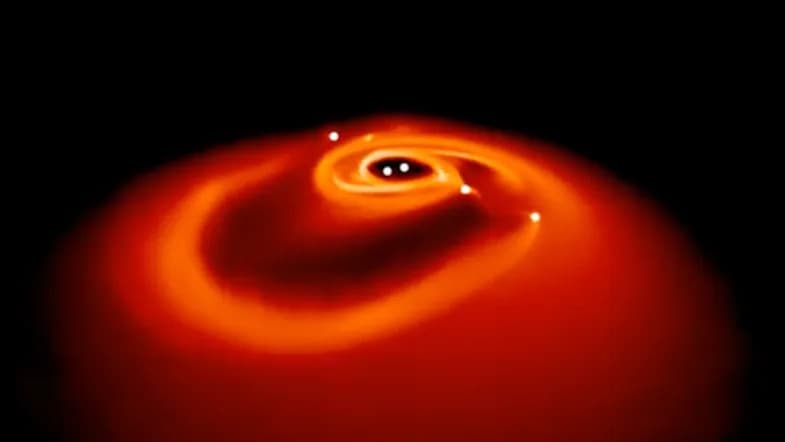
Screenshot from a simulation of a protoplanetary disc around a binary star becoming gravitationally unstable and fragmenting to form planets. | Credit: Teasdale et al.
New simulations suggest that planets may form more readily around binary star systems than around single stars like our Sun. While regions close to two stars are often too chaotic for planets to take shape, the outer reaches of a circumbinary protoplanetary disk can fragment under its own gravity and rapidly produce multiple planets — especially massive gas giants.
How Planet Formation Works Around Binary Stars
Binary star systems, where two stars orbit a common center of mass, are common across the Milky Way. For decades, astronomers considered these systems hostile to planet formation because the competing gravitational forces were thought to stir and disperse the disk material that builds planets.
“Close to a binary star it's simply too violent for planets to form,” said Matthew Teasdale, lead author of the new study from the University of Lancashire. “But move farther out and the disk becomes an ideal environment for planet formation.”
Using detailed computer simulations of protoplanetary disks around young binary stars, the research team identified a central "forbidden zone" near the stellar pair where intense gravitational perturbations prevent stable accumulation of dust and gas. Beyond that boundary, however, the disk can become gravitationally unstable and fragment under its own self-gravity — a process known as gravitational instability — creating multiple nascent planets on wide orbits.
“What we're finding is that they can actually be extremely productive,” said co-author Dimitris Stamatellos, a professor of astrophysics at the University of Lancashire. “Once you get past the danger zone, planets can form quickly and in large numbers.”
Consequences and Predictions
The simulations indicate this pathway preferentially yields massive planets — gas giants similar to Jupiter — at wide separations from their host stars. The complex gravitational dynamics of binary systems can also eject some newly formed bodies, sending them adrift as rogue planets roaming interstellar space.
These findings offer a plausible explanation for the more than 50 circumbinary planets already detected, including several on wide orbits. They also suggest that binary systems may contribute significantly to the galaxy’s population of both bound and rogue worlds.
Opportunities for Observation
The researchers point to powerful observatories such as ALMA (Atacama Large Millimeter/submillimeter Array), the James Webb Space Telescope (JWST), and the upcoming Extremely Large Telescope (ELT) as tools that could directly image circumbinary disks and possibly catch them fragmenting into planets in real time.
The study was published April 27 in the journal Monthly Notices of the Royal Astronomical Society.
Help us improve.