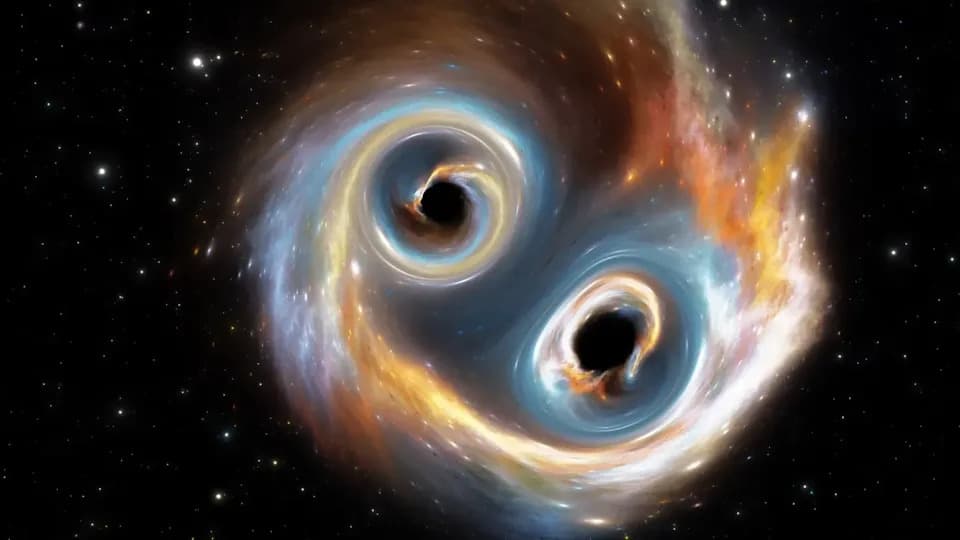
Researchers at the University of Thessaly propose that microscopic wormholes in spacetime foam could make the Gauss–Bonnet term contribute an effective cosmological constant. Topology-changing events (instantons and wormholes) alter the Euler characteristic, making the Gauss–Bonnet variation nonzero and producing an extra term in the semiclassical field equations. With α ≈ lp2, matching Λ ≈ 10−52 m−2 would need ~1016 wormholes per m3 per second, though Planck-scale densities would yield far larger values. The idea is speculative, faces significant mathematical challenges, but suggests a testable new connection between quantum topology and cosmic expansion.
Could Microscopic Wormholes Be Driving Cosmic Expansion? A Topological Route to Dark Energy
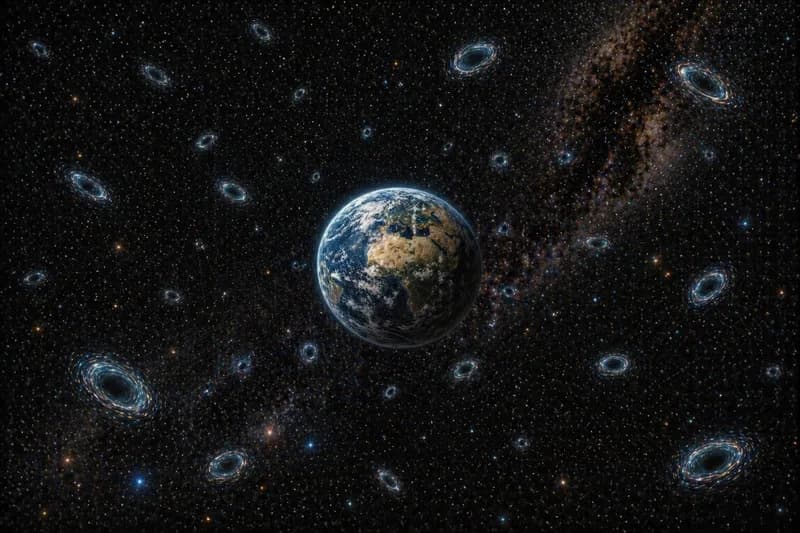
Greek physicists propose that microscopic wormholes could generate an effective dark energy term through topology changes. (CREDIT: AI-generated image / The Brighter Side of News)
Cosmologists have long faced a glaring mismatch between theory and observation: quantum field theory predicts a cosmological constant vastly larger than what we measure. A new theoretical paper from researchers at the University of Thessaly (published in Physical Review D) proposes a fresh—and speculative—mechanism by which microscopic wormholes in spacetime foam could produce an effective cosmological constant through topological effects.
The Proposal In Brief
The authors argue that tiny topology-changing events (instantons and Euclidean wormholes) can alter the Euler characteristic of spacetime. When those microscopic topology changes are included in the variation of the gravitational action, a term that is normally topological and classically inert in four dimensions—the Gauss–Bonnet term—can contribute nontrivially to the semiclassical field equations. That contribution can act like an effective cosmological constant of topological origin and, in a dynamical spacetime, behave like a time-varying dark-energy sector.
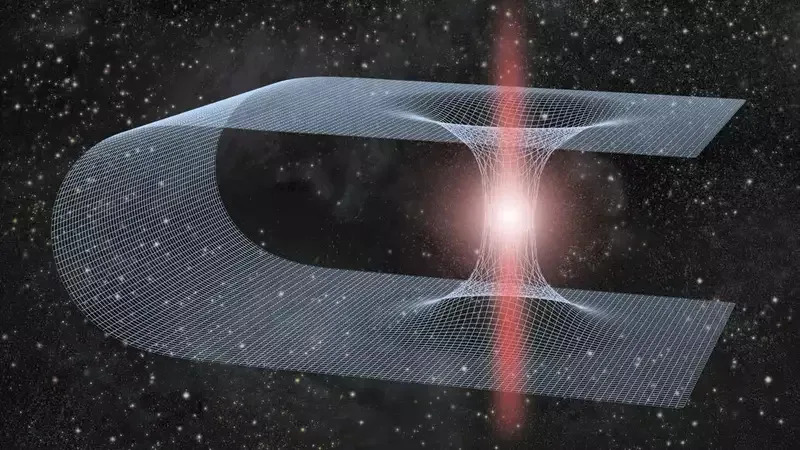
Wormholes do not act as dark energy in a simple, direct sense. (CREDIT: iStock images)
Why Topology Matters
Topology describes the global shape and connectivity of a manifold. The paper highlights two examples: a Euclidean wormhole with topology S1 × S3 decreases the Euler characteristic by 2, while a Nariai instanton with topology S2 × S2 increases it by 2. These microscopic changes, if frequent enough, alter the variation of terms in the gravitational action that depend on global topology.
The Role of the Gauss–Bonnet Term
In four-dimensional classical general relativity, the Gauss–Bonnet term is topological and does not affect the equations of motion. The key claim here is that if the manifold's topology changes because of wormhole nucleation, the variation of the Gauss–Bonnet term is not zero. That nonzero variation yields an extra contribution in the semiclassical Einstein equations which the authors interpret as an effective cosmological constant proportional to the Gauss–Bonnet coupling and the density of wormholes per four-volume.
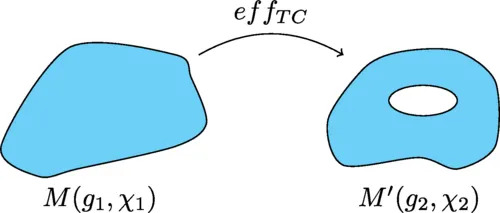
A three-dimensional illustration of the effective topology change from a manifold of Euler characteristic χ1 to a manifold of Euler characteristic χ2. (CREDIT: Physical Review D)
The variation of the Gauss–Bonnet term on a manifold that has topology changes due to the formation of wormholes is not zero.
Estimates and Numbers
To make the idea concrete, the authors set the Gauss–Bonnet coupling α approximately equal to the Planck length squared (α ≈ lp2). With that choice, reproducing the observed cosmological constant (Λ ≈ 10−52 m−2) requires an estimated microscopic-wormhole production density of order 1016 wormholes per cubic meter per second—about ten quadrillion wormholes every second in each cubic meter of space.
By contrast, an upper bound of roughly one wormhole per Planck volume would yield an effective Λ of order 1072 m−2, i.e., ~10124 times the observed value. The wide dynamic range is central to the proposal: if wormhole density varies in space or time, the induced effective cosmological constant would be dynamical rather than fixed.
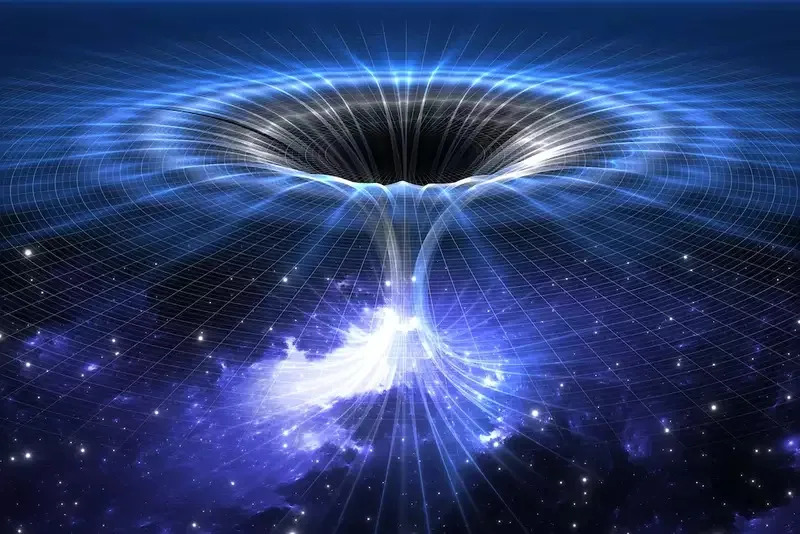
Researchers argue that a strange ingredient from quantum gravity, microscopic wormholes flickering through spacetime foam, could generate an effective cosmological constant of the right kind. (CREDIT: Shutterstock)
Caveats and Limitations
The authors are explicit about the speculative and formal nature of the work. Important mathematical and conceptual caveats include:
- Four-dimensional topologies are not classifiable in any complete sense, complicating a rigorous treatment of topology change.
- The path-integral formulation of quantum gravity, which underlies the Euclidean approach used here, lacks a fully rigorous mathematical definition.
- Singularities and topology change can make the variational calculus ambiguous, and the authors assume quantum fluctuations are large enough to induce topology change yet small enough for perturbation theory to remain meaningful.
- The paper does not present direct observational evidence for microscopic wormholes or spacetime foam with the required properties.
Observational Outlook
Although theoretical, the proposal is testable in principle. If developed into a concrete cosmological model, it could be constrained or falsified using supernova distance measurements, baryon acoustic oscillations (BAO), the cosmic microwave background (CMB), cosmic chronometers, and the growth of large-scale structure. The authors also note possible implications for the early universe, including inflation, if topology change was significant at primordial epochs.
Conclusion
This work offers an intriguing conceptual route toward linking microscopic quantum topology to macroscopic cosmic acceleration. It does not solve the cosmological constant problem, nor does it claim observational confirmation, but it shows how a term usually considered inert in four dimensions—the Gauss–Bonnet correction—might become dynamically relevant if spacetime undergoes frequent microscopic topology change. The paper is thus a provocative mathematical possibility that invites further theoretical and observational scrutiny.
Research source: Physical Review D; authors affiliated with the University of Thessaly. Related popular coverage appeared in The Brighter Side of News.
Help us improve.