The nearly complete Neanderthal infant known as Amud 7, recovered from Amud Cave in Israel and dated to about 51,000–56,000 years ago, shows a striking mismatch between skeletal and dental age. Limb bones suggested an age of ~13.7 months, while tooth histology indicated ~6 months, meaning the skeleton was larger than its dental age. Researchers argue this reflects accelerated early skeletal growth in Neanderthals—likely an adaptive response to harsh environments—with growth patterns later converging with those of modern humans.
Amud 7: Near-Complete Neanderthal Infant Shows Rapid Early Growth Compared With Modern Humans

World
A near-complete Neanderthal infant from Amud Cave in Israel reveals that Neanderthal children grew faster in early life than modern humans, likely as an adaptation to demanding environments. The specimen, known as Amud 7, was recovered in situ in nearly 111 fragments from a niche in the cave wall beneath a red deer jaw and is dated to roughly 51,000–56,000 years ago. The new analysis, published in Current Biology, provides rare insight into Neanderthal development and life history.
Key Findings
Researchers found a notable mismatch between skeletal and dental indicators of age. Postcranial measurements of Amud 7’s arm and leg bones matched those of a modern child about 13.7 months old, while microscopic analysis of tooth enamel growth (tooth histology) indicated an age closer to six months. In other words, Amud 7’s body size was roughly twice what its dental age predicted.
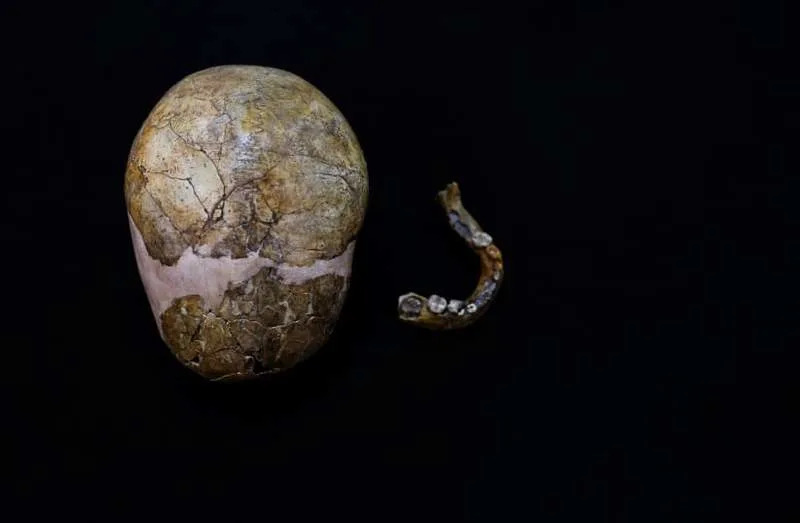
File Photo: The remains of a prehistoric child skull and a lower Jaw, believed to be the earliest known human fossil showing a mixture of morphological traits of both Neanderthals and Homo Sapiens, August 19, 2025. (credit: REUTERS/Ammar Awad)
The team concludes that Neanderthal infants started life with tooth formation, eruption timing, and limb lengths similar to modern humans, but with relatively larger skulls at birth. After birth, Neanderthal skeletal growth appears to have accelerated compared with dental development, producing a period in early childhood when body size outpaced tooth development. Growth trajectories then converge with those of Homo sapiens later in childhood.
Context and Significance
Amud 7 is among the most complete Neanderthal infant skeletons known, and its preservation allowed researchers to combine multiple aging methods. Radiometric and contextual dating support the 51,000–56,000-year age range. The study situates these findings within broader evolutionary patterns: Neanderthals and Homo sapiens began diverging around 600,000 years ago and mostly evolved separately in Eurasia and Africa, although genetic evidence documents episodes of interbreeding during the Middle Paleolithic.
“This suggests an evolutionary strategy emphasizing accelerated development in the early years of life, likely advantageous in the harsh environments Neanderthals inhabited,” the authors write.
Because infant and juvenile remains are rare, Amud 7 offers a valuable window into Neanderthal ontogeny and how closely related human species adopted different developmental strategies in response to their ecological circumstances.
Help us improve.