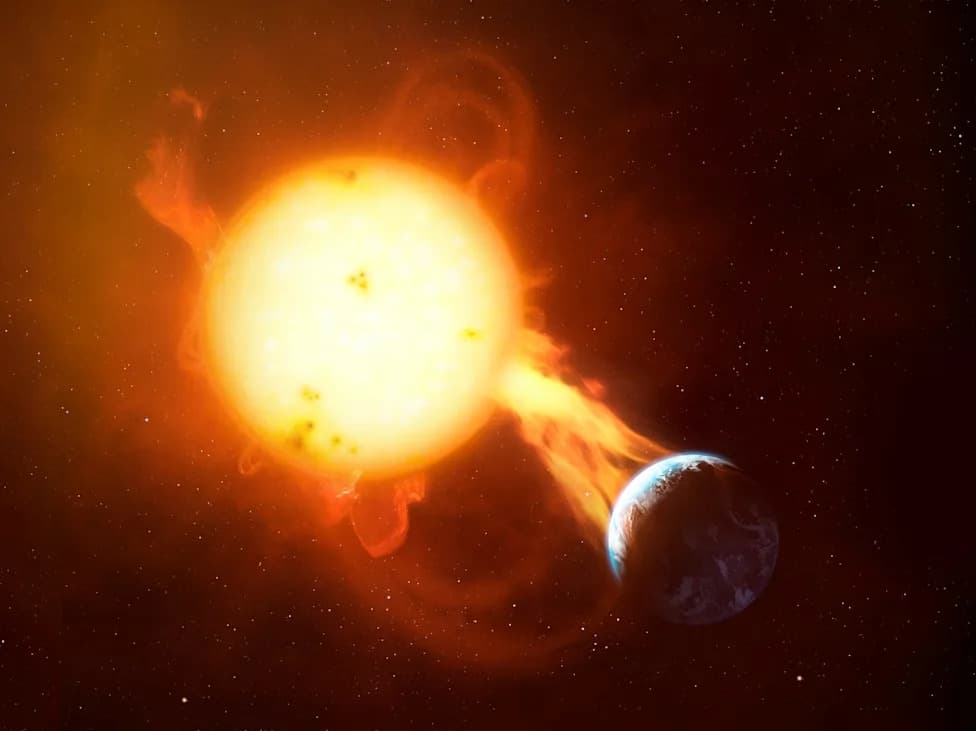
The Sun emitted two X-class flares within hours: an X2.4 at 9:07 p.m. EDT on April 23 and an X2.5 at 4:13 a.m. EDT on April 24, observed by NASA’s Solar Dynamics Observatory. These flares caused temporary radio blackouts across parts of the Pacific Ocean, Australia and East Asia. Although X-class denotes the highest flare category, these events were modest compared with historical extremes such as the November 4, 2003 X40+ flare. Solar activity follows an ~11-year cycle; a roughly year-long solar maximum began in October 2024, and flaring continues as magnetic regions evolve.
Sun Unleashes Two X-Class Solar Flares in Hours, Triggering Brief Radio Blackouts
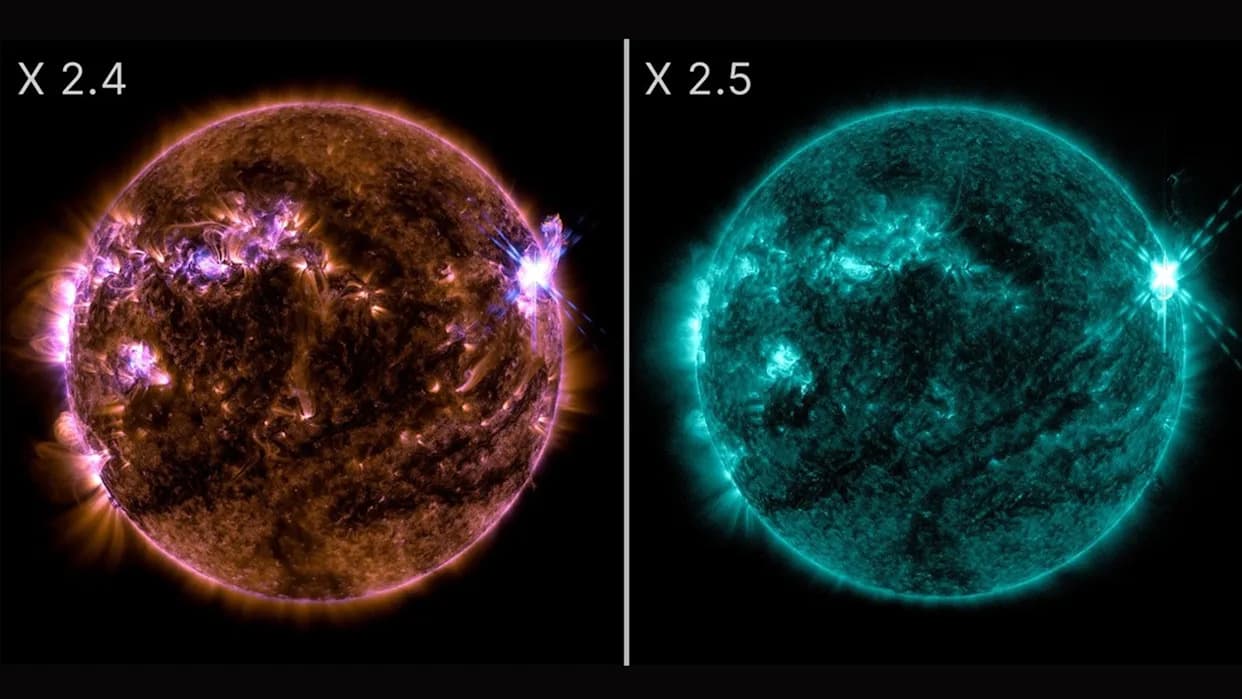
NASA’s Solar Dynamics Observatory captured these images of solar flares — seen as the bright flashes in the top right — on April 23 and 24, 2026. The images show a subset of extreme ultraviolet light that highlights the extremely hot material in flares and which is colorized in in gold and blue on the left and teal on the right.
The Sun — an immense, constantly churning nuclear furnace — produced two X-class solar flares within hours of each other, according to NASA’s Solar Dynamics Observatory. The first flare was measured as X2.4 at 9:07 p.m. EDT on April 23, followed by a slightly stronger X2.5 event at 4:13 a.m. EDT on April 24. While X-class designates the most powerful category of solar flares, these particular bursts are modest compared with the most extreme solar storms on record.
What Happened
Both flares released intense X‑ray and high-energy radiation. Because of their timing and direction, the events produced temporary radio blackouts across parts of the Pacific Ocean, Australia and East Asia. No major, long-lasting disruptions to global infrastructure have been reported.
Solar Cycle Context
Astronomers monitor the Sun’s roughly 11-year cycle of magnetic activity, which alternates between solar maximum and minimum. In October 2024, NASA and NOAA’s Space Weather Prediction Center confirmed the Sun had entered a roughly year-long solar maximum. That peak phase has since passed, but the Sun continues to emit flares and other space-weather events as magnetic regions evolve.
How Flares Affect Earth
Impacts depend on a flare’s strength and whether associated material — especially a coronal mass ejection (CME) — is directed at Earth. Direct hits can disturb Earth’s magnetosphere, spark vivid auroras, and disrupt radio communications, GPS signals, satellite operations and power grids. Flares without an Earth-directed CME often have more limited effects.
Classification And Historical Context
Solar flares are classified by X-ray brightness in ascending tiers: A, B, C, M and X, with each letter representing roughly a tenfold increase in energy. Although the X2.4 and X2.5 flares were strong enough to cause short-lived radio blackouts, they do not rank among the top 50 strongest flares on record. The most powerful observed event occurred on November 4, 2003, rated at least X40 (or higher), and produced a fast coronal mass ejection that traveled at over 2.6 million miles per hour, causing major disruptions to power grids and communications systems.
Bottom line: Two notable X-class flares occurred within hours, produced brief regional radio blackouts, but were modest compared with historical extreme events. Space agencies continue to monitor solar activity and issue warnings when Earth-directed storms are possible.
Help us improve.