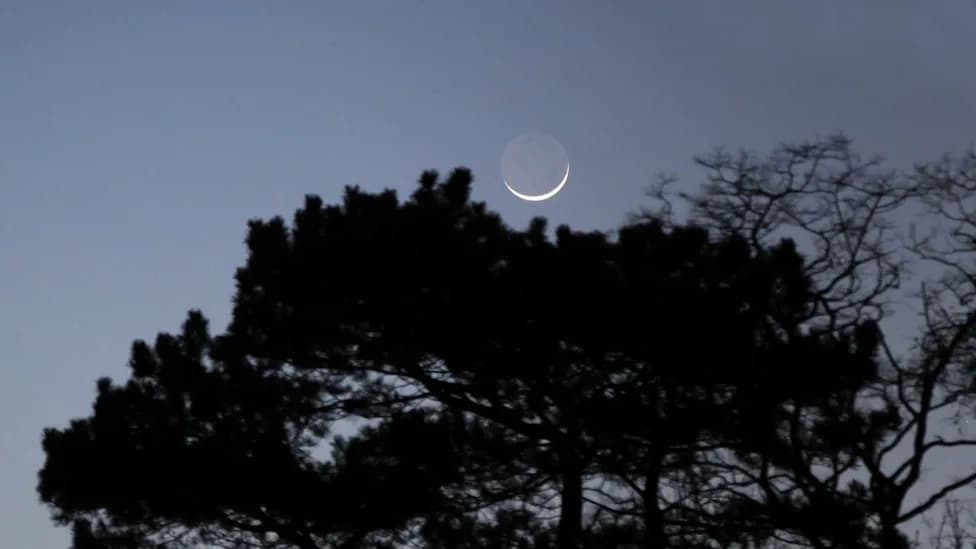
The waxing gibbous Moon (≈70% illuminated) will occult Regulus, Leo’s brightest star, on the evening of April 25 for observers across parts of the mid-Atlantic and southeastern U.S. Observers inside a curved visibility path from Michigan/Ontario southeast through New York, Pennsylvania and New Jersey will see the star disappear behind the Moon’s dark limb and later reappear from the bright limb. The disappearance is easy to see with binoculars and possibly with the naked eye under dark skies; the reappearance typically requires a telescope because of lunar glare. Grazing occultations — multiple disappearances and reappearances — are possible within ~2–3 miles of the central path. For detailed predictions and maps for hundreds of locations, see the IOTA website.
Watch a Bright Star Vanish: The Moon Will Occult Regulus for Up to an Hour on April 25
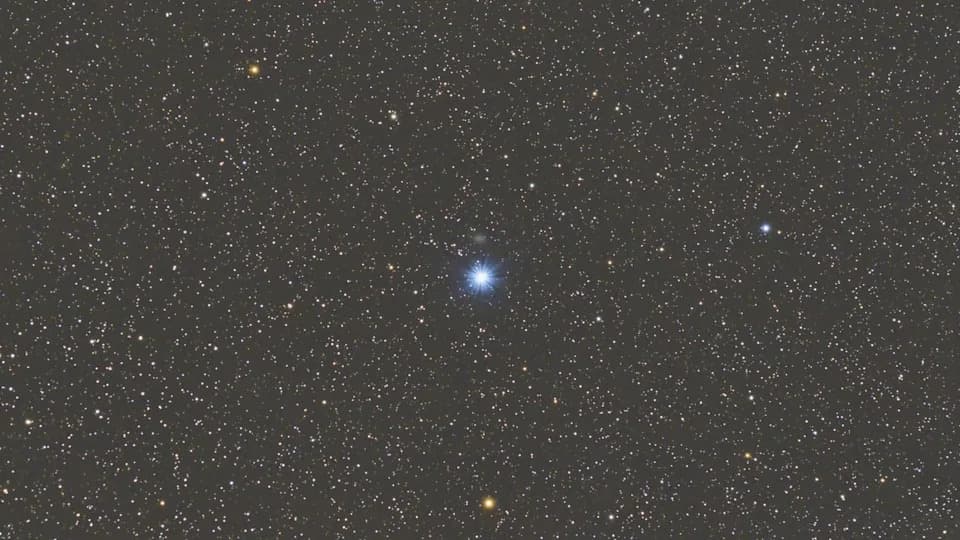
If you live in parts of the mid-Atlantic or southeastern United States, the evening of Saturday, April 25 offers a rare and striking sight: the waxing gibbous Moon (about 70% illuminated) will drift in front of Regulus, the 1st-magnitude star that marks the heart of the constellation Leo. For observers inside the path of visibility, Regulus will disappear behind the Moon’s dark limb and reappear later from the bright limb — an event called an occultation.
What Is an Occultation?
An occultation occurs when one body — here, the Moon — passes in front of another from our viewpoint, temporarily concealing it. The word comes from the Latin occultāre, meaning “to hide” or “to conceal.” The sudden disappearance of a point-like star such as Regulus can look like someone flipping an invisible switch off and on again.
When and Where To Look
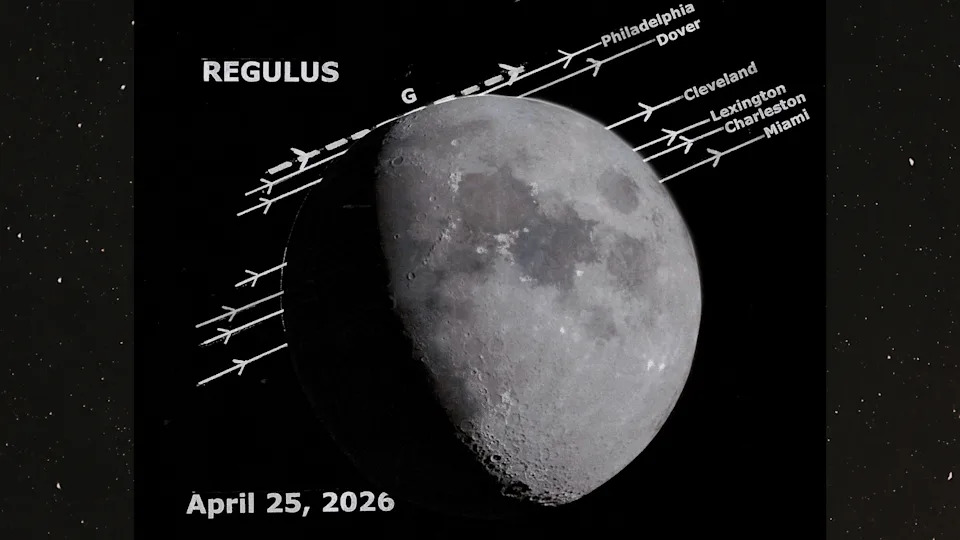
The occultation will be visible along a curved path that runs roughly from near De Tour Village, Michigan, across Lake Huron to Mississauga, Ontario, then southeast through parts of western New York, northeastern Pennsylvania and across western and central New Jersey. Observers south of that line will see the Moon pass directly in front of Regulus; observers north of the line will see the Moon pass below the star (a near miss).
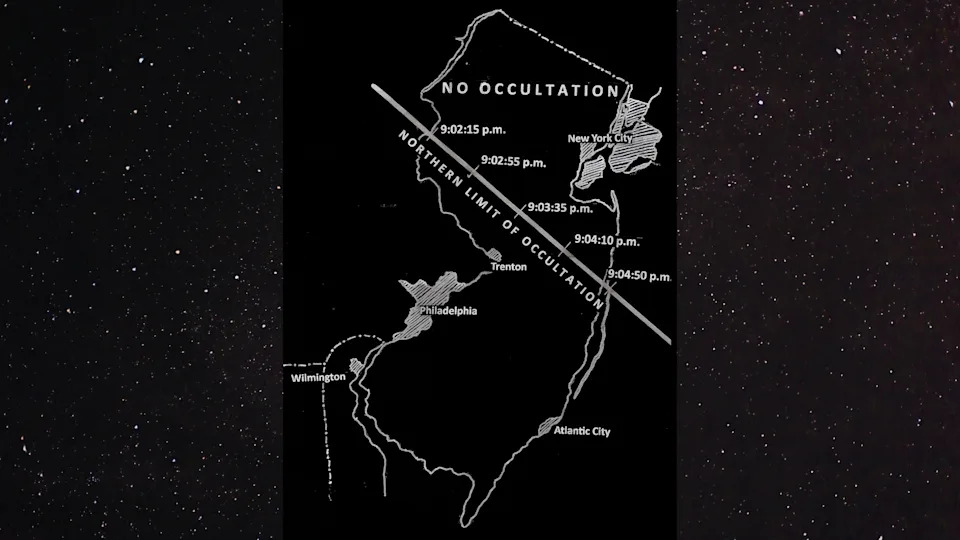
From New York City, the closest apparent approach occurs at 9:04 p.m. EDT, when Regulus will be only ~30 arc seconds from the Moon’s dark upper limb — about 1/63 of a lunar diameter. Boston shares the same closest-approach time but has a larger gap of about 2.9 arc minutes (~0.05°).
How It Will Look
Because the Moon is waxing, its dark, unlit limb faces forward in its orbital motion. Regulus will disappear against that dark limb, making the initial disappearance easy to spot with binoculars and, under sufficiently dark skies, possibly even with the naked eye (you may need to block glare from the Moon’s bright limb with a wall or tree to see it clearly). The reappearance will occur against the Moon’s sunlit limb and is usually much harder to see; a telescope is highly recommended to catch the star re-emerging as a tiny blue-white point on the lunar horizon.
Grazing Occultations
If your location lies within roughly 2–3 miles of the central path, you may witness a grazing occultation. As Regulus moves tangent to the Moon’s rugged limb, it can disappear and reappear several times behind lunar mountains and valleys. New Jersey, especially near the central path, offers among the best chances to see this multiple-blink effect.
Twilight, Daylight and Visibility
Whether you see the event against a dark, twilight, or daytime sky matters. Optimal viewing will be from central and southern New Jersey, the Pennsylvania/New Jersey border region, the Delmarva shoreline down toward Ocean City, Maryland, and the Outer Banks of North Carolina. In those areas, Regulus will vanish into the Moon’s dark limb against a deep cobalt twilight (nautical or late twilight), with the Sun at least 12° below the horizon.
About 100 miles farther west places you into mid-twilight; binoculars should still reveal Regulus. West of a line roughly from central Michigan south through east-central Kentucky to the Gulf Coast, the event occurs in full daylight. Telescope users can sometimes spot Regulus during daytime if skies are clear, the Sun is low, and you know exactly where to look near the Moon.
Times For Selected Cities (Eastern Time)
Below are disappearance and reappearance times for 15 selected eastern U.S. locations. Times marked with an asterisk (*) indicate the disappearance occurs during bright evening twilight or at sunset.
| Location | Disappearance (ET) | Reappearance (ET) |
|---|---|---|
| Lexington, KY | 8:18 p.m.* | 9:24 p.m. |
| Atlanta, GA | 8:18 p.m.* | 9:35 p.m. |
| Detroit, MI | 8:28 p.m.* | 9:10 p.m. |
| Charleston, WV | 8:29 p.m.* | 9:42 p.m. |
| Cleveland, OH | 8:30 p.m.* | 9:14 p.m. |
| Cape Canaveral, FL | 8:30 p.m. | 9:52 p.m. |
| Miami, FL | 8:33 p.m. | 9:59 p.m. |
| Norfolk, VA | 8:41 p.m. | 9:03 p.m. |
| Niagara Falls, NY | 8:42 p.m.* | 9:02 p.m. |
| Salisbury, MD | 8:46 p.m. | 9:24 p.m. |
| Dover, DE | 8:48 p.m. | 9:20 p.m. |
| Williamsport, PA | 8:49 p.m. | 9:09 p.m. |
| Philadelphia, PA | 8:52 p.m. | 9:15 p.m. |
| Atlantic City, NJ | 8:54 p.m. | 9:16 p.m. |
| Allentown, PA | 8:55 p.m. | 9:09 p.m. |
More Detailed Predictions
For precise predictions (times in Universal Time, maps and a larger list of locations), consult the International Occultation Timing Association (IOTA) website, which provides detailed charts and a color-coded visibility map for hundreds of locations.
Credit: Joe Rao prepared the original notes. He is an instructor and guest lecturer at New York’s Hayden Planetarium and contributes to Natural History, Sky & Telescope, The Old Farmer’s Almanac and other publications.
Help us improve.