
On Sept. 8 a thin waning crescent moon will pair with Jupiter in the predawn sky and, for many locations across North America, will briefly occult the planet in daylight. Start looking around 5 a.m. local time and, if possible, locate the pair before sunrise so you can track them into daylight. The occultation will be visible for much of the continent (excluding areas west and south of a line from Bellingham, WA to Rockport, TX); disappearance windows run roughly 12:30 p.m.–3:30 p.m. depending on your time zone. If you miss it, the pair meets again in an easier pre-dawn encounter on Oct. 6.
Sept. 8: How to See the Moon Temporarily Hide Jupiter — Even in Daylight
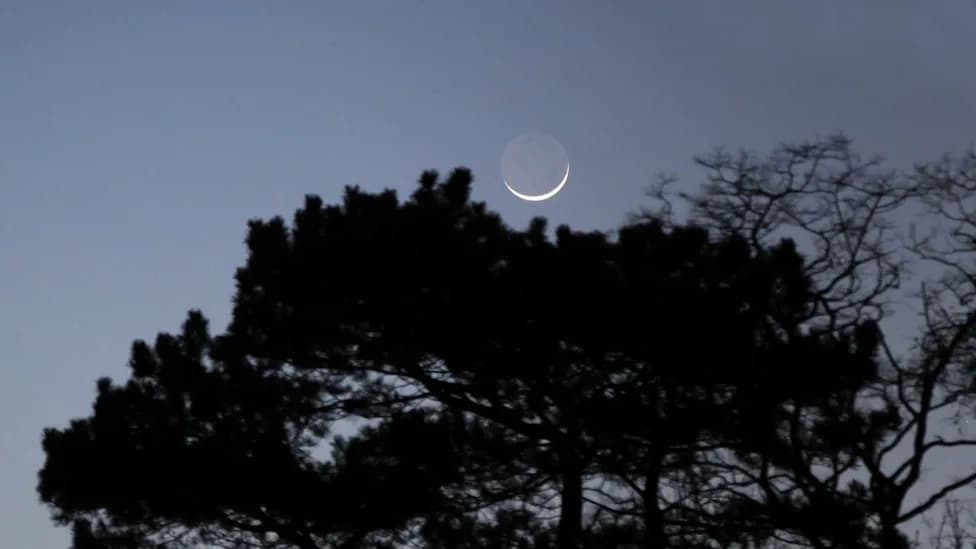
Thin crescent moon shining above silhouetted trees in the foreground.
On Tuesday, Sept. 8, skywatchers across much of North America have a rare chance to see a thin waning crescent moon paired with bright Jupiter before dawn — and, for many locations, to attempt a challenging daytime occultation when the Moon briefly passes in front of the planet.
When to look: Set an alarm for about 5 a.m. local time and scan low toward the east-northeast. Before sunrise you should see a delicate crescent moon (under 10% illuminated) appearing like a faint “celestial smile.” Roughly 5° below that crescent — about half the width of a clenched fist at arm’s length — will be bright Jupiter.
Jupiter rises a little before 4 a.m. local daylight time but remains low until first light. The planet sits in the faint zodiacal constellation Cancer. If you can set up a telescope before dawn, you may be among the first to inspect any changes to Jupiter’s cloud belts after the planet spent much of early July through mid-August hidden in the Sun’s glare.
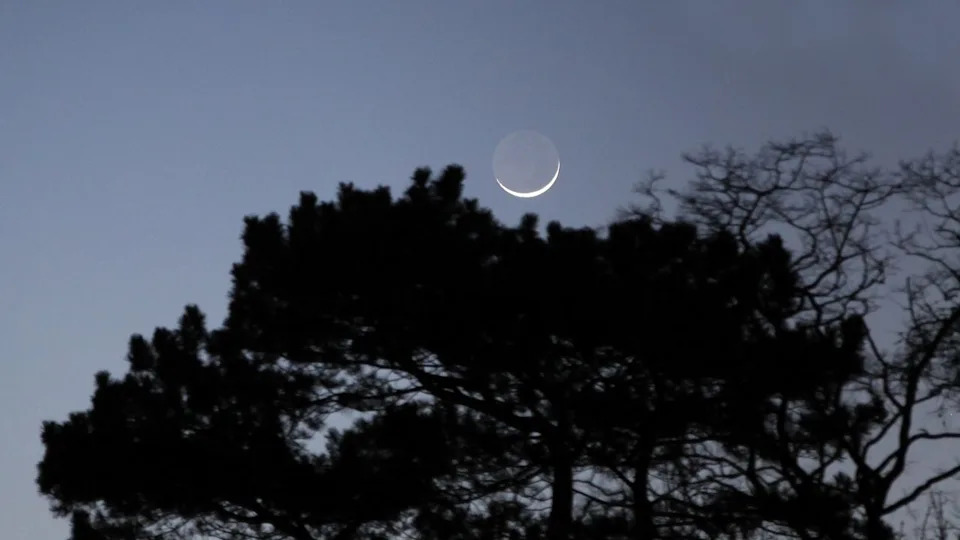
The moon will perform a celestial disappearing act on Sept. 8. | Credit: National Railway Museum/SSPL/Getty Images
Daytime Occultation: What to Expect
Later on Sept. 8 the thin crescent will pass in front of Jupiter for observers inside a broad visibility zone that covers much of North America. A large swath of the western United States — generally locations west and south of an approximate line running from Bellingham, Washington to Rockport, Texas — lies outside the occultation zone.
The occultation happens during the afternoon, when the Moon and Jupiter will appear lower than the Sun and off to its right. Jupiter will disappear behind the Moon’s sunlit limb as the lunar limb moves from north to south, taking roughly a minute or more to fully cover the planet. About 50 minutes later (±10 minutes) Jupiter will reappear from behind the Moon’s dark edge.
Approximate disappearance windows (local daylight times): Eastern: 2:55–3:30 p.m.; Central: 1:45–2:20 p.m.; Mountain: 12:30–1:00 p.m. Exact times vary by location — consult an occultation map and interpolate between nearby reference cities for precise local disappearance and reappearance times.
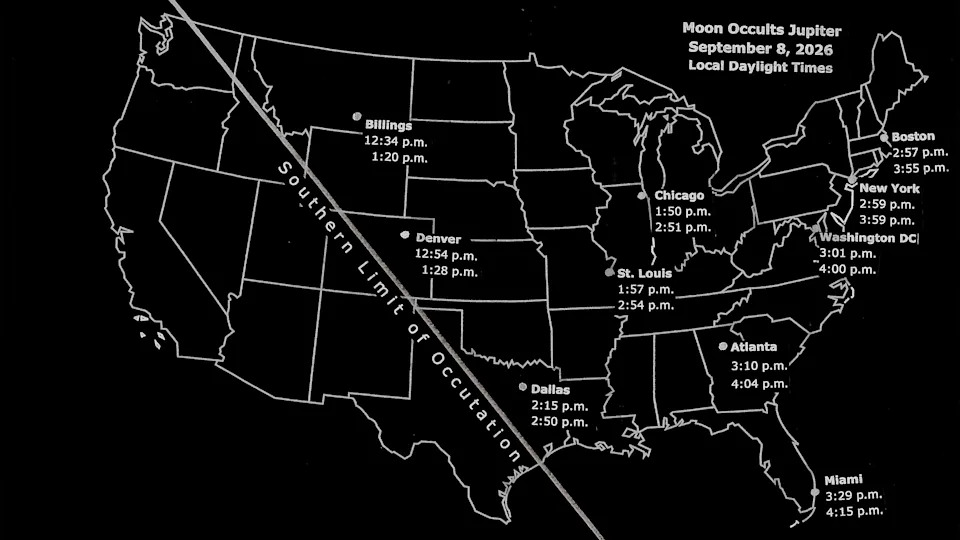
Credit: Joe Rao
How To Find Them In Daylight
The main challenge is locating the Moon and Jupiter against the blue daytime sky, so arrive well in advance. The simplest approach is to locate the pair before sunrise and then track them into daylight. Sky transparency is crucial: a hazy or milky sky will make spotting them much harder.
- Begin just before sunrise when the crescent and Jupiter are most distinct.
- As daylight builds, return to the same patch of sky about 30° from the Sun (roughly four fist-widths at arm’s length), mostly to the Sun’s right and, for most observers, a bit lower.
- Sweep the area with binoculars or a finderscope. The Moon’s thin crescent has low surface brightness and can blend into the blue sky; Jupiter will appear much smaller (about 1/60th the Moon’s apparent diameter) and fainter.
- Watch for Jupiter to reappear along the Moon’s dark limb — a striking sight as the planet seems to emerge from the daytime sky.
Safety note: Never point optical equipment near the Sun or stare in its direction; doing so can cause immediate and permanent eye damage. Keep the Sun well out of the field of view when using binoculars, a finderscope, or a telescope.
If you can’t find them in daylight, don’t be discouraged: on the morning of Tuesday, Oct. 6, the Moon and Jupiter have another close interaction that occurs several hours earlier — before sunrise in darker or twilight skies — and should be much easier to see with the naked eye, binoculars, or a telescope. Space.com and other astronomy outlets will publish local viewing details as the date approaches.
Author: Joe Rao, instructor and guest lecturer at New York’s Hayden Planetarium. He writes for Natural History magazine, Sky & Telescope, The Old Farmer’s Almanac and other publications.
Help us improve.





















