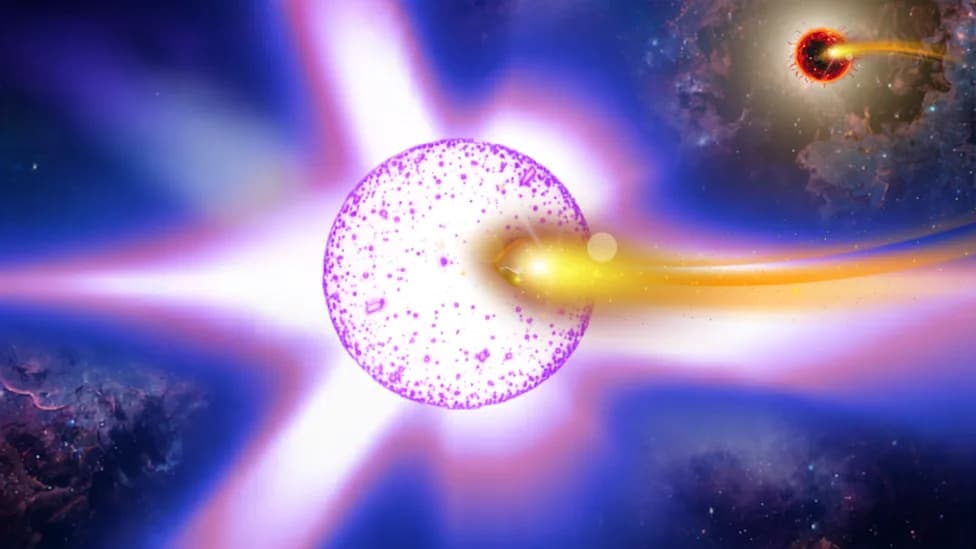
Scientists report that magnetic fields formed early in a star's life can survive through later stages and appear on white dwarfs as "fossil fields." Using asteroseismology to compare red-giant core magnetism with white-dwarf surface fields, the team finds that a larger fraction of the star must be magnetized to explain observations of older white dwarfs. The work suggests magnetism may be common in stars and could alter predictions for the Sun's evolution.
Fossil Magnetic Fields on White Dwarfs May Reveal How the Sun Will End
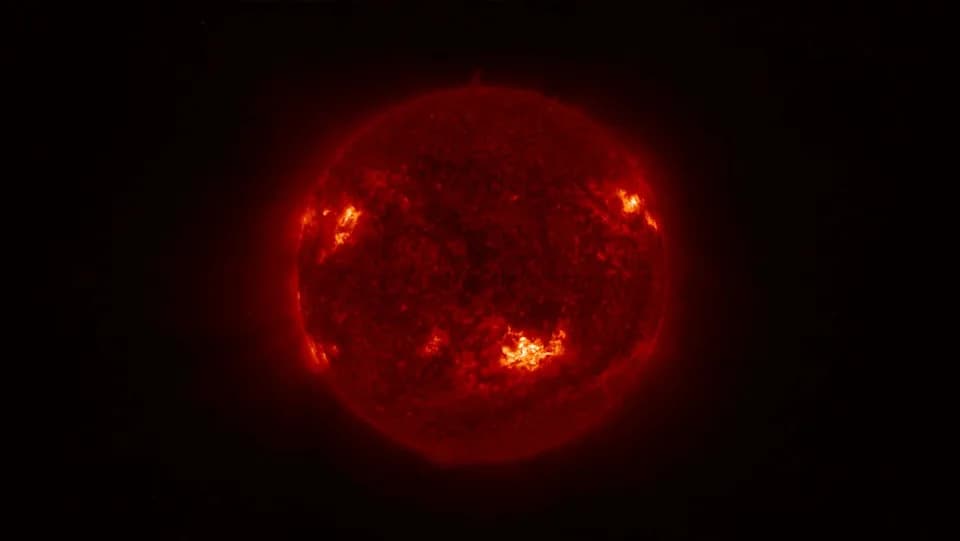
The sun seen in two different X-ray wavelengths, 17.4 and 30.4 nanometers, on 21 May 2024. | Credit: ESA & NASA/Solar Orbiter/EUI Team
Scientists working like "stellar archaeologists" report evidence that magnetic fields formed early in a star’s life can survive through later stages and reappear on white dwarfs as so-called "fossil fields." This new work links magnetic fields measured at the cores of red giants to magnetism observed at the surfaces of white dwarfs and offers fresh insight into how stars like our Sun evolve and die.
New Evidence and Methods
The research team combined a theoretical framework with observations of stars at multiple evolutionary stages. They used asteroseismology — the study of stellar oscillations or "starquakes" — to probe deep stellar interiors and compare those measurements with surface magnetism seen on white dwarfs. Their model proposes that magnetic fields created early in a star's life remain present through successive phases and later appear at the surface of white dwarfs as fossilized magnetism.
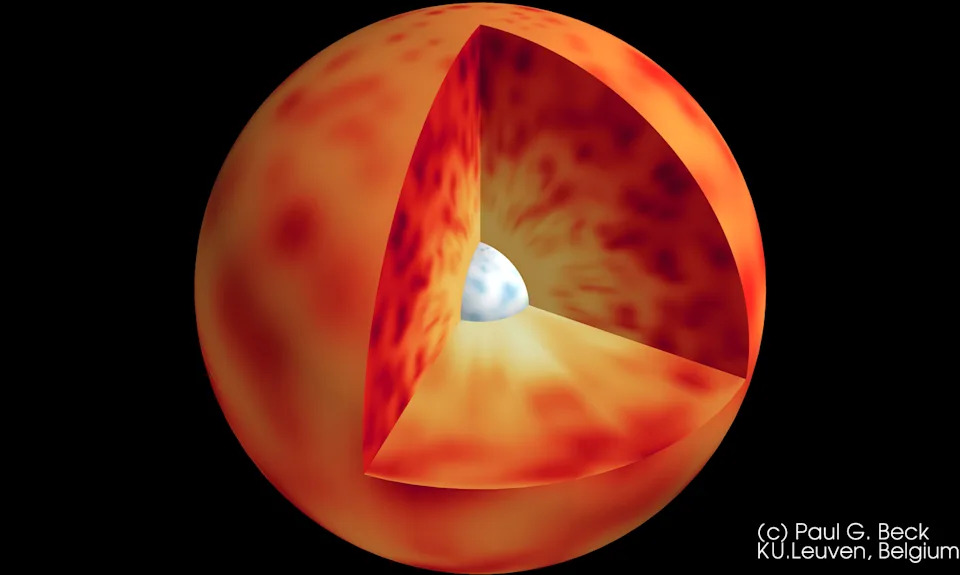
The hot core in the center of a red giant star rotates 10 times faster than the surface. | Credit: Paul Beck (KU Leuven, Belgium)
"The magnetic field in a star is important for how the star works on the inside and how long it lives and evolves," said team co-leader Lukas Einramhof of the Institute of Science and Technology Austria (ISTA). "Generally, more of the older white dwarfs tend to be more magnetic than younger white dwarfs."
Connecting Red Giants to White Dwarfs
A white dwarf is the exposed core left behind after a red giant sheds its outer envelope, so observations of red giant cores and white dwarf surfaces probe essentially the same stellar region at different times. The team finds that to explain the relatively strong surface magnetism of older white dwarfs, a larger fraction of the progenitor star must already have been magnetized during the red giant phase. This does not necessarily mean the fields were stronger overall, but that they extended over a greater portion of the interior.
The researchers also modeled how a star’s evolution reshapes magnetic geometry. Rather than a simple central dipole, the field can become segmented — somewhat like the panels of a basketball — with field strengths that may be stronger nearer the surface than at the center.
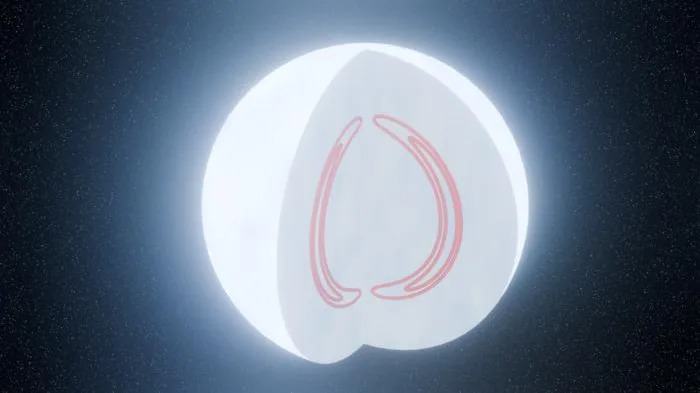
How the evolution of a star changes the shape of a magnetic field. Rather than being centered at one point, the ISTA team’s simulations suggest that magnetic fields can form shell‑like structures (pink field lines). | Credit: Lukas Einramhof | ISTA
Implications for the Sun
These results have direct implications for the future of our Sun. In roughly 5 billion years the Sun will exhaust hydrogen in its core and begin to transform into a red giant: the core will contract while the outer layers expand, possibly inflating the Sun to around 100 times its present diameter and potentially engulfing the inner rocky planets, perhaps out to Mars.
The red giant phase is short on cosmic timescales — roughly 1 billion years — after which the Sun will shed its outer layers and leave behind a cooling core: a white dwarf. Whether the Sun’s core is magnetic today is still unknown; prevailing solar models typically assume it is not. If the Sun’s core is magnetic, many models would need revision.
Einramhof and colleagues note that magnetic processes could alter the Sun’s lifetime: if magnetic mixing draws hydrogen from the outer layers into the core, the Sun could burn longer; conversely, strong magnetic effects might produce different and less predictable outcomes.
The study was published on April 14 in the journal Astronomy & Astrophysics.
Help us improve.