Three‑dimensional simulations show that some oxygen–neon–magnesium white dwarfs can collapse into neutron stars via accretion‑induced collapse (AIC) when they steadily siphon mass from a companion at just the right rate. The accretion window is narrow: too slow brings novae that remove mass, too fast causes winds or expansion that prevent collapse. AICs are expected to be faint, fast ultraviolet/optical flashes (≈2–3 days), with neutron‑rich ejecta concentrated at mid‑latitudes and newborn neutron stars at the low end of the mass distribution.
How 'Vampire' White Dwarfs Can Become Neutron Stars — And How We'll Spot Them
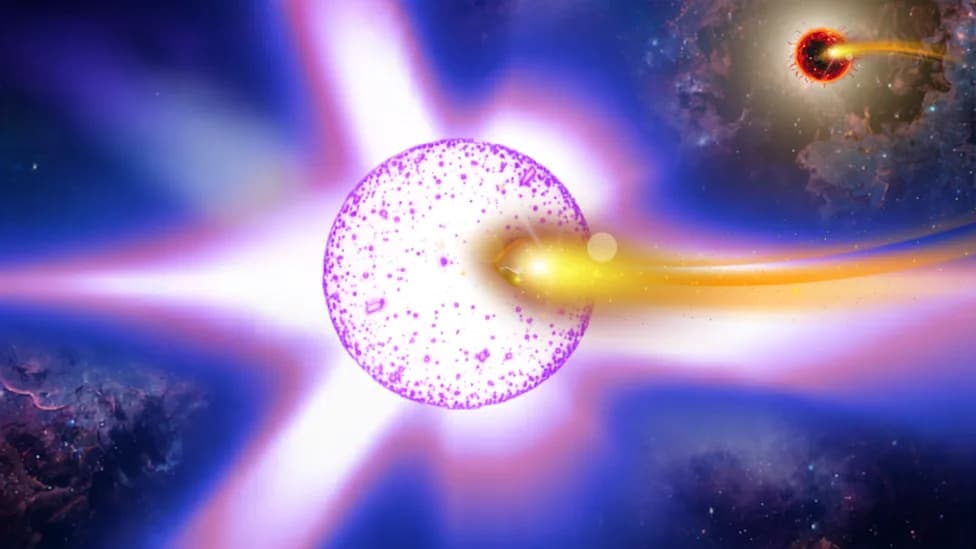
An illustration of a white dwarf transforming into a neutron star as it feeds on a distant companion star.
New three‑dimensional simulations show that under a narrow set of conditions some white dwarfs can collapse into neutron stars by siphoning material from a companion — a process called accretion‑induced collapse (AIC). These rare events are faint, fast, and may be identifiable as brief ultraviolet and optical flashes lasting just a few days.
What Is Accretion‑Induced Collapse?
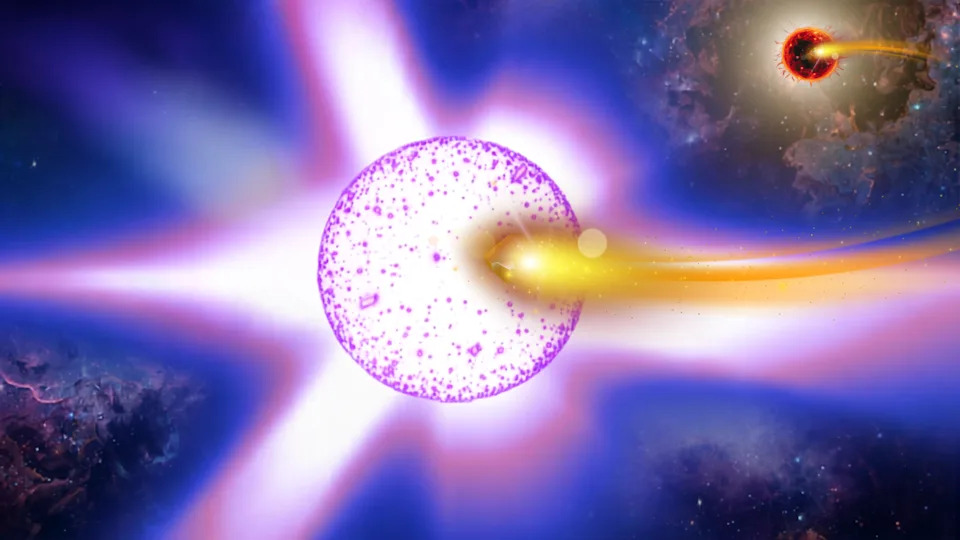
An illustration of a white dwarf transforming into a neutron star as it feeds on a distant companion star. | Credit: Robert Lea (created with Canva)
AIC is a pathway to form a neutron star that doesn’t start with a massive, living star. Instead, a white dwarf — a dense stellar remnant — steadily accretes matter from a close companion until internal conditions trigger collapse. Although the core implosion resembles that in ordinary core‑collapse supernovae (with neutrinos carrying away energy), AICs lack the thick, ejected stellar envelope of massive‑star explosions and therefore produce a much fainter, faster transient.
Which White Dwarfs Can Undergo AIC?
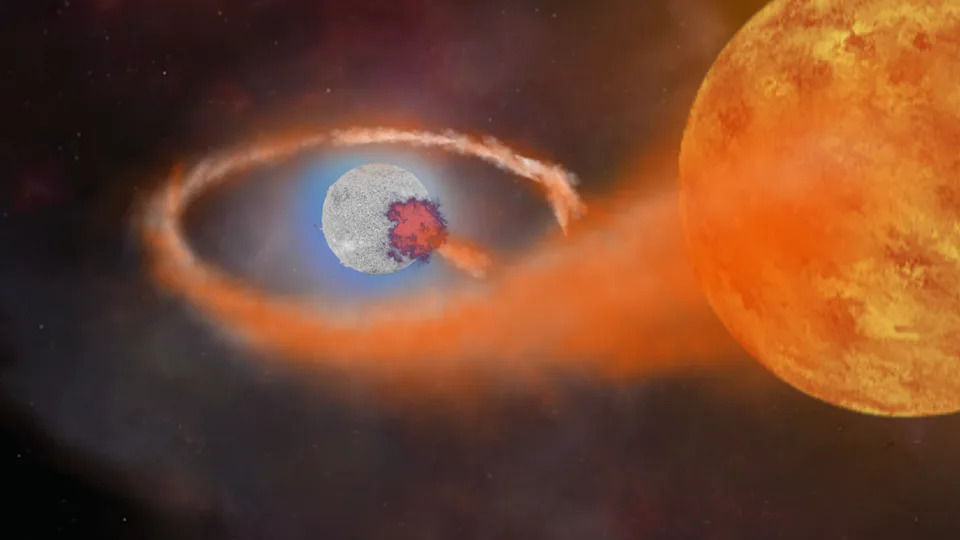
An illustration shows a "vampire" neutron star feeding on a close companion star. | Credit: Robert Lea (created with Canva)
Most white dwarfs are carbon–oxygen (C/O) and, if pushed past the Chandrasekhar limit (~1.4 solar masses), tend to ignite thermonuclear runaway and explode as Type Ia supernovae rather than become neutron stars. By contrast, rarer oxygen–neon–magnesium (O/Ne/Mg) white dwarfs are denser at birth and require less added mass to reach collapse conditions, making them the primary AIC candidates.
How The Collapse Happens
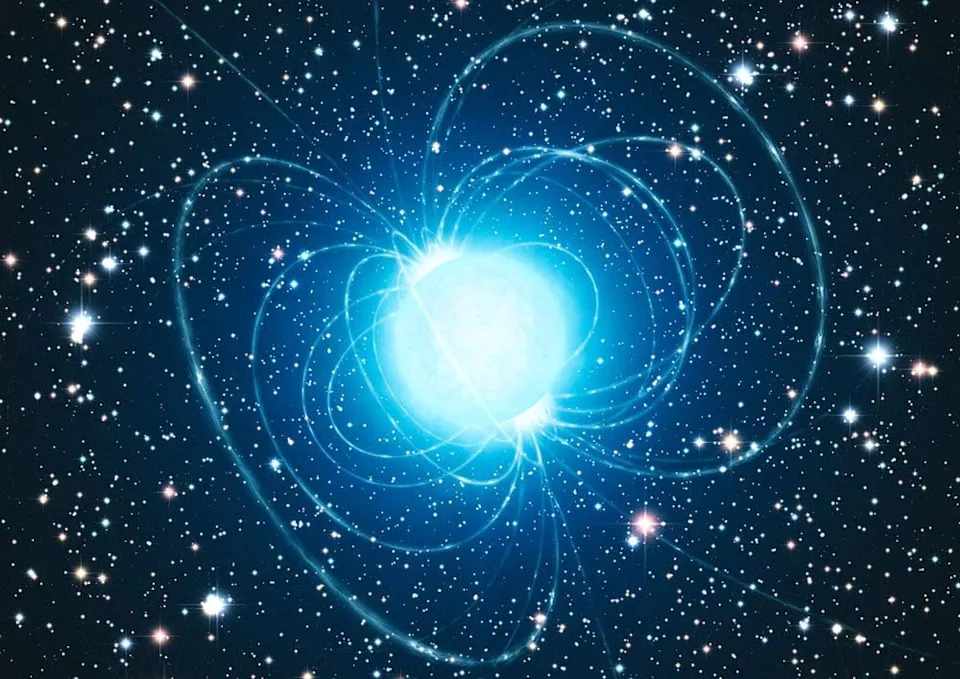
An illustration of a highly magnetic neutron star. | Credit: ESO/L. Calçada
The simulations show the accretion rate must lie in a fairly narrow window. If accretion is too slow, recurrent nova outbursts expel accumulated material. If accretion is too fast, winds, envelope expansion, or binary interactions can halt the path to collapse. When accretion is steady and the internal conditions are met, electrons are captured by neon and magnesium nuclei. This electron capture removes degeneracy pressure and triggers implosion to a neutron star.
"The accretion has to be fast enough, and steady enough, to get it there without triggering explosive burning along the way," said Laurenz Thümmler of ETH Zurich, lead author of the study.
Surprising Geometry And Observable Signals
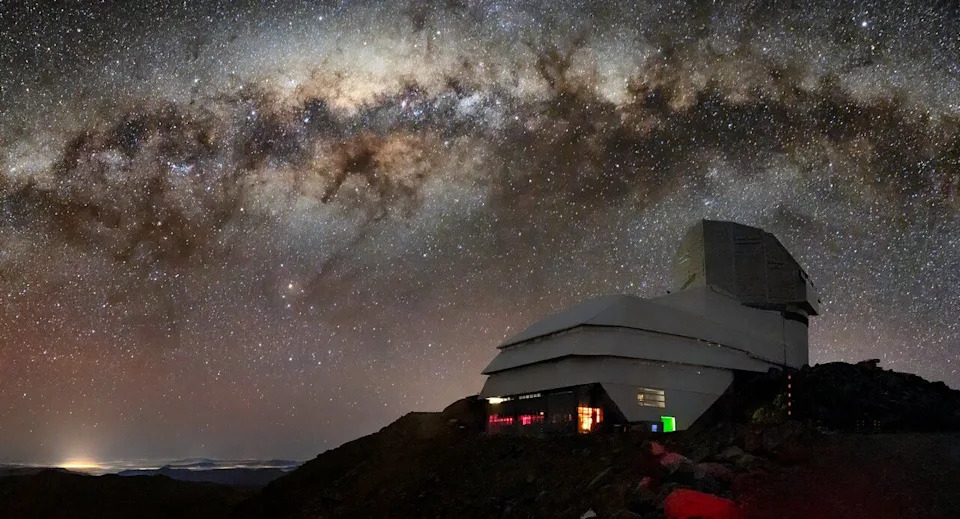
The Vera C. Rubin observatory gazes out at the Milky Way | Credit: RubinObs/NOIRLab/SLAC/NSF/DOE/AURA/B. Quint
Contrary to expectations, the models predict the most neutron‑rich ejecta do not flow along the rotation axis. Instead, they concentrate at mid‑latitudes where magnetically driven outflows collide with neutrino‑heated winds — a geometry that makes observed signals angle‑dependent. Observationally, AICs should be brief ultraviolet/optical transients lasting about two to three days, possibly accompanied by X‑ray emission and longer‑lived radio afterglows. The Vera C. Rubin Observatory and fast‑cadence surveys are promising tools to detect such events.
Remnants And Rates
Neutron stars born by AIC are expected near the low end of the mass distribution (roughly 1.1–1.4 solar masses) because little mass is ejected. However, similar masses can also come from low‑mass massive‑star collapses, so remnant mass alone won’t uniquely identify an AIC origin. AICs are expected to be rare, and their true rate remains uncertain.
What Comes Next?
Thümmler and colleagues plan two follow‑up directions: improving light‑curve predictions by more detailed modeling of radioactive heating, gamma‑ray escape, and charged‑particle deposition; and testing how more complex or tilted magnetic fields affect the explosion geometry and angular distribution of ejecta. The team’s results are available as a preprint on arXiv for further scrutiny.
Help us improve.