NASA's Curiosity rover photographed extensive patches of polygonal, honeycomb-like rocks on Mount Sharp while approaching the 33-foot-wide Antofagasta crater. Images taken on April 7 and April 13 (Sols 4859 and 4865) were released in mid-April. Scientists say the textures are geological and may relate to drying mud, subsurface ice, or other processes; Curiosity's imagery and chemical data will be used to test formation hypotheses.
Curiosity Photographs Vast Fields of 'Dragon-Scale' Polygonal Rocks on Mars
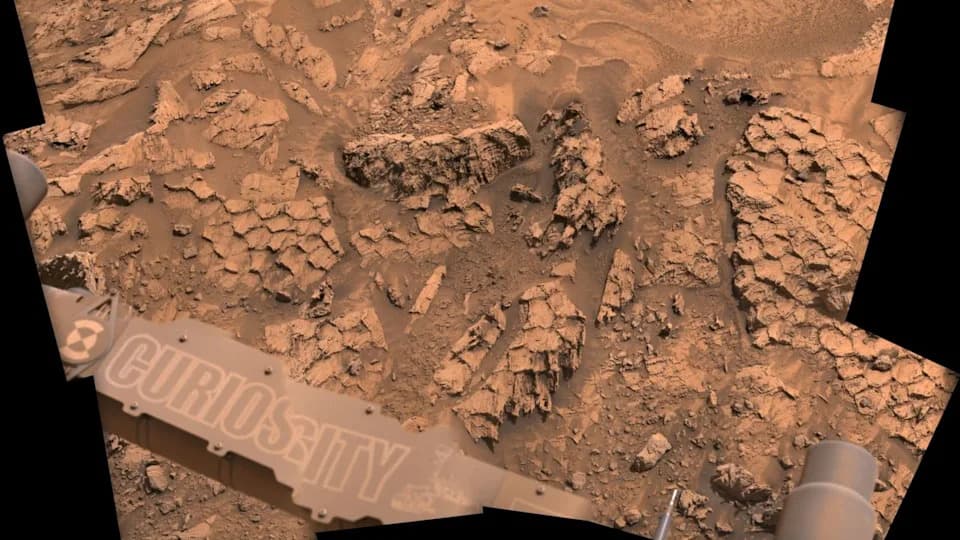
Dozens of polygon-covered rocks, which look suspiciously like clumps of fossilized "scales" from a monstrously large reptile, surround the surface of Mars near Antofagasta in the Gale crater. | Credit: NASA/JPL-Caltech/MSSS/Kevin M. Gill
NASA's Curiosity rover has photographed dense patches of polygonal, honeycomb-like rocks on the slopes of Mount Sharp that resemble giant reptile scales — but the features are geological, not biological. The images were taken as Curiosity drove toward Antofagasta, a relatively young, roughly 33-foot-wide (10-meter) impact crater inside Gale Crater near Mars' equator.
Two black-and-white images showing the scale-like textures were released by NASA on April 14, and a close-up color view was posted online April 15 by Kevin M. Gill, an image-processing engineer at NASA's Jet Propulsion Laboratory (JPL). The photos were captured on April 7 and April 13, corresponding to Sol 4859 and Sol 4865 in the rover's mission clock.
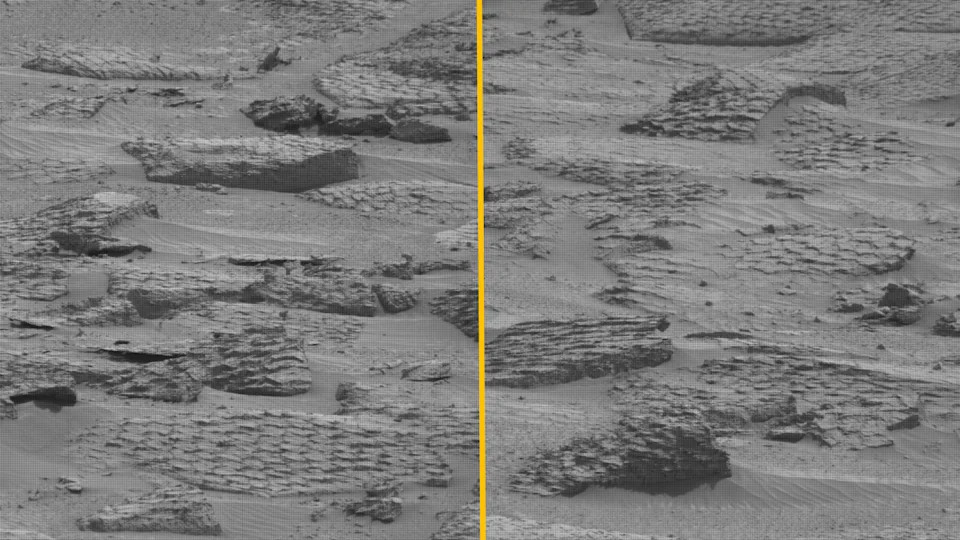
Curiosity snapped several photos of the scaly rocks stretching "for meters and meters" as it drove toward Antofagasta. | Credit: NASA/JPL-Caltech/MSSS
What the Team Observed
Mission scientists and observers compared the tight, multi-faceted clusters to reptile scales — even joking that some formations look "dragon-like" — but researchers emphasize the similarity is visual only. According to an April 10 NASA blog post, the polygonal patterns “stretched for meters and meters” across the ground. JPL planetary scientist Abigail Fraeman noted that while polygonal, honeycomb textures have been seen before on Mars, the sheer abundance here surprised the team: "Many of the rocks we've driven over have these incredible textures — thousands of honeycomb-shaped polygons crisscross their surface."
Possible Origins
Similar polygonal patterns on Mars have previously been linked to nonbiological processes such as the drying and cracking of mud or the action of ice crystals moving beneath or within sediment. At present, scientists do not have a definitive explanation for these specific textures. Curiosity has collected extensive imagery and chemical measurements in the area that researchers will use to test hypotheses and distinguish between competing formation mechanisms.
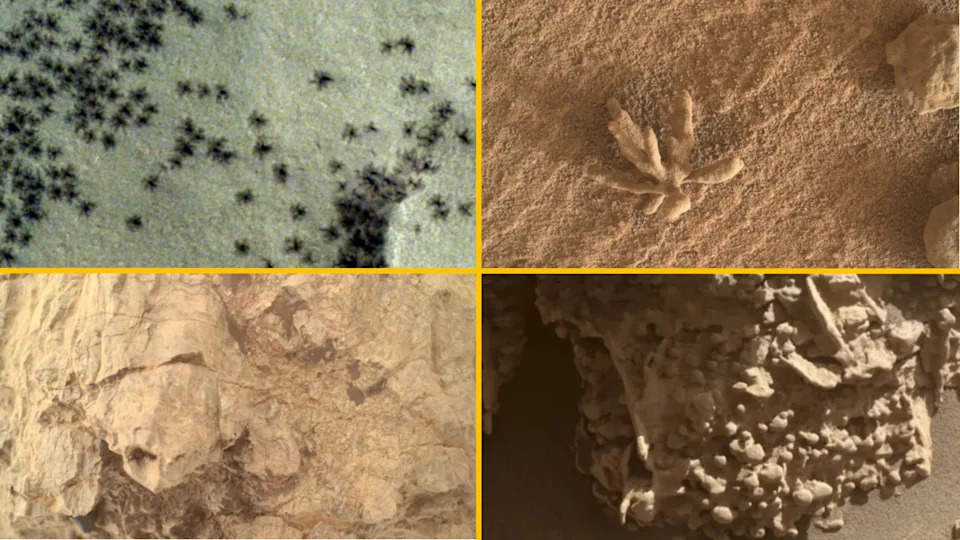
Curiosity and the other spacecraft on or around Mars have spied dozens of animal impostors on the Red Planet's surface, including "Spiders on Mars" (top left), a coral-like rock (top right), a Martian turtle (bottom left) and egg-like spheroids (bottom right). | Credit: Top left: ESA/DLR/FU Berlin; top right: NASA/JPL-Caltech/MSSS; bottom left: NASA/JPL-Caltech; bottom right: NASA/JPL-Caltech/MSSS.
Context and Related Observations
Before arriving at Antofagasta, Curiosity spent nearly a year studying ridges on Mount Sharp known as "boxwork," sometimes nicknamed Martian "spiderwebs" for their zigzag patterns; the rover also observed tiny, egg-like spheroids attached to those ridges. These boxwork features are distinct from the planet-wide dark features commonly called "spiders."
Since landing in 2012, Curiosity has repeatedly captured rock shapes that trigger pareidolia — the human tendency to see familiar forms in random patterns — including coral-like textures. NASA's newer rover, Perseverance (landed 2021), and orbiting spacecraft have produced similar examples of animal-like associations, such as images likened to a turtle, a butterfly-shaped crater and a dog-like shape buried beneath the north pole.
Next Steps: Scientists will analyze Curiosity's high-resolution photos and onboard chemical data from the Antofagasta approach to determine whether the polygons formed from drying sediments, subsurface ice processes, mineral precipitation, or another geological mechanism. These results could help refine our understanding of Mars' past climate and hydrologic activity.
Help us improve.