Curiosity photographed thousands of honeycomb-shaped polygonal patterns near Antofagasta crater on Sol 4865 (13 April 2026). Project scientist Abigail Fraeman described the textures as "honeycomb-shaped polygons" stretching for meters in Mastcam mosaics. The pattern resembles a 2023 site at Pontours, where repeated wet–dry cycles and salt deposition were inferred; raised ridges at Antofagasta suggest mineral-filled cracks. Curiosity collected imaging and chemical data, which scientists will analyze to test formation hypotheses and refine Mars' water history.
Curiosity Spots 'Dragon-Scale' Honeycomb Rocks at Antofagasta — Clues to Ancient Wet–Dry Cycles on Mars
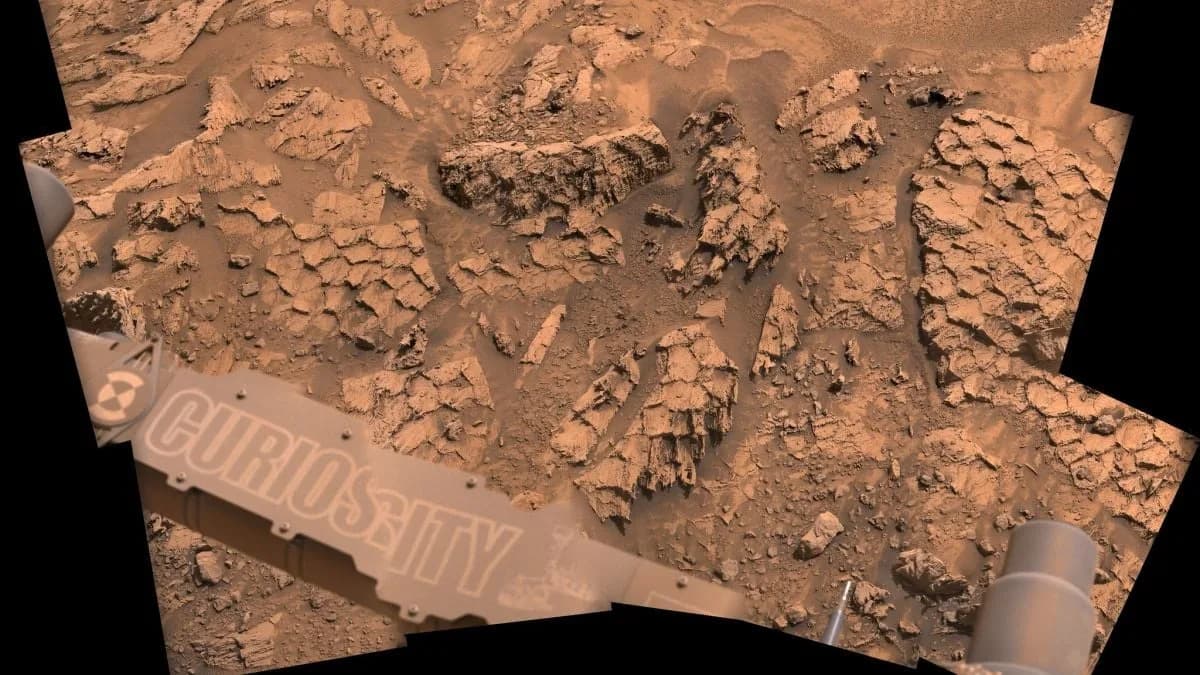
The dragonscale-like patterning on the surface of Mars. (NASA/JPL-Caltech/MSSS/Kevin M. Gill)
The Curiosity rover has photographed an unusually extensive, honeycomb-like pattern of polygons in rocks near the Antofagasta crater on Mars. The textured terrain—resembling reptile scales or a fossilized honeycomb—was imaged on Sol 4865 (13 April 2026) and has attracted keen interest from mission scientists.
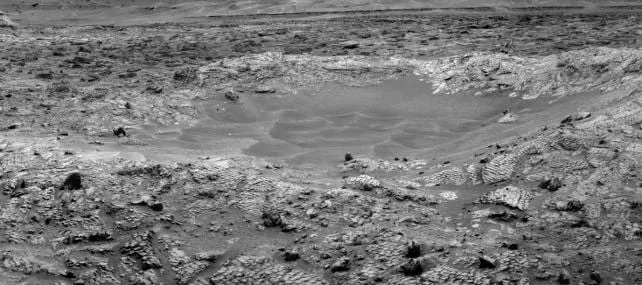
A view cropped from a wider panorama of Antofagasta crater, showing the patterning in the foreground. (NASA/JPL-Caltech/Kevin M. Gill)
What Was Observed
Project scientist Abigail Fraeman of NASA's Jet Propulsion Laboratory described the feature as "honeycomb-shaped polygons," noting that the tessellations appear in the thousands and extend for meters across Mastcam mosaics. The pattern includes raised ridges along many polygon boundaries, which stand out in relief in the photos.
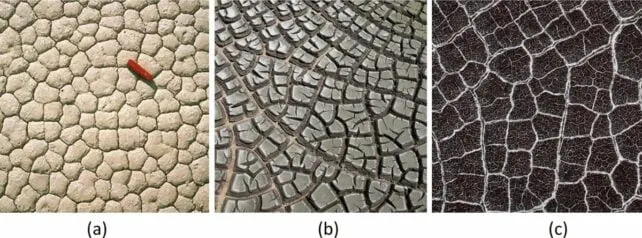
Polygonal ground patterns: (a) and (b) desiccation crack patterns in mud, (c) polygonal patterned ground on Mars. (Bálint et al.,J. Stat. Phys., 2023)
"We've seen polygon-patterned rocks like these before, but they didn't seem quite this dramatically abundant, stretching across the ground for meters and meters in our Mastcam mosaics." — Abigail Fraeman, JPL
How Such Patterns Form
On Earth, polygonal crack networks commonly form when wet sediment repeatedly dries or when frozen ground experiences repeated freeze–thaw cycles. Single drying events tend to produce T-shaped intersections; repeated wetting and drying matures those intersections into Y-shaped junctions and ultimately into regular hexagonal patterns.

Subscribe to ScienceAlert's free fact-checked newsletter
Polygons are rarer on Mars because the planet lost stable surface liquid water long ago, but Curiosity previously reported desiccation-like cracks in Gale Crater. A 2023 Curiosity discovery at a site called Pontours revealed very regular hexagons interpreted as the product of many wet–dry cycles, with salts preserved that point to evaporating brines.
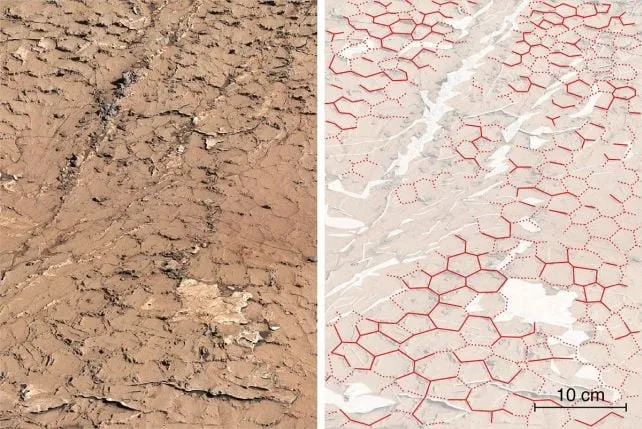
The polygonal patterning at Pontours. (Rapin et al.,Nature, 2023)
How Antofagasta Compares
Antofagasta's patterning is similar in overall geometry to Pontours but appears more extensive and features raised ridges along polygon boundaries. Such ridges on Mars can form when minerals precipitate within ancient cracks and later resist erosion better than surrounding rock, leaving the seams standing proud.
Because the images are recent, mission scientists will analyze the imaging and chemical data Curiosity collected at the site to test whether Antofagasta formed through repeated wet–dry cycling, brine evaporation, freeze–thaw activity, or another process. Determining the minerals present—particularly salts or cementing phases—will be a critical clue.
Why It Matters
If Antofagasta records cyclical wetting and drying like Pontours, it would add to growing evidence that Mars' watery past was more dynamic and seasonally variable than its present dusty appearance suggests. That, in turn, informs our understanding of the planet's past climate and its potential habitability.
Help us improve.