Researchers in Current Biology report that Bruce, a male Kea missing the upper half of his beak, has adapted a stabbing "jousting" attack with his exposed lower mandible. The tactic deters rivals, allowing him to monopolize food and preferred perches and correlates with the lowest male stress-hormone levels in his group. Scientists praise Kea creativity but note that prostheses or other welfare interventions could still benefit Bruce.
How Bruce the Kea Turned a Broken Beak Into a Social Weapon
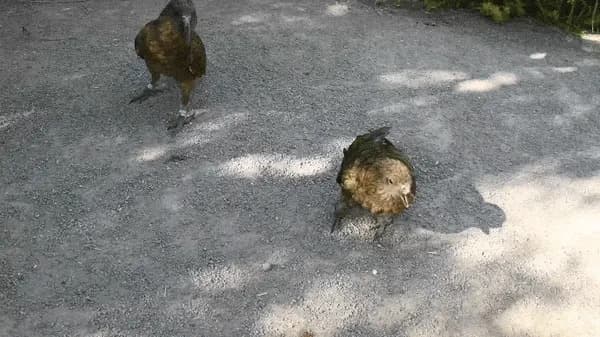
Bruce and another Kea "joust."Sign up for Today in Science, a free daily newsletter from Scientific American and join a community of science-loving readers.Ximena Nelson
New research published in Current Biology describes how Bruce, a male Kea at Willowbank Wildlife Reserve on New Zealand’s South Island, used a childhood injury to develop a novel social strategy. Missing the curved upper half of his beak, Bruce exposes the sharp lower mandible and performs a repeated, forward-thrusting attack researchers call a "joust."
Observers and video evidence show Bruce crouching, running, and launching himself at other birds, aiming his lower beak at wings, legs and occasionally faces. Targets typically "spring away" to avoid contact, which gives Bruce space to roam the aviary and monopolize prime feeding stations and perches while other males remain occupied with displays and fights.
Social Advantage and Low Stress
The study’s authors found the group—described as a "circus"—is unusually deferential toward Bruce. Other males have been seen grooming him (a behavior usually reserved for mates), and analysis of his droppings indicates he has the lowest measured stress-hormone levels among the males in his group. Rather than acting like a classic bully, Bruce’s dominance is described as more aloof: he gains priority access by being a credible threat.
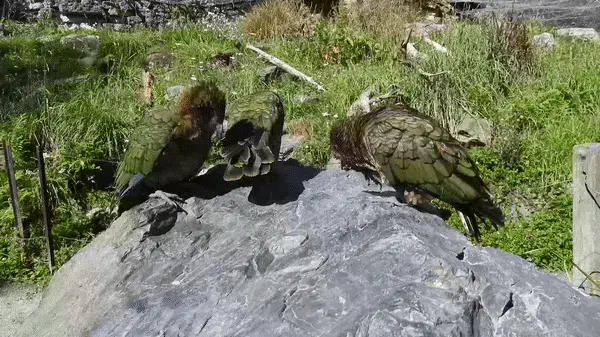
Bruce runs toward a subordinate male, who leaps out of the way.Alex Grabham
Kea Intelligence and Innovation
Co-author Ximena Nelson, a professor of animal behavior at the University of Canterbury, says Bruce’s case highlights Kea ingenuity. These mountain parrots are famous for playful, curious behavior—making snowballs, sliding on their backs, damaging tourist property and even using tools. Bruce himself was observed in 2021 using a pebble to help preen—a practical workaround for tasks made harder by his missing upper mandible.
Welfare and Intervention
Raoul Schwing, who first discovered Bruce as an undersized fledgling more than a decade ago, notes that social success does not eliminate welfare concerns. He and other researchers suggest that interventions—such as prosthetic devices—could still improve Bruce’s day-to-day life, helping with feeding or grooming even if they might alter his established social role.
"Because of his disability, he has had to innovate behaviors. He’s found a way to make himself more dangerous," says Nelson, summarizing how loss created new behavioral opportunities rather than just disadvantages.
Why It Matters
Bruce’s story adds to growing evidence that animals can turn physical impairments into behavioral advantages by innovating. For scientists, it’s a vivid example of how individual variation, intelligence and social dynamics interact—raising questions about animal welfare, rehabilitation options and the broader links between disability and adaptive behavior in the wild.
Help us improve.