Researchers from Université Libre de Bruxelles and Khalifa University demonstrated that tiny graphene aerogel samples can generate rapid, laser-driven thrust when tested under microgravity during ESA's May 2025 parabolic flights. In vacuum and near-weightless conditions, 10×10×5 mm aerogel coupons hit by a 532 nm, 5 W laser produced main acceleration pulses on the order of 30 ms, with peak thrusts near 600 μN and velocities up to ~1.7 m/s. The effect is attributed to gas-mediated thermal forces (Knudsen pumping) and photophoresis rather than photon pressure alone, and could enable propellant-free attitude control and solar-sail assistance for small satellites.
Laser-Powered Graphene Aerogels Produce Millisecond Thrust in Microgravity — A Propellant-Free Option for Small Satellites
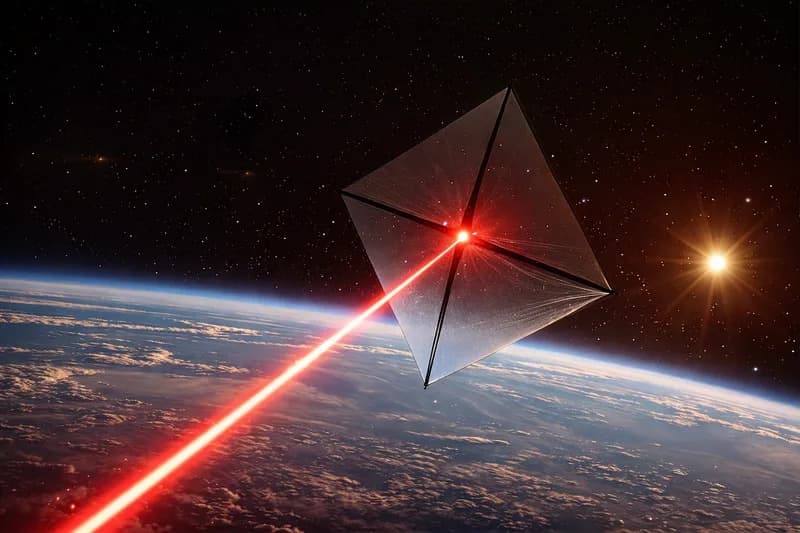
Graphene aerogels shot forward under laser light in microgravity, hinting at fuel-free propulsion for future spacecraft. (CREDIT: AI-generated image / The Brighter Side of News)
A small black cube jolted forward the instant a laser struck it — a split-second motion captured during a parabolic flight that points to a promising new propulsion concept for space. Researchers tested ultralight graphene aerogels and found they can convert focused light into measurable motion with surprising force when gravity is effectively removed. The primary acceleration pulse concluded in roughly 30 milliseconds.

Inside a vacuum chamber, a continuous laser fired at three tiny graphene aerogel cubes, while a high-speed camera captured every moment through glass tubes. (CREDIT: ESA)
Experiment Overview
The experiment, led by teams at Université Libre de Bruxelles and Khalifa University and published in Advanced Science, was performed during ESA's 86th parabolic flight campaign in May 2025. Tiny graphene aerogel coupons (10×10×5 mm) sat inside tapered glass tubes in a vacuum chamber held below about 10⁻´ mbar. A continuous 532 nm, 5 W laser illuminated the samples from below while a high-speed camera recorded motion at 400 frames per second and a triaxial accelerometer confirmed the microgravity window.
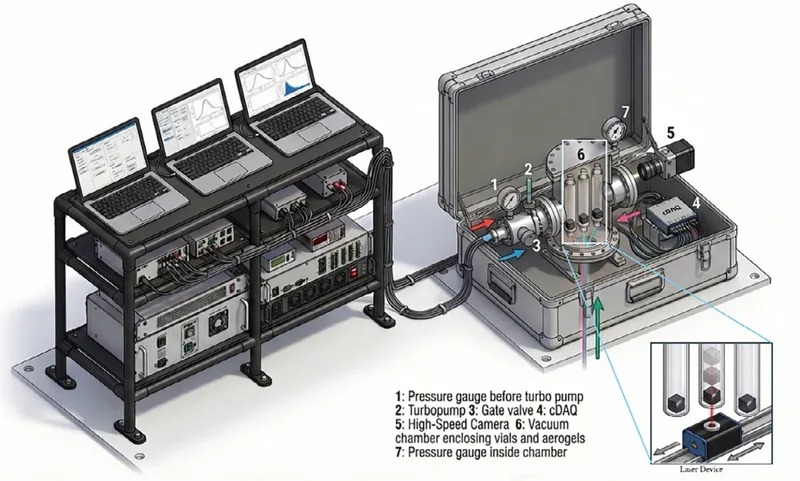
Graphene and lasers experiment setup. (CREDIT: ESA)
Key Observations
- Under microgravity, samples reached displacements near 0.05 m by ~0.05 s, peak velocities around 1.7 m/s, and peak thrusts close to 600 μN within 0.02–0.03 s.
- At 1 g, responses were much smaller: displacement ~0.015 m, peak velocity ~0.06 m/s, and peak thrust ~11 μN, with peak times delayed to ~0.12–0.16 s.
- Three densities were tested (AG-10, AG-15, AG-20). AG-20 tended to give the largest displacement and velocity, while the intermediate AG-15 produced the highest peak thrust and acceleration (about 102 m/s² in microgravity at the highest laser power).
- Varying laser power produced predictable tuning: stronger illumination produced larger displacement, faster motion, and higher thrust pulses, with no clear saturation at the highest tested power (~99% of maximum).
The reaction was fast and furious. Before you could even begin to blink, the graphene aerogels experienced large accelerations. It was all over in 30 milliseconds.
— Marco Braibanti, ESA project scientist
Proposed Mechanism
The authors argue the observed motion cannot be explained by photon pressure alone. Instead, the thrust appears to arise from gas-mediated thermal forces and photophoretic effects. Laser illumination heats the front of the porous aerogel far more quickly than its interior and rear, creating transient temperature gradients. Those gradients can drive gas flow through the porous network (Knudsen pumping) and produce asymmetric surface forces (photophoresis), generating a net thrust. In microgravity, with weight and contact friction largely absent, these forces can move the samples freely; on the ground they are largely masked by gravity and normal-force friction.
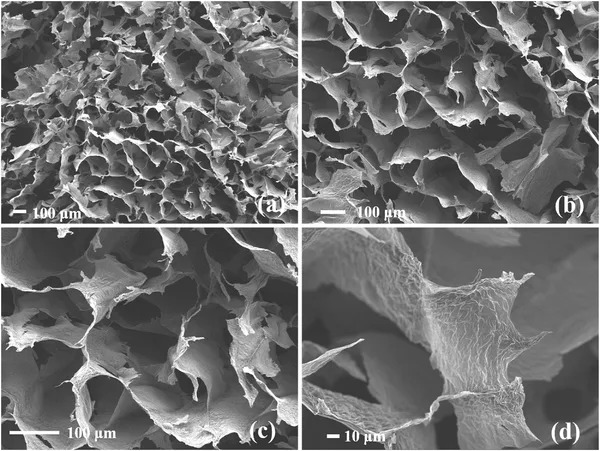
Graphene aerogels up close. (CREDIT: ESA)
Limitations and Caveats
- Tests were run at nearly fixed chamber pressure, so the role of ambient pressure was not fully explored.
- Thrust estimates focus on the first 10–30 ms after the laser pulse, before contact with tube walls could affect measurements.
- Data showed shot-to-shot variability and occasional incomplete captures (one AG-20 run at 90% power missed the camera window), indicating the technique is still experimental and sensitive to sample orientation and tracking alignment.
Applications and Next Steps
Despite limitations, the results suggest potential near-term uses for light-responsive graphene structures, particularly for small satellites. Possible applications include propellant-free attitude control, fine adjustments for solar sails, and other precision maneuvers where predictable, tunable microthrust is valuable. The findings also emphasize that material architecture and pore structure matter as much as bulk density: intermediate designs may outperform extremes.
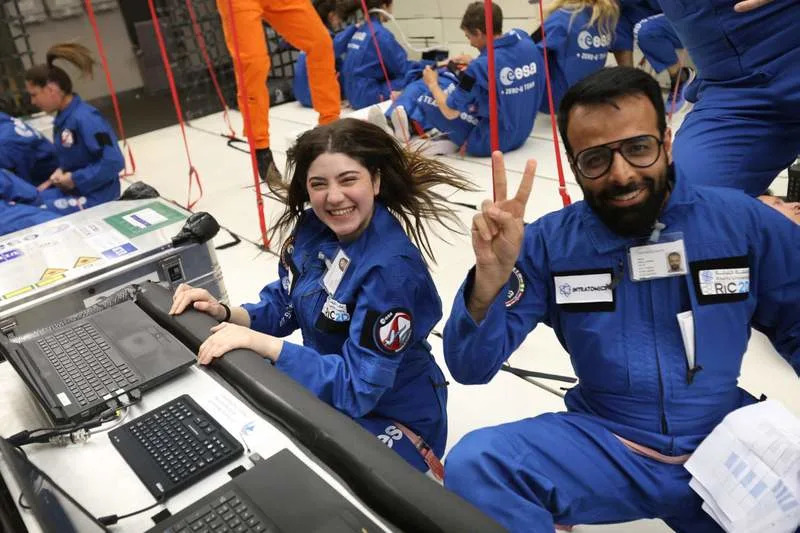
Graphene experiment on parabolic flight. (CREDIT: ESA)
The research is published online in Advanced Science. ESA researchers describe this work as an early but important step toward propellant-free micropropulsion systems that could save mass and complexity on future spacecraft.
Help us improve.