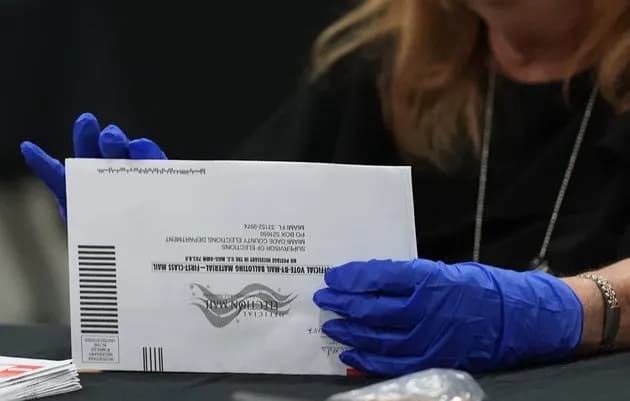
The Supreme Court refused an emergency request to restore Samuel Ronan to the Ohio GOP primary ballot, issuing an unsigned order without explanation. Ronan, a former DNC candidate, had been certified by Franklin County but was removed after a protest and a tie-breaking decision by Secretary of State Frank LaRose. Federal courts upheld the removal, and Ronan’s backers argued the action violated his First Amendment rights and could chill political speech.
Supreme Court Denies Emergency Bid To Reinstall Ohio GOP Candidate Removed As A Democrat
UNITED STATES - MARCH 18: U.S. Supreme Court building on Wednesday, March 18, 2026. (Bill Clark/CQ-Roll Call, Inc via Getty Images)(Bill Clark / CQ-Roll Call, Inc via Getty Images)
The U.S. Supreme Court on Thursday declined an emergency request to restore Samuel Ronan to the Republican primary ballot in Ohio’s 15th Congressional District, issuing an unsigned shadow-docket order without comment or a recorded dissent.
Background
Ronan, who previously ran unsuccessfully for chair of the Democratic National Committee, filed to run as a Republican and signed an affidavit swearing that he was a member of the GOP and intended to support its principles. Franklin County’s Board of Elections certified his candidacy in February.
After a Republican voter protested, asserting Ronan was not a genuine Republican, the county board deadlocked along party lines. Ohio Secretary of State Frank LaRose, a Republican, broke the tie and removed Ronan from the ballot.
Court Battles
U.S. District Judge Sarah Morrison, a Trump appointee, denied Ronan’s federal challenge. Judge Morrison wrote that the state’s interest in administering elections outweighed what she described as a minimal burden on Ronan’s First Amendment rights:
"It cannot be the case that a State must allow a candidate on a partisan ballot even if he lied about his party affiliation simply because the First Amendment is implicated."
A three-judge federal appellate panel declined to order Ronan placed back on the ballot. Ronan and supporter Ana Cordero then asked the Supreme Court for emergency relief, arguing the removal was a First Amendment violation and warned that upholding it could chill political speech.
The Republican-led Ohio Attorney General’s Office opposed the request, bluntly stating the core objection: "There was just one problem: he is a Democrat." Ronan’s supporters maintain he did not lie about his party status and contend the removal was based on political speech and affiliation rather than objective qualification rules.
What This Means
The high court’s unsigned denial leaves the state-court and federal-court rulings intact, keeping Ronan off the GOP primary ballot for now. The case underscores tensions between state election administration, party primaries, and First Amendment protections — and highlights how quickly such disputes can travel to the Supreme Court’s shadow docket without public explanation.
Help us improve.