The mummified fossil of Captorhinus aguti from Richards Spur, Oklahoma, preserves the oldest direct evidence of rib-driven (costal) breathing, dating to about 289 million years ago. Neutron computed tomography revealed an "accordion-textured" skin, a segmented cartilage breastbone, and multiple rib layers anchored to the shoulder, enabling reconstruction of an early amniote's full breathing apparatus. The anatomy shows a shift from throat-driven buccal pumping to more efficient rib-powered aspiration, a change that likely helped vertebrates exploit terrestrial environments. The specimens are curated at the Royal Ontario Museum and the study was published in Nature on April 8.
289-Million-Year-Old 'Mummy' Fossil Reveals Earliest Rib-Powered Breathing
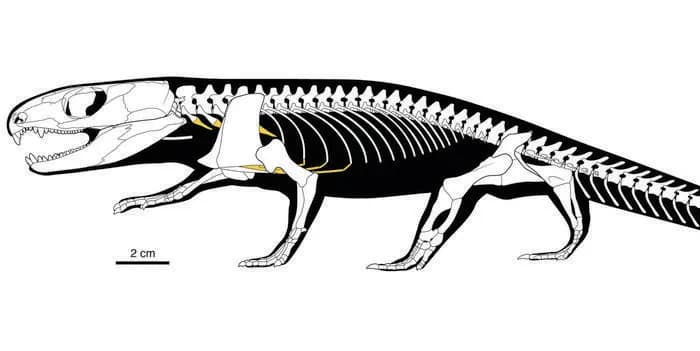
Illustrated whole body skeletal diagram in left side view depicting the cartilaginous components in yellow that are described for the first time in this study.Credit: Reisz et al.
Take a deep breath. That familiar rise and fall of your chest traces back nearly 300 million years — and a newly described, mummified fossil offers the earliest direct evidence of the rib-powered breathing system used by reptiles, birds and mammals today.
The specimen, a small lizard-like amniote called Captorhinus aguti, was entombed in a cave at Richards Spur, Oklahoma, during the early Permian (about 289 million years ago). A rare combination of oxygen-poor mud and ancient oil seeps preserved the animal in three dimensions, protecting delicate soft tissues such as skin and cartilage that normally vanish over geological time.
High-Tech Imaging Reveals an Ancient Respiratory Engine
Researchers applied advanced neutron computed tomography (nCT) to peer non-invasively inside the specimen. The scans showed an "accordion-textured" layer of skin around the torso and a remarkably complete chest assembly: a segmented cartilage breastbone and multiple layers of ribs anchored directly to the shoulder girdle. Combined with two additional Captorhinus specimens, these data allowed reconstruction of the earliest comprehensive breathing apparatus known for an early amniote.
This anatomy documents the oldest known example of costal (rib-driven) aspiration — the mechanism by which amniotes draw air into their lungs by expanding the ribcage. Before this transition, many early tetrapods used throat-driven buccal pumping, a less efficient method that limited sustained activity and life away from water.
"Captorhinus is an interesting lizard-looking critter that is critical to understanding early amniote evolution," said Ethan Mooney, a co-leader of the study and a PhD candidate at Harvard University.
By pulling ribs outward with specialized muscles to create negative pressure, Captorhinus could inhale more deeply and efficiently — a physiological upgrade that likely supported higher energy output for running, hunting and exploiting terrestrial habitats.
Organic molecules recovered from the mummified tissues are nearly 100 million years older than the previous record for preserved biomolecules, extending the molecular record far deeper into the Permian. The fossils are curated at the Royal Ontario Museum in Toronto and remain available to the international scientific community for further study.
"We propose that the system found in Captorhinus represents the ancestral condition for the kind of rib-assisted respiration present in living reptiles, birds, and mammals," said Professor Robert R. Reisz of the University of Toronto.
The team's findings were published in Nature on April 8. Although Captorhinus was only a few inches long, its preserved chest anatomy offers a crucial glimpse into the evolutionary origins of the breathing system that powers most terrestrial vertebrates today.
Help us improve.