Technion researchers used ultrafast, sub-wavelength microscopy to observe optical phase singularities — zero-amplitude "dark" vortices — moving at apparent superluminal speeds inside slowed polariton waves in hexagonal boron nitride. Because these singularities are absences in the field rather than carriers of information, the effect does not violate relativity. The work, published in Nature, validates a decades-old theoretical distinction between particle speed limits and wave-structure motion and suggests new directions for imaging and photonic technologies.
Dark Vortices That Appear To Move Faster Than Light — Relativity Intact
Image: Deposit Photos
Researchers at Technion have observed a striking wave phenomenon: tiny optical phase singularities — zero-amplitude “dark” vortices inside a light field — that can move at apparent superluminal speeds in a slowed polariton medium, while remaining fully consistent with Einstein’s relativity.
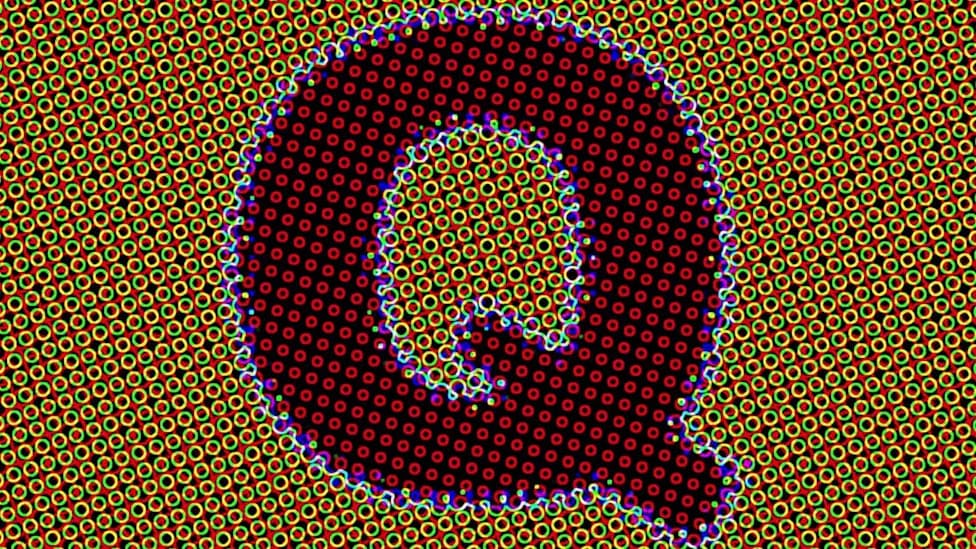
What they studied: The team generated and imaged polaritons (hybrid light–matter excitations) confined in a thin flake of hexagonal boron nitride, a medium where the effective propagation speed of light is reduced by roughly 100×. In that slow-wave environment, ultrafast, sub-wavelength microscopy tracked the creation, motion, and annihilation of phase singularities in real time.
How A 'Dark' Point Can Look Faster Than Light
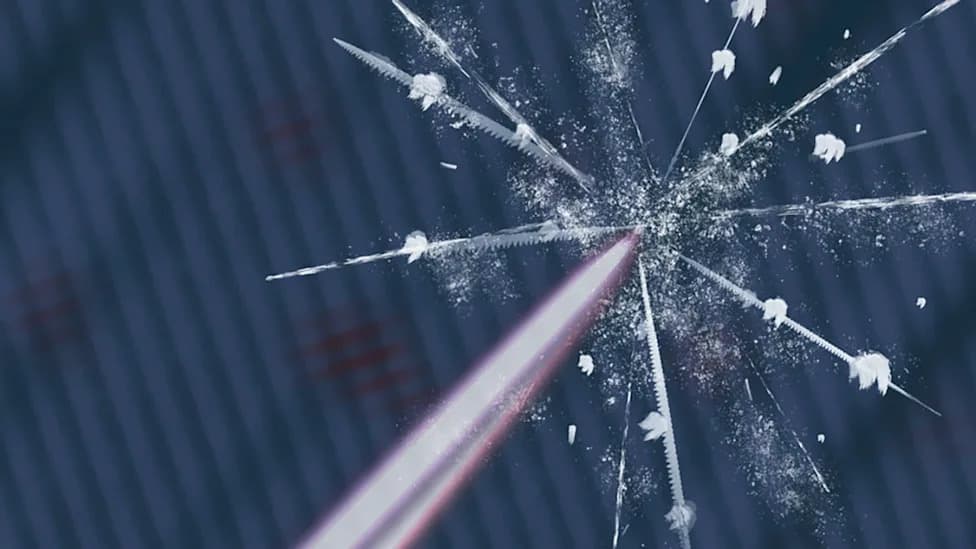
Phase singularities are locations in a wave field where amplitude drops to zero and the wave phase becomes undefined. Because they are features of the wave pattern — not particles or packets carrying energy or information — their apparent motion is not constrained by the speed limit that applies to massive objects or to energy transfer. During pair-creation and annihilation events the dark vortices can accelerate to arbitrarily large apparent speeds, an effect analogous to a shadow sweeping across a distant surface faster than the object that casts it.
“Our discovery reveals universal laws of nature shared by all types of waves… enabling study of hidden processes in physics, chemistry, and biology.” — Ido Kaminer, lead researcher
Why This Doesn’t Break Relativity
The observed superluminal motion is an example of phase-structure dynamics: phase velocity or the apparent motion of pattern features can exceed c without transmitting usable information, energy, or matter. The Technion team emphasizes that these dark points are absences in the field, not particles moving through space, so no causal paradoxes arise.
Methods And Reliability
The experiment, published in Nature, used advanced ultrafast microscopy with sub-wavelength spatial resolution to resolve the field dynamics directly. The researchers note this result contrasts with earlier false alarms — such as the 2011 OPERA neutrino anomaly later traced to instrumentation error — thanks to modern imaging rigor and careful controls.
Potential Applications
Beyond fundamental insight, the imaging and control techniques demonstrated here could inspire new technologies: higher-resolution, faster medical imaging; finer light control for AR and display systems; compact polariton-based lasers; and enhanced quantum or nanoscale sensors that exploit wave-structure dynamics. These are prospective directions rather than immediate products.
Bottom line: The experiment confirms a long-standing theoretical distinction between particle speed limits and the behavior of massless wave features. It opens a window onto exotic wave dynamics without overturning the core principles of relativity.
Help us improve.