Researchers using ultra-high-field 7T fMRI found that time perception is not generated by a single neural clock but is constructed in stages across cortex. Early visual areas encoded physical duration with monotonic responses, parietal and premotor regions represented specific durations, and frontal cortex and anterior insula reflected each person’s categorical boundary (PSE). The authors propose three stages—encoding, readout and categorization—while noting limits such as the study’s focus on cortex, vision and a single duration range.
How the Brain Assembles Time: New 7T fMRI Study Reveals Three Cortical Stages
New study reveals three distinct stages of visual time perception in the cortex, from sensory encoding to subjective experience. (CREDIT: AI-generated image / The Brighter Side of News)
A tennis return can look effortless, but the brain's timing behind that split-second action is complex. New research published in PLOS Biology suggests that the perception of duration is not produced by a single internal clock; instead, it is built in stages across multiple cortical regions, beginning in visual cortex and progressing through parietal, premotor and frontal areas until it becomes a subjective judgment.
What the Researchers Did
Led by Valeria Centanino, Gianfranco Fortunato and Domenica Bueti at Scuola Internazionale Superiore di Studi Avanzati, the team scanned 13 healthy volunteers using ultra-high-field 7T functional MRI. Participants viewed a circular visual stimulus that lasted between 0.2 and 0.8 seconds and judged whether each interval was shorter or longer than a learned 0.5-second reference. This design allowed the authors to examine not only which regions were active, but how different cortical areas were tuned to specific durations.
Novak Djokovic at Qatar Open. (CREDIT: Hanson K Joseph / Wikimedia / CC BY-SA 4.0)
Three Processing Stages
Duration Encoding (Visual Cortex): In early occipital visual areas, neural responses scaled monotonically with stimulus length—longer stimuli produced stronger activity—consistent with an initial, sensory-based encoding of physical duration.
Duration Readout (Parietal and Premotor Regions): Further along the cortical hierarchy, parietal and premotor regions showed selective responses to particular durations rather than simple ramping. The authors interpret this as a readout stage where incoming timing signals are transformed into distinct duration representations.
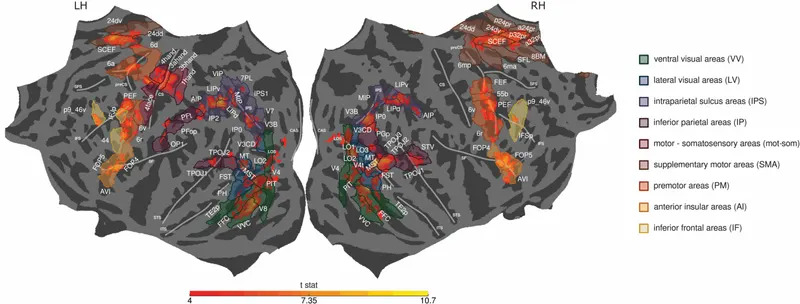
Regions of interest (ROIs) are displayed on a common (fsaverage) flattened cortical surface, overlaid on group-level t-value clusters obtained from a GLM analysis that identified cortical locations significantly activated at the offset of the 6 presented durations. (CREDIT: PLOS Biology)
Duration Categorization (Frontal Cortex and Anterior Insula): Higher-order regions tended to cluster activity near the center of the tested range. Several frontal and insular areas tracked each participant's point of subjective equality (PSE)—the internal boundary at which a person is equally likely to label an interval "shorter" or "longer" than the reference—suggesting these areas contribute to subjective categorization rather than pure physical encoding.
Spatial Organization and Notable Findings
The study also found variable spatial organization of timing signals across cortex. Some regions showed orderly maps in which neighboring populations preferred similar durations; other areas were less organized. The supplementary motor area (SMA) was noteworthy: caudal SMA represented the full tested range, while rostral SMA favored more categorical, mid-range representations—hinting at a division between perceptual and action-related timing roles.
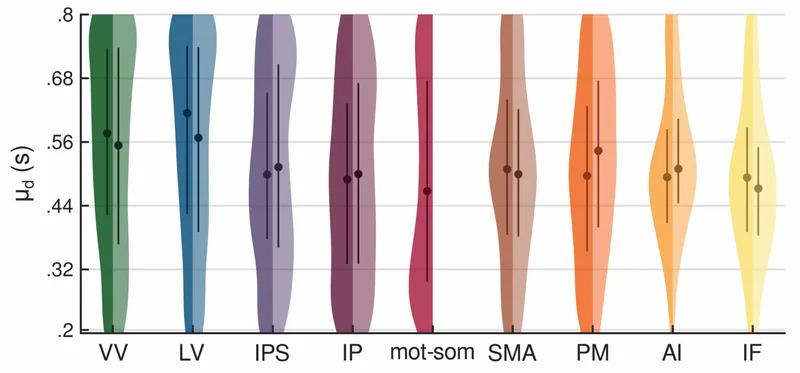
Each violin plot shows the vertex-wise distribution of duration preferences at group level across streams. (CREDIT: PLOS Biology)
Limitations
The authors acknowledge important limitations: the sample size was modest (13 participants); the study examined only cortical regions, excluding the cerebellum and other subcortical structures known to support timing; it focused solely on visual stimuli, so applicability to auditory or multisensory timing is untested; and it used a single stimulus range (0.2–0.8 s), leaving open how flexible the observed boundary signals are across different ranges or contexts.
Why This Matters
By mapping where physical duration signals become subjective judgments, this work provides a mechanistic framework for how the brain constructs time from sensory input to actionable perception. The staged model—encoding, readout, categorization—helps explain how timing can serve multiple functions at once, from rapid perceptual judgments to motor planning, and may inform future studies of disorders in which time perception is altered.
“Our results show that time perception is not a unitary process, but the outcome of multiple processing stages distributed across the cerebral cortex,” the authors write, noting that each stage contributes differently—from encoding physical duration to constructing subjective experience.
The full findings are available online in PLOS Biology.
Help us improve.