Earth is constantly struck by cosmic rays—particles originating from the Sun, the Milky Way, and distant galaxies. In 1991 the Fly’s Eye detector recorded the "Oh-My-God" particle with about 320 quintillion eV (≈51 J), far beyond human-made accelerators. Likely accelerated by shocks and jets around supermassive black holes via first-order Fermi acceleration, such ultrahigh-energy protons should be limited by interactions with the cosmic microwave background (the GZK cutoff), so some events are probably heavier nuclei or come from relatively nearby sources. These rare events reveal extreme astrophysical engines and probe early-universe physics.
Where Did the “Oh-My-God” Particle Come From? The Mystery of a 320-Quintillion-eV Cosmic Ray

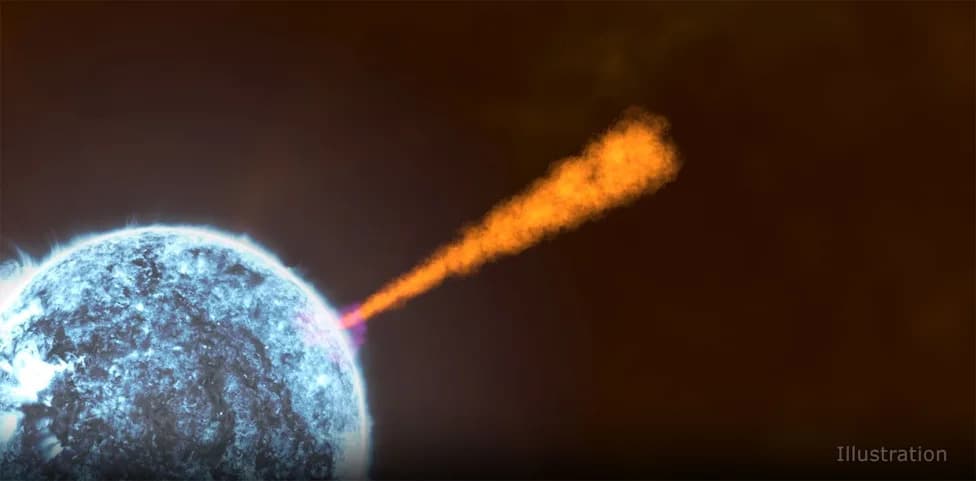
Our planet is continually bombarded by radiation from space. That term covers familiar light as well as streams of high-energy subatomic particles known as cosmic rays. Some originate in the Sun, others elsewhere in the Milky Way, and a subset—extragalactic cosmic rays—trace back across enormous distances to other galaxies.
What Was Detected?
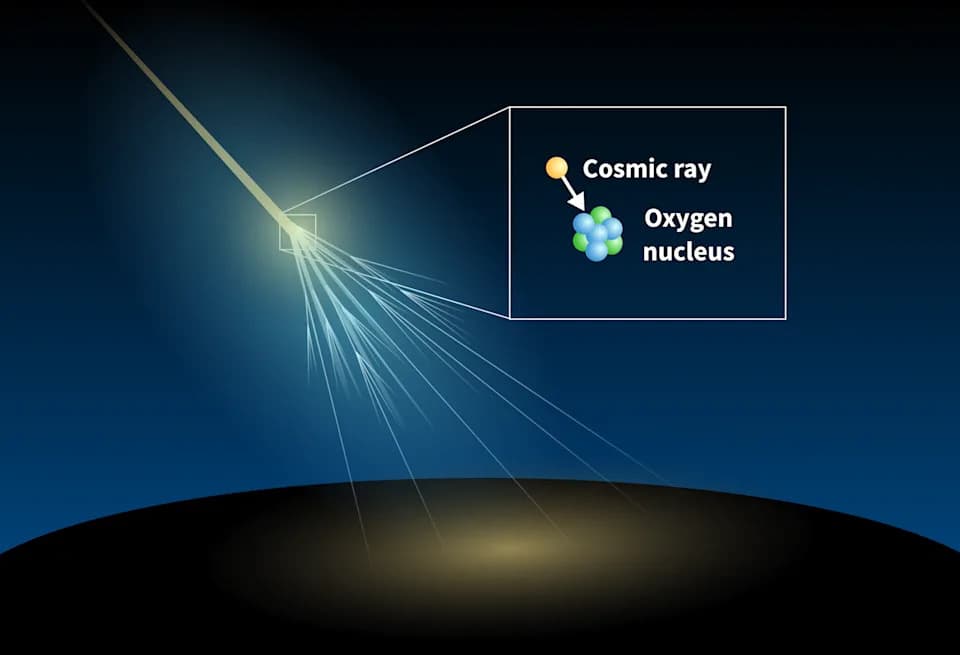
In 1991 the Fly’s Eye observatory recorded an atmospheric shower so intense that it pointed to a single incoming particle with an energy of about 320 quintillion electron volts (3.2×10²⁰ eV)—roughly 51 joules, comparable to the kinetic energy of a slow baseball pitch. That single-particle event earned the unforgettable nickname the “Oh-My-God” (OMG) particle.
How Fast Was It Going?
If the OMG particle was a proton, it must have traveled at an almost inconceivable fraction of light speed—within about one part in 1023 of c—meaning that, had it raced a photon since the Big Bang, it would now lag by only hundreds of meters.
How Could a Particle Reach Such Energies?
The leading acceleration mechanism invoked by astrophysicists involves shock fronts and powerful jets around extreme objects such as supermassive black holes. Rapidly moving ionized gas drags intense magnetic fields, and charged particles gain energy as they scatter across shocks in a process called first-order Fermi acceleration. Repeated crossings can accelerate particles to ultrahigh energies—analogous to repeatedly flinging a stone from a trebuchet.
Because the Milky Way contains no obvious sources capable of producing the most extreme events, researchers suspect many ultrahigh-energy cosmic rays, including the OMG particle, are extragalactic. For example, a later event nicknamed Amaterasu (≈244 quintillion eV) appears to align with the active galaxy PKS 1717+177, which hosts powerful jets.
The Cosmic Microwave Background and the GZK Cutoff
Another piece of the puzzle is the cosmic microwave background (CMB)—the low-energy relic radiation from the Big Bang. A particle moving near light speed sees CMB photons Doppler-boosted to much higher energies; collisions with those photons should drain energy from ultrarelativistic protons. Above an energy threshold of order 5×10¹⁹ eV (roughly 50 quintillion eV), proton–CMB interactions can produce pions and neutrons, preventing protons from traveling cosmological distances without losing energy. This theoretical limit is known as the GZK cutoff.
So How Did the OMG Particle Reach Earth?
One plausible resolution is that the detected primary was not a lone proton but a heavier nucleus. Cosmic rays include helium nuclei and heavier elements such as iron; heavier nuclei interact differently with the CMB and intergalactic fields, which can allow them to reach Earth from greater distances. Other possibilities include a relatively nearby extragalactic source, statistical rarity, or exotic physics—but current evidence favors conventional astrophysical accelerators and composition explanations.
Why This Matters
Ultrahigh-energy cosmic rays are rare but powerful messengers. They demonstrate the existence of natural particle accelerators far beyond human capability and offer a probe of extreme astrophysical engines and conditions akin to those in the early universe. Every detection helps constrain where and how nature achieves these stupendous energies.
The OMG particle remains a striking reminder that the cosmos can still surprise us—and that tiny travelers from distant realms can carry outsized lessons about the universe.
Help us improve.