New research suggests the single-celled ciliate Stentor coeruleus can form Pavlovian-like associations. In petri-dish experiments, a weak mechanical tap paired 1 second before a strong tap caused Stentor to contract to the weak tap alone, while weak→weak controls did not. The authors propose a cellular, non-synaptic mechanism—possibly involving calcium-permeable touch receptors—and note the results come from a bioRxiv preprint that needs peer review and replication.
Single-Cell Pavlov? Stentor coeruleus Shows Evidence of Associative Learning
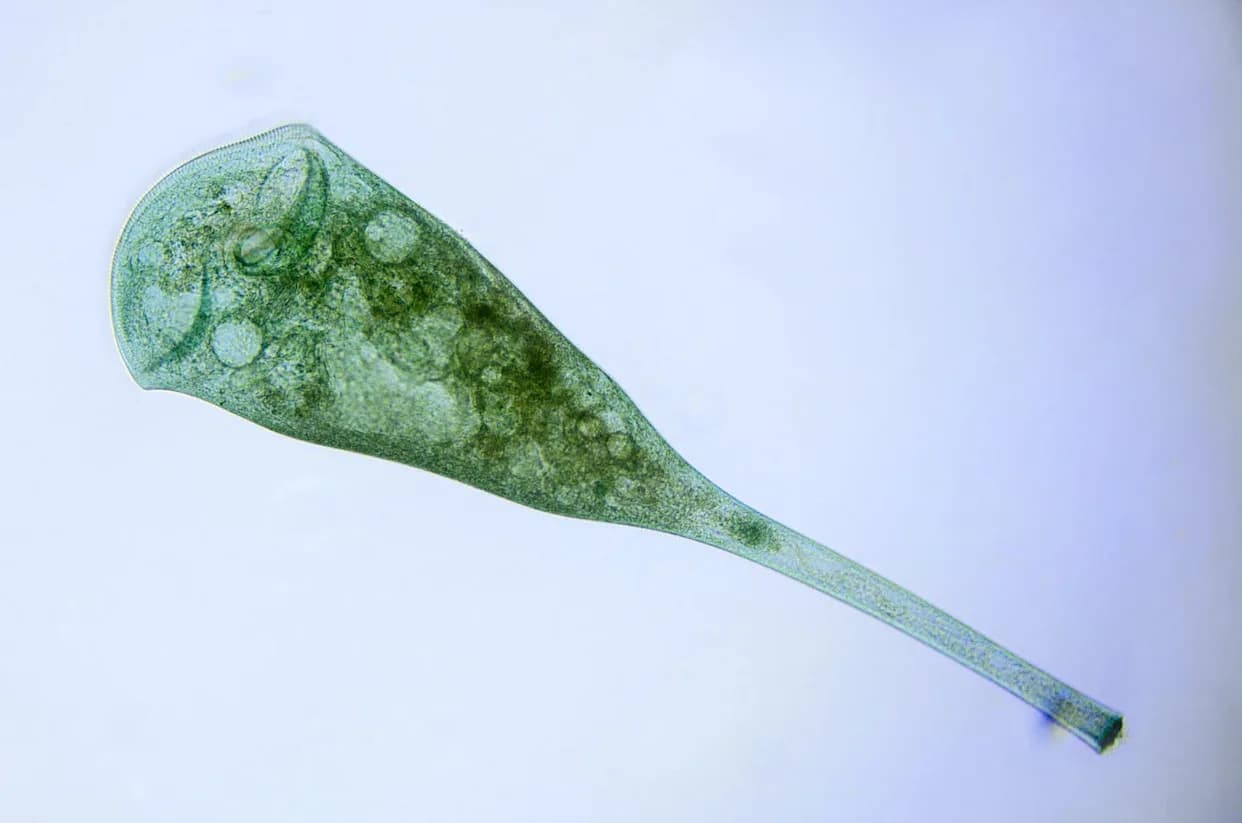
Experts Say These Single-Cell Creatures Can LearnNNehring - Getty Images
Researchers report that the trumpet-shaped single-celled ciliate Stentor coeruleus can form stimulus–stimulus associations, a behavior resembling Pavlovian (associative) learning. The finding, reported in a bioRxiv preprint and highlighted by New Scientist, challenges the idea that associative learning requires a nervous system built from synapses.
Background
Single-celled organisms are often seen as simple, but many protists display surprisingly complex behaviors such as chemotaxis and habituation. Associative learning—linking one stimulus to another so that one predicts the other—has long been considered a higher-level capability tied to nervous systems. The new study tested whether a large, solitary ciliate could learn that a mild mechanical disturbance predicts a stronger one.
Experimental Design
Researchers placed Stentor coeruleus specimens on petri dishes and applied mechanical taps. First, they delivered 60 strong taps spaced roughly 45 seconds apart (about the time the organisms need to re-extend) and observed habituation: contractions declined with repeated stimulation. Then they compared two conditioning regimens: a weak tap followed 1 second later by a strong tap (weak→strong), and a weak tap followed 1 second later by another weak tap (weak→weak) as a control.
Key Findings
Individuals exposed to the weak→strong pairing began to contract in response to the weak tap alone, as if the weak stimulus had become a predictor of the imminent strong disturbance. That anticipatory response gradually faded with further trials, a form the authors call "predictive habituation." The weak→weak control group did not show the enhanced response to the first weak tap, suggesting the effect was not mere sensitization or repetition.
Proposed Mechanism and Caveats
The authors propose a non-synaptic cellular mechanism. Co-author Sam Gershman told New Scientist that touch-sensitive receptors in S. coeruleus admit calcium ions into the cell; changes in receptor activity or downstream signaling could act like a cellular switch that records temporal associations. Because the paper is a preprint, the result awaits peer review and independent replication; the study’s methods and sample sizes should be evaluated by the community before strong conclusions are drawn.
Implication: If confirmed, associative learning mechanisms may have evolved before multicellular nervous systems, pushing the evolutionary origin of associative processes back into single-cell life.
Overall, the study invites a rethink of how much information single cells can encode and how early in evolution the capacity for association-based behavior emerged.
Help us improve.