Italian authorities say the Russian tanker Arctic Metagaz, damaged in a March 3 attack, is drifting unmanned toward Libya after its 30 crew abandoned ship. Moscow blames Ukraine for the strike; Ukraine has not commented. Russia and Libya report differing cargo figures—about 700 tonnes of fuel versus roughly 62,000 tonnes of LNG—and officials say there is no confirmed fuel leak. The vessel is severely damaged, unstable and poses an explosion risk while salvage teams stand by in Malta.
Damaged Russian Tanker Arctic Metagaz Drifts Unmanned Toward Libya; Salvage Teams Stand By
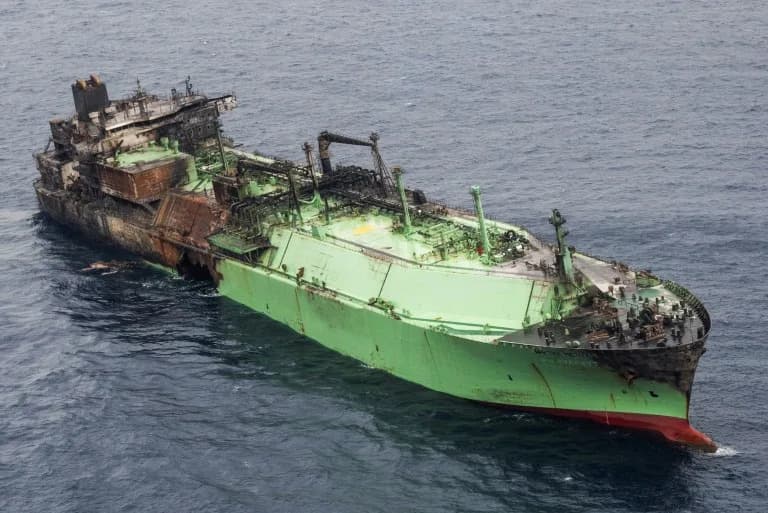
A series of explosions rocked the Arctic Metagaz on March 3 (Miguela XUEREB)(Miguela XUEREB/Newsbook Malta/AFP)
A Russian tanker badly damaged in a March 3 attack in the central Mediterranean is drifting unmanned toward the Libyan coast, Italy’s civil protection service said on Friday. The vessel, named Arctic Metagaz, was reportedly carrying liquefied natural gas (LNG) bound for Egypt when it was struck.
Moscow has accused Ukraine of attempting to blow up the ship. Ukraine has not commented on the allegation. Italian authorities said the tanker’s 30 crew members abandoned ship and that the vessel is now without personnel as it moves in the Mediterranean.
Officials said there are currently no confirmed signs of fuel leakage from the ship’s engines, but they could not confirm the status of the LNG cargo. Russian sources have said the vessel carried roughly 700 tonnes of fuel in addition to the gas consignment, while Libya’s port authority reported the tanker was carrying about 62,000 tonnes of LNG destined for Egypt.
"At this stage, we have no information that the fuel has started to disperse," Pierfrancesco Demilito, the civil protection service’s press chief, said at a news conference.
Demilito said the ship was in international waters but within Libya’s search-and-rescue zone, about 53 nautical miles north of Tripoli, and was heading south. He warned the cargo was "potentially dangerous" because of the risk of explosion and said towing the vessel would be complex because it is "severely damaged" and unstable.
The tanker has been flagged by U.S. and EU authorities as a suspected member of Russia’s so-called "shadow fleet" — vessels thought to be moving Russian oil and gas in violation of sanctions — and has faced corresponding sanctions. Salvage specialists have been positioned in Malta and Mediterranean countries are closely monitoring the ship’s course.
Photographs taken by AFP show the tanker farther north than the position cited by Italian officials and reveal extensive fire and blast damage. Observers reported blackened sections of the hull and at least two holes visible on each side.
Risks and next steps: Authorities continue to monitor for signs of pollution or structural collapse. Salvage teams are preparing for a complex operation to secure or tow the vessel, while regional governments weigh emergency response and environmental contingency plans.
Help us improve.