On September 2, Norway detained the Russian research vessel Professor Molchanov in Barentsburg, Svalbard, to enforce a $4.22 billion arbitration award won by Naftogaz in 2023. The arrest — filed August 28 and approved without notifying Russia — is the first time Ukraine’s lawfare targeted an actively used physical asset abroad. While proceeds from selling the aging ship would not satisfy the full award, the move symbolically demonstrates that state-linked Russian property in commercial service can be seized, with implications for shipping, insurance and geopolitical tensions in the Arctic.
How Ukraine’s Legal Campaign Enabled Norway To Seize A Russian Ship In Svalbard
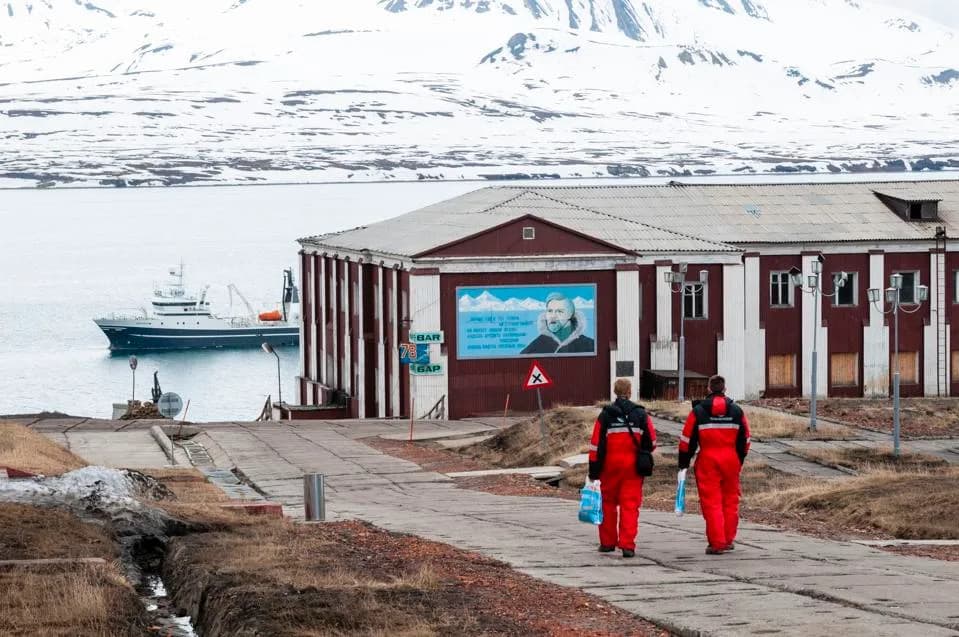
Men in arctic protective clothing walk toward an anchored ship. Barentsburg, Spitsbergen Island, Svalbard, Norway.. (Photo by: Sergio Pitamitz / VWPics/Universal Images Group via Getty Images)VW Pics/Universal Images Group via Getty Images
On September 2, Norwegian police boarded and detained the 43-year-old research vessel Professor Molchanov while it was moored at the quay in Barentsburg, Svalbard — a Russian-run coal-mining settlement. The arrest enforced a $4.22 billion arbitration award won by Ukraine’s state energy company Naftogaz in 2023 before a tribunal in The Hague, and marks a striking example of how Ukraine’s years-long lawfare campaign can produce tangible effects far beyond its borders.
What Happened
Norwegian authorities executed an arrest petition filed by Naftogaz on August 28. A local court granted the petition without notifying Russian parties, citing the risk that delay could permit Russia to take steps to frustrate enforcement. Norway, Finland, Austria, the United Kingdom and France have confirmed the Hague award is enforceable in their jurisdictions. Svalbard Governor Lars Fause said local officials "have only acted as a messenger," enforcing a civil judgment; the Norwegian government said it "was not aware of the case before the decision on arrest was taken."
Legal Background: Ukraine’s Lawfare
Since 2014 Ukraine has pursued a deliberate, state-level legal strategy — often described as "lawfare" — to hold Russia accountable for expropriations, treaty violations and other acts tied to the invasion of Crimea and the broader conflict. Kyiv’s legal victories include provisional measures at the International Court of Justice and multiple arbitration awards against Russian entities. Those rulings have helped to mobilize sanctions, diplomatic pressure and legal avenues to seek compensation, and they aim to raise the political and financial costs of Russian aggression over time.
Svalbard: Geography, Treaty Law And Rising Tensions
The Svalbard archipelago, administered by Norway and home to roughly 3,000 people, occupies a sensitive legal position under the 1920 Svalbard Treaty: Norway retains sovereignty, but other signatory states have rights to settle and conduct scientific research there. For decades Svalbard was notable for relative coexistence between Norwegian and Russian communities. In recent years, however, Moscow has increased demonstrations, symbolic actions and diplomatic claims challenging Norway’s administration — from military-style parades in Barentsburg to the placement of Soviet flags.
The Vessel And Its Activities
At the time of the seizure, Professor Molchanov reportedly carried 51 people, including an expedition from the Russian Geographical Society. Vladimir Putin chairs the Society’s Board of Trustees and Sergei Shoigu serves as its president. Other passengers were participants in the First Arctic Biennale, installing works in Barentsburg. The vessel has for years been used for seabed mineral surveys around Svalbard and, according to reporting, has been associated with surveillance and hybrid operations that bolster Russian territorial claims.
Norwegian broadcaster NRK and other outlets have linked the ship to the Shirshov Institute, an entity sanctioned by the U.S. and Ukraine in December 2022; U.S. authorities have described Shirshov as developing observation and guidance systems used by Russia’s navy.
Symbolism, Practical Effects And Broader Implications
Practically speaking, the forced sale of a 43-year-old converted research hull will recover only a tiny fraction of a $4.22 billion award. The primary value is symbolic and legal: the seizure signals that state-linked Russian property operating commercially can be reached by creditors enforcing international judgments. That exposure has implications for shipping, marine insurance, charterers of state-linked tonnage and any states hosting Russian assets.
More broadly, the episode shows how creditor-driven enforcement can produce geopolitical effects: a commercial legal action reinforced Norway’s ability to uphold sovereignty in Svalbard and, intentionally or not, provided a tool to counter certain Russian hybrid activities. It also demonstrates that Ukraine’s legal strategy can extend the reach of accountability beyond frozen bank accounts and corporate shares to tangible assets in use.
What To Watch
Whether Naftogaz succeeds in forcing the sale or enforcing judgments elsewhere, the case establishes a precedent: arbitral awards and ICJ measures can be translated into actions that touch Russian state-linked assets in third countries. Expect legal teams, insurers and maritime operators to reassess exposure to state-associated vessels in commercial service.
Originally published on Forbes.com.
Help us improve.