High-resolution X-ray computed tomography of particles returned from asteroid Bennu reveals pervasive networks of fine fractures throughout the samples. These internal cracks likely help explain Bennu’s low thermal inertia, reconciling remote thermal measurements with observations of its rocky surface. OSIRIS-REx returned the material in September 2023 after a ~4-billion-mile (6.2-billion-km) journey, and laboratory studies have already found amino acids and hints of material that may predate the Solar System.
X-Ray Scans Reveal Bennu Particles Riddled With Fine Cracks — Clues to Low Thermal Inertia
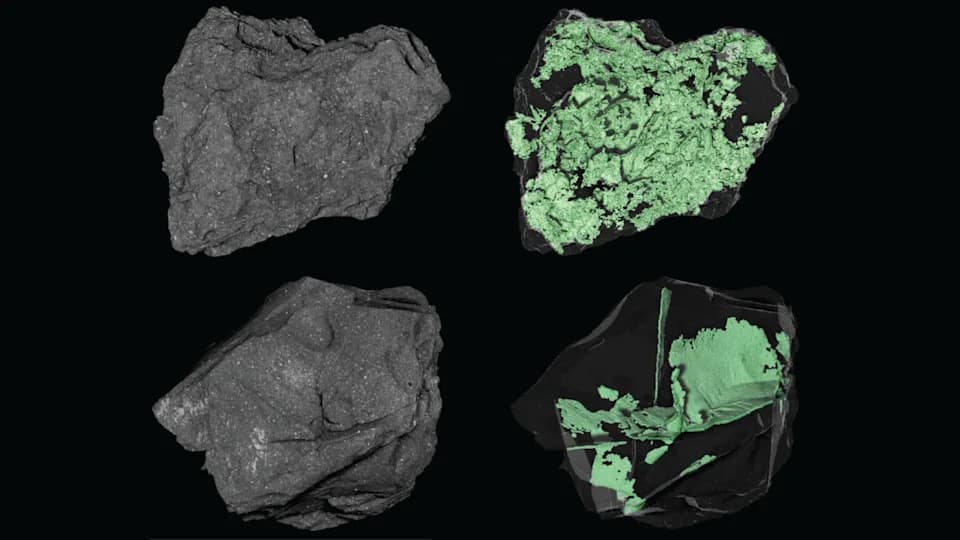
X-ray computed tomography (XCT) scans of particles from asteroid Bennu. They show the most common types of crack networks observed in Bennu samples. One has an extensive and connect framework of curved cracks, whereas the other has sparse, straight and flat fractures. | Credit: NASA/Scott Eckley
NASA scientists have used high-resolution X-ray computed tomography (XCT) to peer inside tiny rock particles returned from asteroid Bennu, revealing pervasive networks of fine fractures woven through the samples.
Detailed Imaging Shows Extensive Internal Cracking
The newly released XCT images present two perspectives of small particles collected by the OSIRIS-REx mission. XCT is a nondestructive technique that reveals interior structure—such as voids, grains and fractures—without altering the samples. The scans show that many particles are threaded with microscopic cracks that extend through the material.
How Cracks Explain Bennu’s Thermal Behavior
Bennu’s surface displays low thermal inertia, meaning it heats and cools quickly as the asteroid rotates. One long-standing hypothesis suggested that high porosity or a very fine-grained surface could explain this behavior. The XCT results provide a complementary explanation: internal fracturing increases effective porosity and reduces the ability of rock fragments to retain heat, helping reconcile remote thermal observations with the boulder-rich appearance seen in spacecraft images.
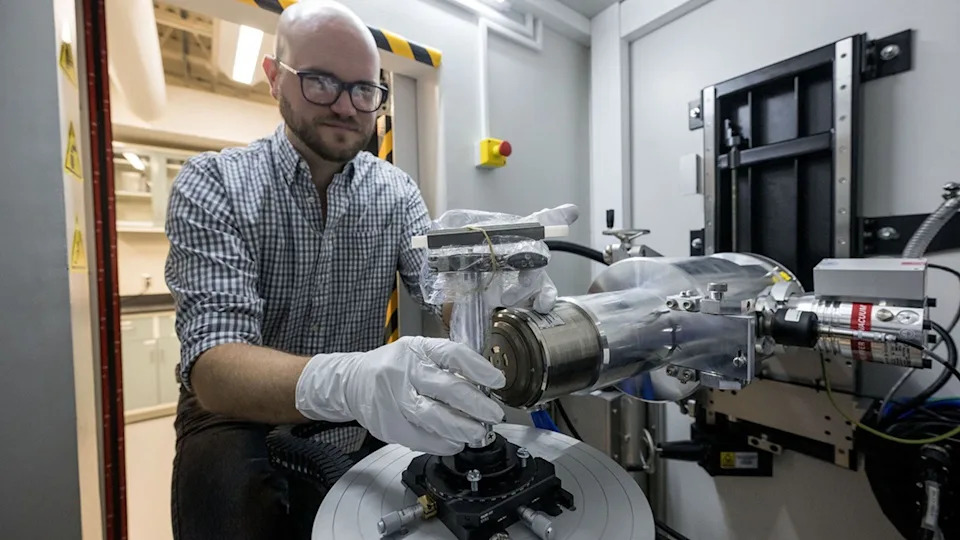
Scott Eckley, X-ray scientist within NASA Johnson Space Center's Astromaterials Research and Exploration Science (ARES), demonstrates the process for placing a container holding a piece of asteroid material in an X-ray Computed Tomography (XCT) machine. | Credit: NASA/Robert Markowitz
"It turns out that they're really cracked too, and that was the missing piece of the puzzle," said Andrew Ryan, who led the OSIRIS-REx sample physical and thermal analysis working group, in a NASA statement.
Context: OSIRIS-REx Sample Return and Ongoing Discoveries
OSIRIS-REx returned Bennu material to Earth in September 2023 after roughly a 4-billion-mile (about 6.2-billion-kilometer) round trip. The sample capsule landed in the Utah desert and has been the focus of intensive laboratory study. Analyses of the returned material have already detected amino acids—organic molecules considered among life’s building blocks—and indicate that some portions of the material may predate the Solar System.
Why This Matters
These interior scans give researchers a rare look at primordial asteroid material and refine how scientists interpret thermal data gathered remotely by telescopes and spacecraft. Improving the link between observable thermal properties and internal structure will help astronomers predict the makeup of other asteroids without always needing to return physical samples, informing both science and planetary defense planning.
What’s next: researchers will continue detailed physical and chemical analyses of the Bennu fragments to quantify fracture networks, porosity, and thermal properties across particle sizes and types.
Help us improve.