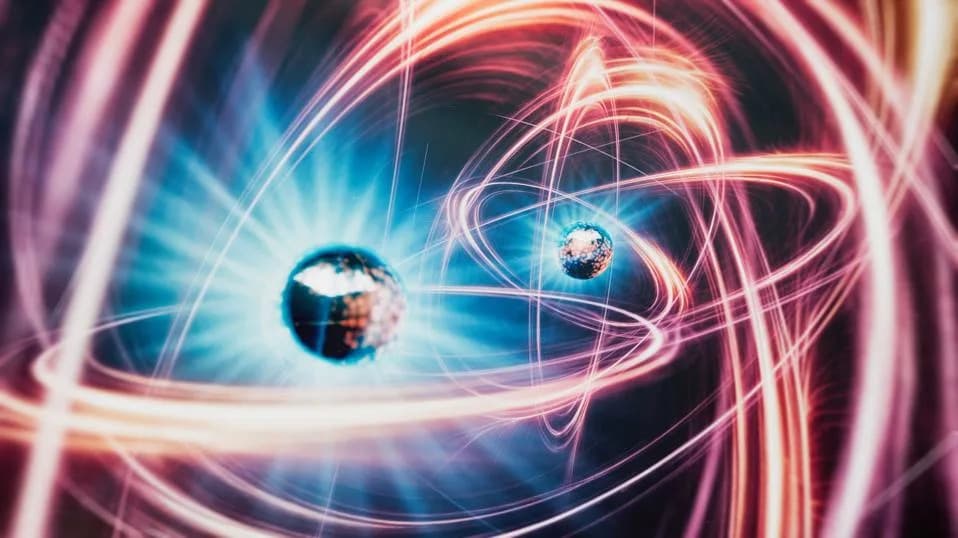
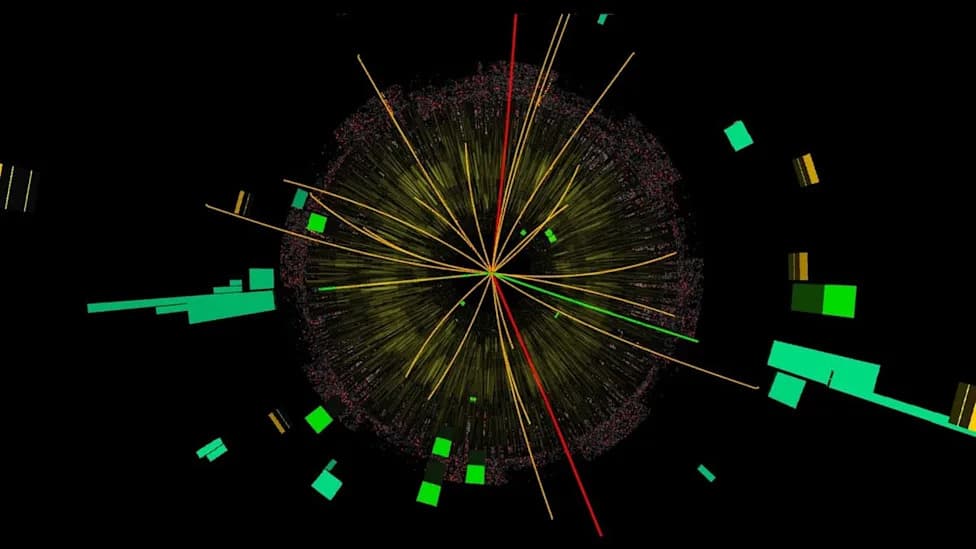
The Large Hadron Collider’s LHCb experiment has discovered Xi-cc-plus, the 80th particle identified at CERN. This baryon contains two charm quarks and one down quark, making it roughly four times heavier than a proton and much shorter lived than a similar 2017 particle. The finding — made after LHCb’s 2023 upgrades — offers new tests for quantum chromodynamics and informs future accelerator plans such as the proposed Future Circular Collider.
CERN’s LHC Finds New Baryon Xi-cc-plus — The 80th Particle Identified
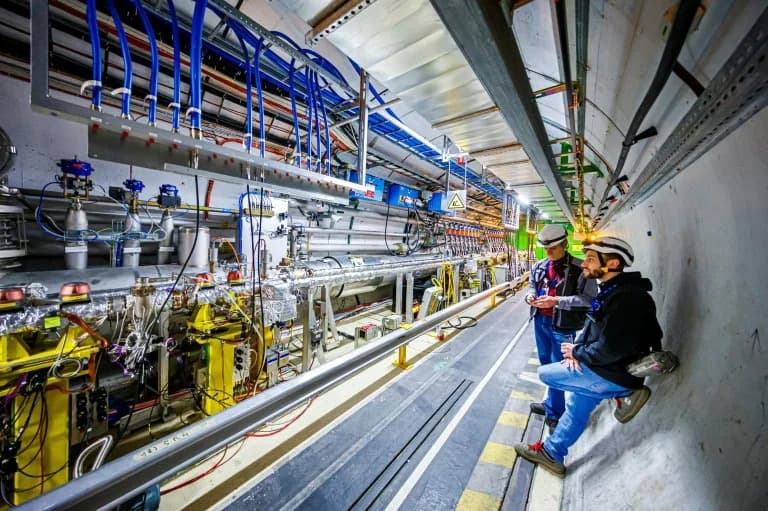
Physicists using the Large Hadron Collider have discovered a new particle (VALENTIN FLAURAUD)(VALENTIN FLAURAUD/AFP/AFP)
The Large Hadron Collider (LHC) at CERN has announced the discovery of a new particle, named Xi-cc-plus, marking the 80th particle identified by the world's most powerful particle accelerator, the laboratory said on Tuesday.
Xi-cc-plus is a baryon — a class of particles that also includes protons and neutrons — composed of three quarks: two charm quarks and one down quark. Because charm quarks are substantially heavier than the up quarks found in a proton, Xi-cc-plus is roughly four times the mass of a proton.
How It Was Found
Researchers at the LHCb experiment observed Xi-cc-plus in high-energy proton collisions. The LHC accelerates particles around its 27-kilometre underground ring (about 100 metres below the France–Switzerland border) and smashes them together to produce short-lived states. By studying the decay patterns of those products, scientists infer the properties of the parent particles.
Vincenzo Vagnoni, spokesperson for the LHCb collaboration, said this is "only the second time a baryon with two heavy quarks has been observed" and noted it is the first new particle found after the 2023 upgrades to the LHCb detector.
In 2017, LHCb reported a related baryon made of two charm quarks and one up quark. CERN says Xi-cc-plus is expected to have a lifetime about six times shorter than that 2017 particle, which made it more difficult to detect.
Why It Matters
The discovery provides an important new data point for testing models of quantum chromodynamics (QCD), the theory describing the strong force that binds quarks into baryons, mesons and more exotic states such as tetraquarks and pentaquarks. Observing baryons with two heavy quarks helps theorists refine predictions about how quarks interact at short distances and under extreme conditions.
Beyond this result, CERN continues to plan future projects such as the proposed Future Circular Collider, intended to probe the fundamental structure of matter with even greater reach.
Quick facts: LHC = 27 km ring, ~100 m underground; landmark achievement: Higgs boson confirmed in 2012; Xi-cc-plus = two charm quarks + one down quark; detected by the upgraded LHCb detector completed in 2023.
Help us improve.