NASA's Curiosity photographed a pitted rock called Timboy Chaco on Mount Sharp in Gale Crater, revealing spiderweb-like boxwork formations that are ridges and hollows at ground level. These exposed mineral deposits point to past water flow and raise the possibility that groundwater persisted later in Mars' history. Scientists hope close analysis of these deposits could reveal preserved traces of ancient microbial life.
Curiosity Reveals 'Timboy Chaco': Pitted Rock and Spiderweb-Like Boxwork on Mount Sharp
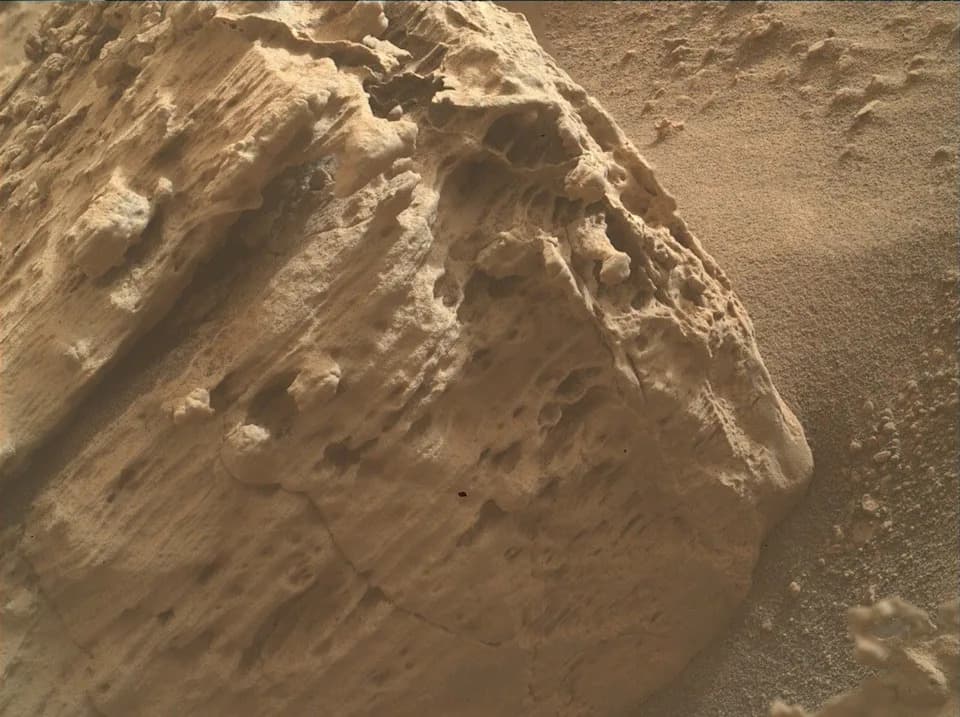
NASA's Mars rover Curiosity acquired this image of a pitted vertical rock face dubbed "Timboy Chaco" on March 5, 2026. | Credit: NASA/JPL-Caltech/MSSS
NASA's Curiosity Mars rover captured a striking image of a pitted rock face it has nicknamed Timboy Chaco while exploring the slopes of Mount Sharp inside Gale Crater on March 16, 2026. Mount Sharp rises roughly 3 miles (5 kilometers) above the crater floor.
For months the rover has been studying so-called boxwork formations. From orbit these features resemble spiderwebs, but at ground level they appear as low ridges and hollows etched into bedrock by wind, erosion and the exposure of mineral veins.
Curiosity is currently investigating the eastern and southern "borderlands" of the Mount Sharp region, where winds have stripped away loose sand and revealed mineral-rich deposits that now appear as pitted, scarred rock surfaces like Timboy Chaco.
Researchers say the exposed minerals are strong evidence that water once flowed through this area, and some boxwork structures suggest groundwater persisted later in Mars' history than earlier orbital studies indicated. Close-up sampling and detailed chemical analyses could show whether organic material or other traces of ancient microbial life were preserved in those deposits.
"Seeing boxwork this far up the mountain suggests the groundwater table had to be pretty high," said Tina Seeger, a mission scientist at Rice University, in a September 2025 statement from NASA's Jet Propulsion Laboratory. "And that means the water needed for sustaining life could have lasted much longer than we thought, looking from orbit."
Curiosity's ongoing measurements of Timboy Chaco and nearby boxwork will help scientists refine models of Mars' watery past and guide future searches for biosignatures on the Red Planet.
Help us improve.