The scarlet monkeyflower on the U.S. West Coast evolved rapidly enough to recover after an extreme, prolonged drought, according to a Science paper published March 12. Researchers compared stored pre-drought seeds and leaves with post-drought samples from populations monitored since 2010 and documented genome-wide changes linked to recovery. Populations with greater genetic diversity evolved fastest and were most likely to rebound — demonstrating "evolutionary rescue" — though scientists caution this capacity will vary across species.
Wild Monkeyflower Rapidly Evolved to Survive Record Drought, Study Finds
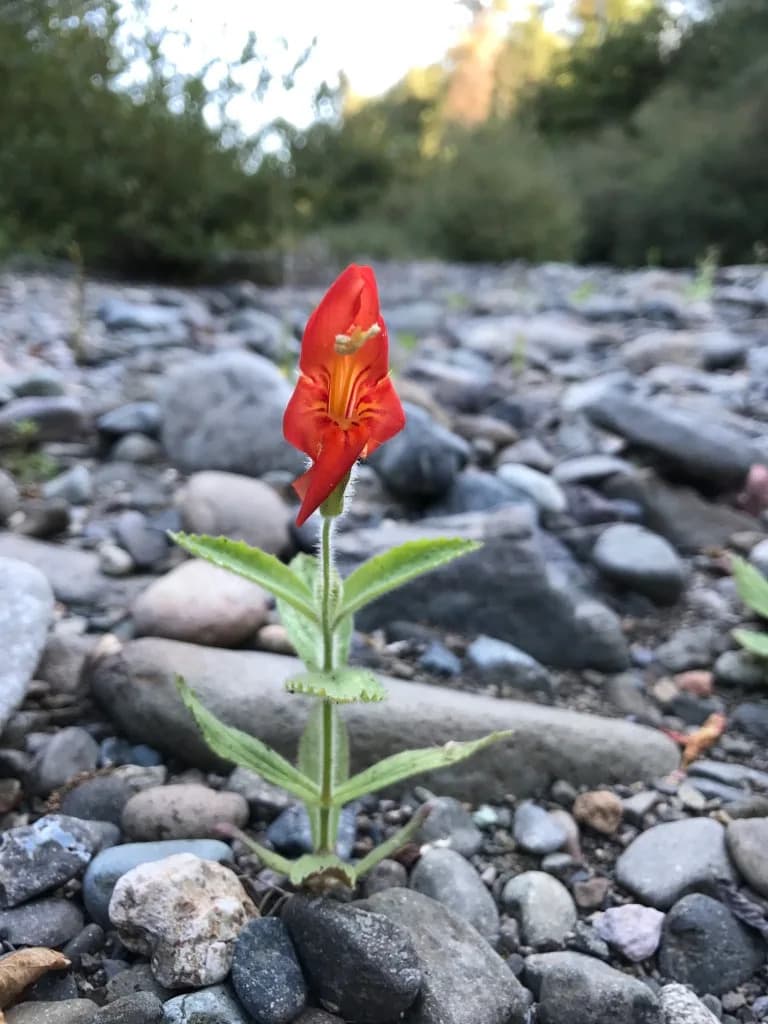
A scarlet monkeyflower plant in its natural habitat in California.
A West Coast wildflower — the scarlet monkeyflower — has offered a rare note of optimism in climate-change biology by demonstrating a remarkable capacity to evolve rapidly in the face of extreme drought. A new study published in Science on March 12 tracked populations in Oregon and California for more than a decade and documents genome-wide changes that helped some populations rebound after a severe, prolonged drought.
A Time Capsule Allowed Direct Comparison
Researchers began monitoring scarlet monkeyflower populations in 2010, before the most extreme drought in California in more than 10,000 years began in 2012. Because the team had collected and stored leaves and seeds before the drought, they were able to compare pre-drought and post-drought traits and genetics — essentially using a natural time capsule to track evolutionary change.
"This study shows, for the first time in the wild, that some plant populations were able to evolve quickly enough to rebound from extreme drought," said study senior author Amy Angert, a professor of botany and zoology at the University of British Columbia.
Evolutionary Rescue Documented in Nature
The researchers found that while some populations declined sharply or went locally extinct during the drought, others recovered. The populations that recovered were the ones that showed the fastest genetic change. Study lead author Daniel Anstett of Cornell University called this a clear example of "evolutionary rescue": genetic adaptation that allows a population to avoid extinction under severe environmental stress.
"Essentially what we found is that the populations that recovered are also the populations that evolved the fastest," said Daniel Anstett.
The study is notable because it documents three linked outcomes in natural populations: a climate-driven decline, genome-wide adaptation related to drought tolerance, and subsequent population recovery.
Why Genetic Diversity Matters
The team found that populations with higher genetic diversity were more likely to adapt and recover. That suggests genetic variation is a key predictor of a population's ability to respond to rapid environmental change — and it reinforces the conservation case for preserving genetic diversity across landscapes.
"The concern has been that climate change is happening too fast and its changes are too big for populations to be able to keep up through evolution," Angert said. "This shows that at least some populations have the capacity to run fast enough through evolution to stay on the treadmill."
Broader Implications and Cautions
Conservation geneticist Christy Edwards of the Missouri Botanical Garden described the work as "evolution caught in the act," noting that it validates efforts to conserve genetic diversity as a buffer against environmental change. At the same time, the authors and outside experts urge caution: not all species or populations will have the same adaptive capacity, and relying on rapid evolution as a universal solution would be risky.
The scarlet monkeyflower is part of a larger group of monkeyflowers common in California. The perennial is known for bright red blooms that attract hummingbirds and are often avoided by bees. The study was led by researchers at institutions including the University of British Columbia and Cornell University and was reported by USA TODAY.
Help us improve.