The study tracked 81 African turquoise killifish continuously from puberty to natural death and used deep learning to identify 100 behavioral motifs from billions of video frames. Behavioral divergence—especially increased daytime sleep and lower daytime peak speeds—appeared by ~70–100 days and predicted shorter lifespan with >70% accuracy. Liver gene expression (ribosome and protein synthesis pathways) aligned with behavioral trajectories, aging proceeded via discrete rapid transitions, and dietary restriction slowed the behavioral aging clock by about 42 days.
Early Sleep and Activity Patterns Predict Lifespan — Killifish Study Suggests Wearables Could Help
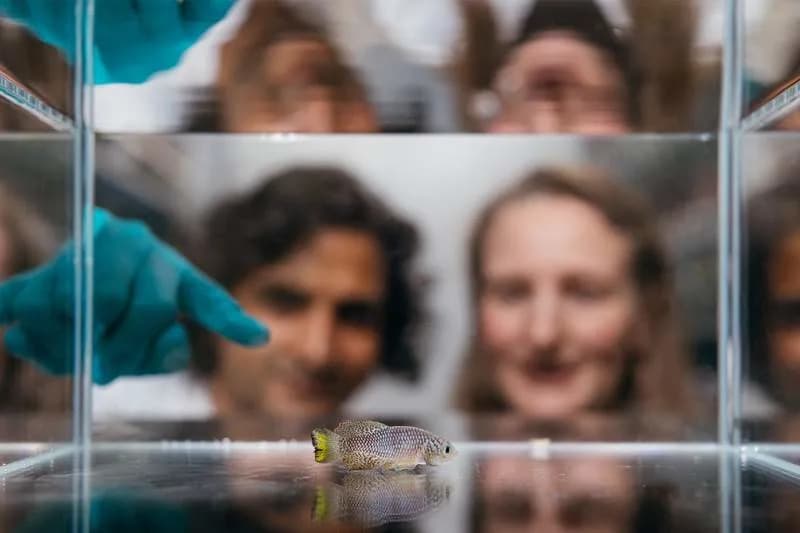
Researchers Ravi David Nath and Claire Nicole Bedbrook place African killifish under continuous behavioral surveillance to track movement patterns across their lifespan, finding that activity levels in young adults may serve as an early predictor of longevity. (CREDIT: Stanford University / Andrew Brodhead)
Some killifish are early risers: they swim energetically in daylight, confine sleep to the night, and tend to live longer. Others begin to nap during the day, move less vigorously and die sooner. Remarkably, these behavioral differences appear well before midlife in animals raised under identical conditions.
Study Overview
A team led by postdoctoral researchers Claire Bedbrook and Ravi Nath at Stanford's Wu Tsai Neurosciences Institute (in collaboration with the labs of Anne Brunet and Karl Deisseroth) published a study in Science that tracked the full aging trajectory of individual vertebrates for the first time. The researchers continuously filmed 81 African turquoise killifish from puberty until natural death at 20 frames per second, producing billions of video frames.

Ravi Nath (left) and Claire Bedbrook with an aging African killifish. (CREDIT: Stanford University / Andrew Brodhead)
From Video To Behavior And Prediction
A deep-learning pipeline converted the video into 100 distinct behavioral motifs—short, recurring movements and rest states that described how each fish spent its day and night. Comparing individuals revealed that behavioral differences predictive of lifespan emerged early: around 70–100 days of age, well before midlife for this species.
“Behavior is a wonderfully integrated readout, reflecting what’s happening across the brain and body,” said Anne Brunet. “With behavior, you see the whole organism continuously and non-invasively.”
Machine-learning classifiers trained on only a few days of middle-age behavior predicted future lifespan with greater than 70% accuracy. Short-lived fish tended to sleep more during daytime hours and exhibited lower daytime peak speeds, while longer-lived fish kept sleep tightly nocturnal and showed stronger daytime bursts.
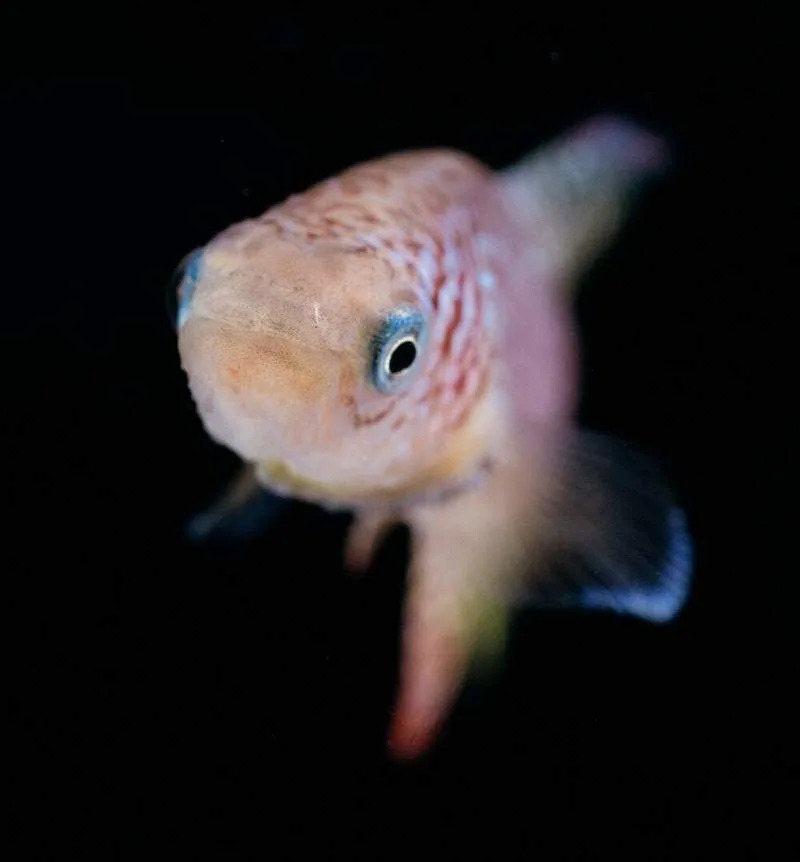
Researchers place African killifish under continuous behavioral surveillance to track movement patterns across their lifespan, finding that activity levels in young adults may serve as an early predictor of longevity. (CREDIT: Stanford University / Andrew Brodhead)
Molecular Signals And The Shape Of Aging
Sequencing gene activity in a separate cohort sacrificed at middle age revealed that liver expression best separated long- and short-lived trajectories. Fish destined for shorter lives had higher expression of genes involved in ribosome biogenesis and protein synthesis—pathways that also intensify with age generally, suggesting a possible causal role.
Contrary to the expectation of smooth, continuous decline, most animals experienced 2–6 abrupt behavioral transitions across life, each lasting only a few days and followed by long periods of stability. These staged shifts yielded six distinct life stages, and individuals typically progressed forward through stages without reverting.

Claire Bedbrook studying data in the lab. (CREDIT: Stanford University / Andrew Brodhead)
The authors liken aging to a Jenga tower: stress accumulates quietly until a threshold is crossed and the system reorganizes into a new stable state. Human molecular studies find analogous pulses of change across decades, consistent with discrete transitions rather than gradual drift.
Dietary Restriction, Sex Differences, And Human Implications
In a dietary-restriction experiment, 39 fish fed three times per day (all in the morning) instead of seven distributed feedings woke earlier, slept more at night, and reached higher daytime peak speeds. The behavioral aging clock estimated these fish to be about 42 days biologically younger than their chronological age—the same sequence of stages, traversed more slowly.
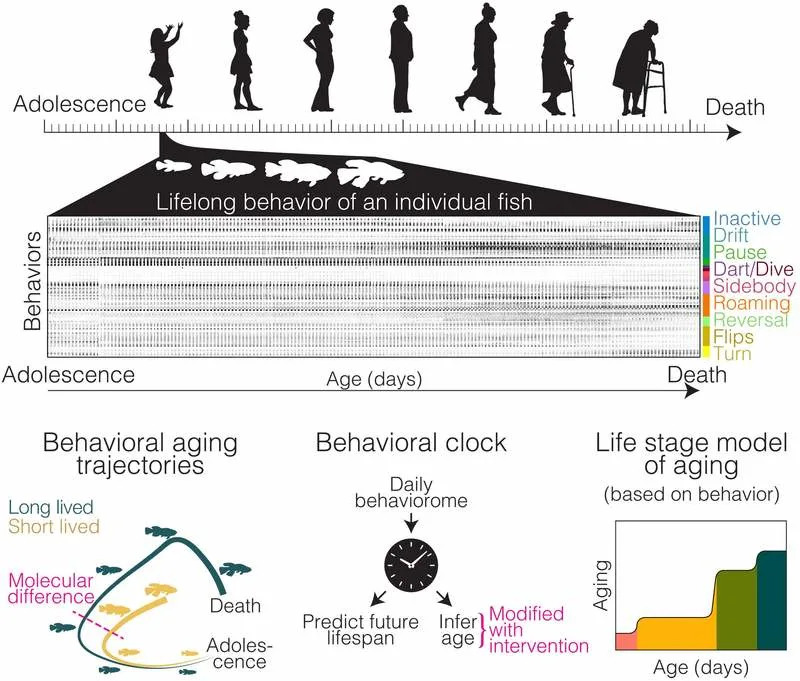
Lifelong behavioral screen. To investigate the lifelong progression of aging, we continuously tracked behavior from adolescence to death in the naturally short-lived African turquoise killifish. Naturalistic behavioral readout, which is noninvasive, revealed individual animal aging trajectories across life. (CREDIT: Science)
Female killifish followed a distinct and accelerated aging path compared with males. A classifier trained mostly on male data nonetheless identified short lifespan in 74% of tested females, indicating some shared predictive features across sexes.
Because millions of people already wear devices that continuously record movement and sleep, the researchers suggest these early behavioral signals might be extractable in humans and could reshape preventive medicine. Interventions timed before abrupt transitions may offer new therapeutic windows, and modifiable signals such as sleep timing, circadian regularity and peak activity are accessible noninvasively.
Future directions: Teams will continue to map neural activity alongside behavior, test whether manipulating sleep alters the pace of aging, and explore whether wearable data can reveal comparable early predictors in people.
Research findings are available online in the journal Science.
Help us improve.