Los Alamos researchers revisited and resolved century-old ambiguities in Schrödinger’s geometric definitions of hue, saturation and lightness. By formally defining the neutral axis from the perceptual metric and moving beyond a Riemannian model, they explain effects such as the Bezold–Brücke shift and perceptual diminishing returns. Their non-Riemannian framework yields metric-derived definitions and practical algorithms for modeling perceptual color differences.
Los Alamos Researchers Complete Schrödinger’s Century-Old Color Theory — Showing Color Qualities Are Intrinsic
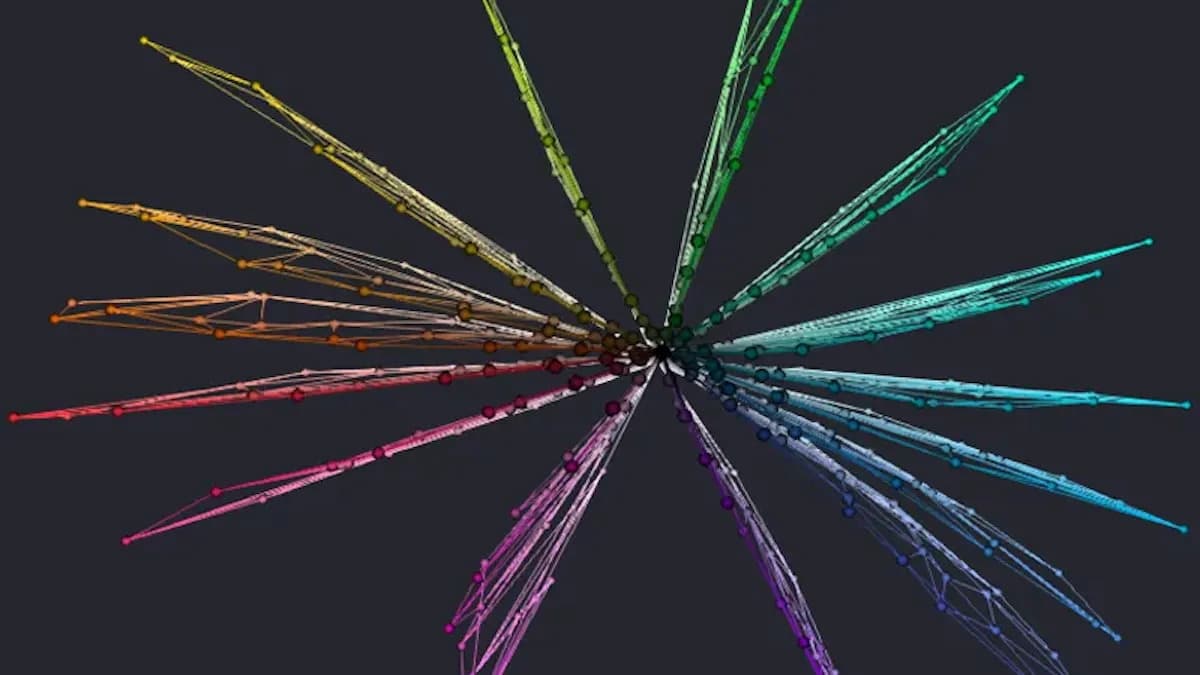
Visual representation of color spaces aligning with a mathematical apex. (LANL)
Researchers at Los Alamos National Laboratory report a major advance in understanding how humans perceive color: key color attributes such as hue, saturation and lightness can be defined directly from the geometry of perceptual color space rather than from cultural or learned constructs. Building on a century of theory that traces back to Bernhard Riemann, Hermann von Helmholtz and Erwin Schrödinger, the team resolves long-standing ambiguities and extends the mathematics beyond the classical Riemannian framework.
Why This Matters
Accurate mathematical definitions of color qualities matter for both theoretical vision science and practical applications like scientific visualization, image processing and color-critical industries. While disagreements over color names (and viral debates like the 2015 "dress") emphasize differences in labeling, the Los Alamos study argues the perceptual distinctions people make are governed by intrinsic geometric properties of color space.

Subscribe to ScienceAlert's free fact-checked newsletter
What The Researchers Did
The team examined Schrödinger’s 1920s Riemannian formulation of hue, saturation and lightness and identified gaps and inconsistencies, most notably that Schrödinger never formally defined the neutral axis (the gray scale between black and white) on which many of his definitions rely. By combining contemporary psychophysical results with geometric analysis, the researchers derived a formal definition of the neutral axis directly from the perceptual metric.
"What we conclude is that these color qualities don't emerge from additional external constructs such as cultural or learned experiences but reflect the intrinsic properties of the color metric itself," said lead author Roxana Bujack. "This metric geometrically encodes the perceived color distance — that is, how different two colors appear to an observer."
Extending Beyond Riemannian Geometry
The authors show that some observed phenomena — such as the Bezold–Brücke effect, where changes in light intensity alter perceived hue, and the diminishing-returns behavior in perceived differences — cannot be fully explained within a strict Riemannian model. To fix this, they replace straight-line stimulus definitions with the true shortest paths (geodesics) in perceptual color space and introduce a non-Riemannian framework that accommodates diminishing returns in perceptual difference.
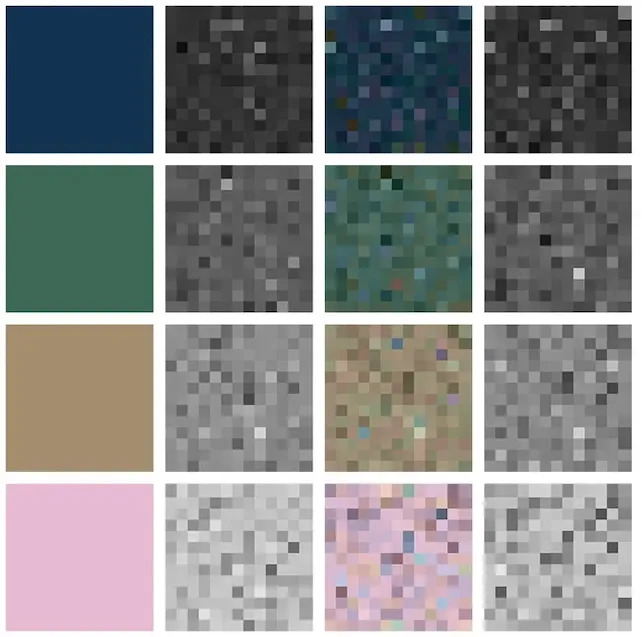
Results from the color perception experiments the team conducted: If the colors of the second and fourth columns match, then the closest perceived color to the neutral axis coincides with the color at the end of the shortest path. (LANL)
Results and Implications
The study presents corrected, metric-derived definitions of hue, saturation and lightness and supplies algorithms for modeling perceptual color differences in the proposed non-Riemannian framework. The authors characterize the work as completing Helmholtz’s and Schrödinger’s geometric vision for color perception and provide practical tools that could improve scientific visualization, color appearance models and other color-related technologies.
Publication: The paper was published in the journal Computer Graphics Forum.
Help us improve.