
Erwin Schrödinger’s 1926 wave equation remains fundamental to quantum chemistry. While exact solutions are limited to the smallest systems, approximation methods and modern software let scientists compute properties for molecules of a few dozen atoms. Quantum effects such as tunneling — especially by hydrogen nuclei — can enable reactions below classical energy barriers; replacing hydrogen with heavier deuterium suppresses tunneling and can change reaction outcomes. Advances in computational methods and, eventually, quantum computers may extend these predictions to much larger molecular systems.
A Century Later: How Schrödinger’s Equation Still Drives Quantum Chemistry and Improves Chemical Reactions

At the quantum level, particles act like waves rather than discrete points.GarryKillian/iStock via Getty Images
The objects you handle every day seem predictable: you can lift a box, sit in a chair, or twist a doorknob and feel resistance. But when you zoom in to the scale of individual atoms, matter behaves very differently.
In 1926 Austrian physicist Erwin Schrödinger formulated an equation that describes quantum particles via a wave function — a mathematical object that gives the probability of finding a particle in a region of space. Rather than acting like tiny solid pellets, particles at the quantum scale display wave-like behavior. Properties that feel definite at our scale, such as position, become probabilistic when described by the wave function.
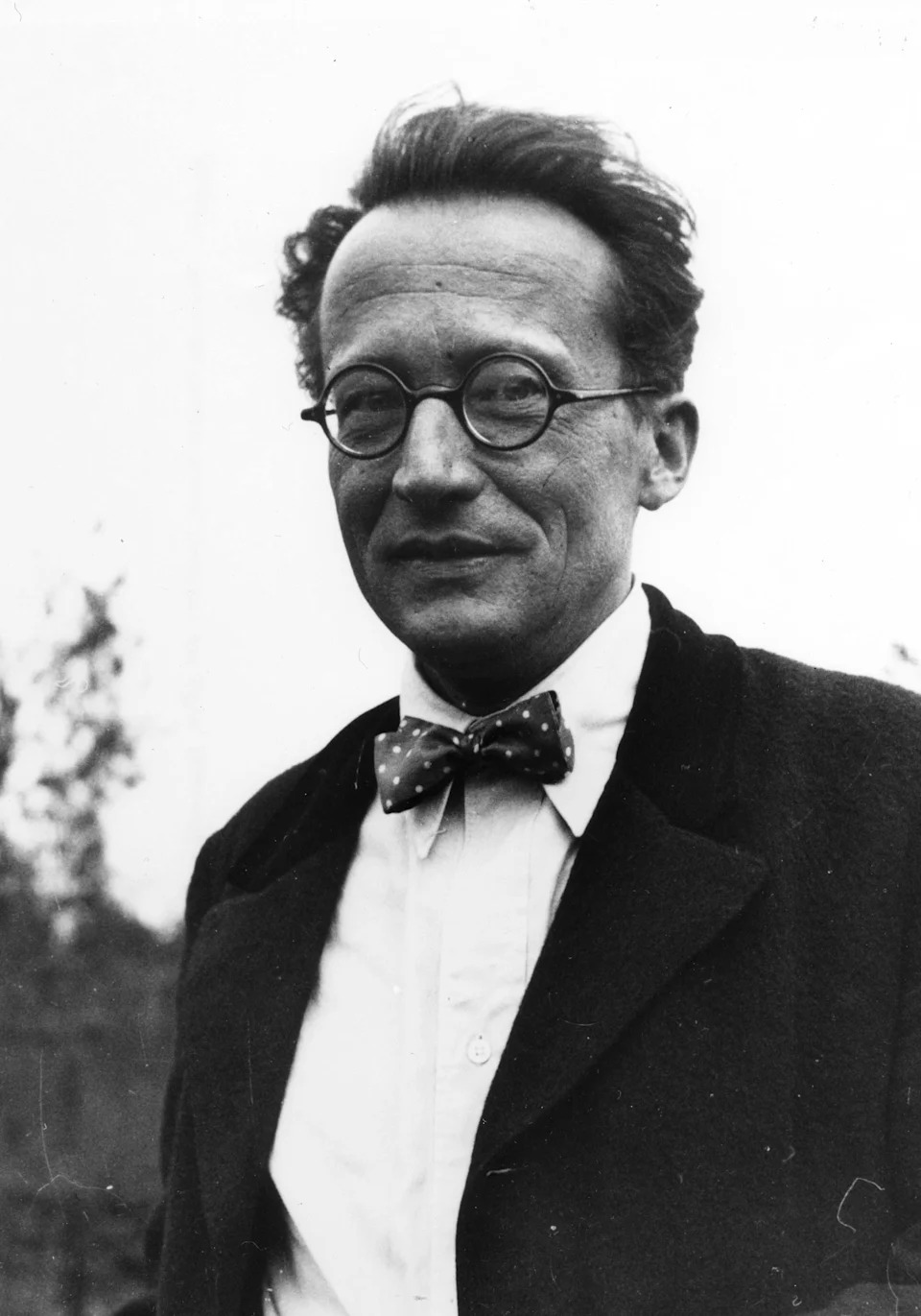
Erwin Schrodinger developed equations that could describe where a particle might be in space.Francis Simon/American Institute of Physics,CC BY
Why This Matters
These quantum behaviors underlie familiar phenomena: they determine why plants are green, enable modern electronics and information technology, and control many material properties. I am a theoretical chemist, and Schrödinger's equation remains central to my work: computing how atoms rearrange during chemical reactions helps researchers design more efficient processes for applications such as biofuels, solar-energy technologies and advanced materials.
Computational Challenges
Although Schrödinger's equation is the foundation for predicting molecular behavior, it can be solved exactly only for the smallest systems — essentially atoms and the tiniest molecules (roughly up to five or six atoms). The computational cost grows exponentially with system size. For example, if you represent each particle with 10 discrete states, two interacting particles require 10^2 = 100 states, three particles require 10^3 = 1,000, and so on. That exponential explosion makes exact solutions infeasible for large molecules.
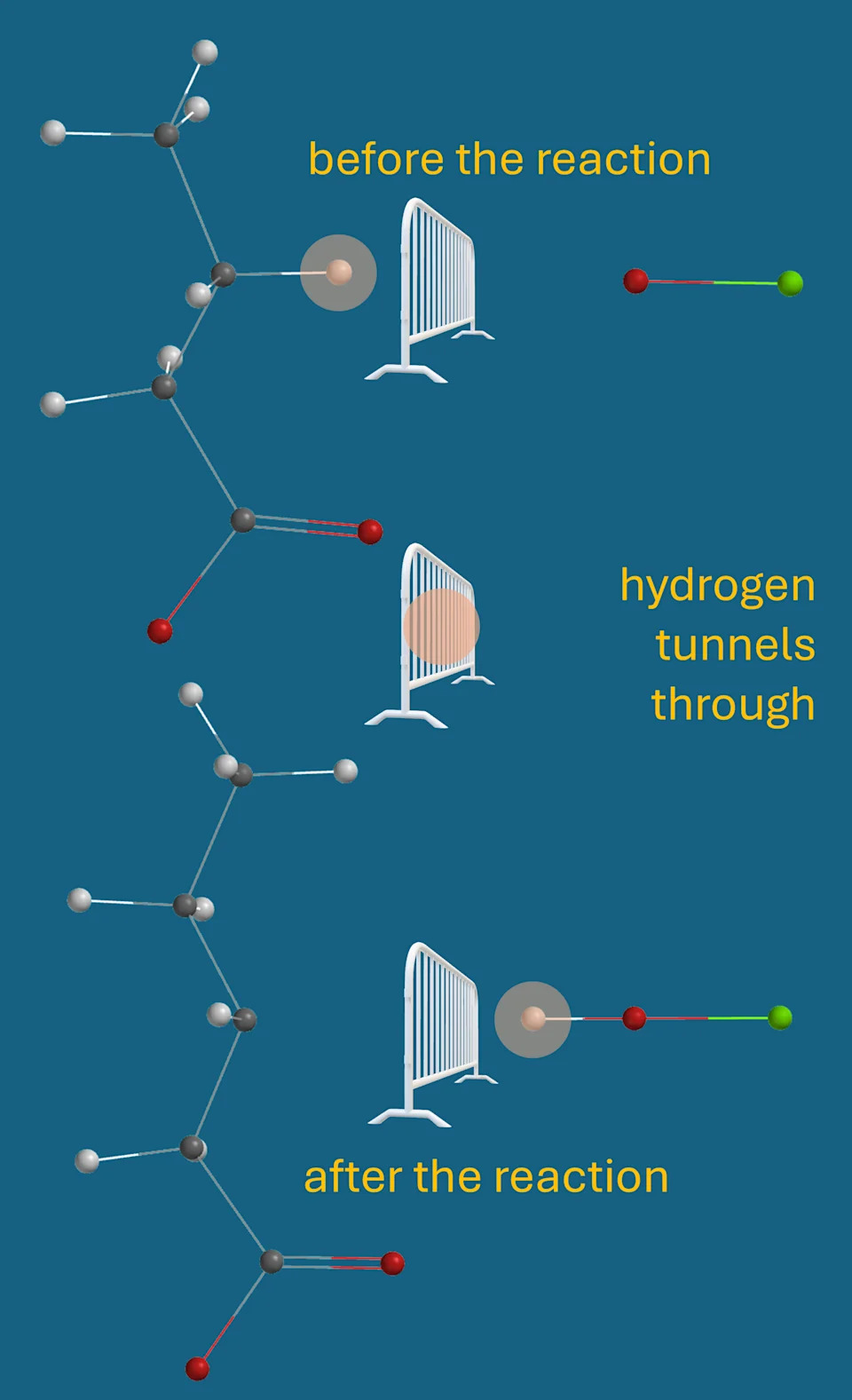
The hydrogen atom highlighted in peach will transfer from one of the carbon atoms (gray spheres) to the oxygen atom (red sphere) bonded to the iron atom (green sphere). It can do this even though it does not have enough energy to overcome the energy 'barrier' thanks to quantum tunneling. Sophya Garashchuk
To study larger systems, researchers use approximation methods that produce useful wave functions. With well-established commercial and free software, chemists can routinely compute electronic structure and basic properties for molecules of a few dozen atoms — things like stability, absorption wavelengths, and reaction energetics. For subtler quantum effects in larger systems, specialized methods and high-performance computing are needed.
Quantum Tunneling and Chemical Reactions
One striking quantum phenomenon is tunneling. In many reactions, reactants must surmount an energy barrier to form products — typically requiring thermal energy. Quantum mechanics allows a finite probability that a particle crosses the barrier even when its total classical energy is lower. Tunneling is most important at low temperatures and for light nuclei, whose wave functions are more spatially spread.
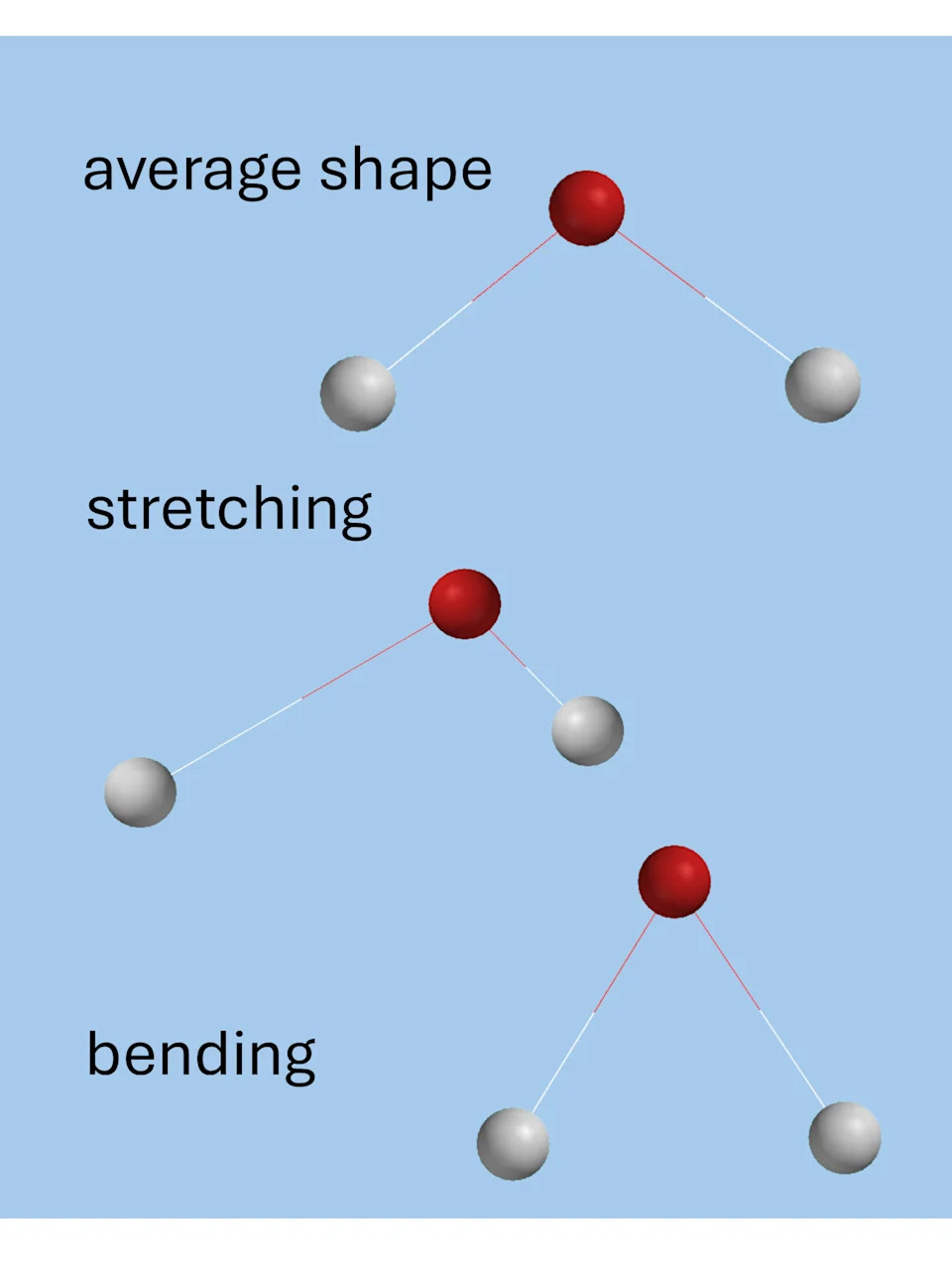
Molecules are characterized by their 'average' shapes. However, because of the quantum nature of their nuclei, they can stretch, bend and twist even at a temperature of absolute zero. This stretching is shown here for a water molecule, with red and silver spheres representing oxygen and hydrogen atoms, respectively. These small changes at the quantum level can affect how they react, if a chemical bond is broken. source
Hydrogen nuclei (protons) are the lightest and therefore the most likely to tunnel. Chemists exploit this by substituting hydrogen with its heavier isotope deuterium (which contains one neutron): deuterium is roughly twice as heavy and far less likely to tunnel. Comparing rates with H and D therefore reveals the role of tunneling in a reaction mechanism.
In 2022 my collaborators and I investigated a hydrogen-atom transfer step relevant to converting biomass feedstocks (such as straw and switchgrass) into liquid fuels like gasoline and diesel. Our quantum calculations showed that a hydrogen atom tunnels during the critical step, enabling the reaction to proceed efficiently with lower thermal input. Replacing hydrogen with deuterium increased the effective barrier and suppressed tunneling, which could substantially reduce reaction efficiency — a concrete example of how tiny quantum effects influence macroscopic outcomes.
Beyond Classical Computers
Some technological applications of quantum behavior already seem futuristic — notably quantum computers. Mature quantum machines could one day simulate Schrödinger's equation directly for much larger molecules, potentially enabling direct predictions for systems comprising thousands of atoms. Today’s quantum computers are early-stage prototypes: large, complex, and experimental, much like the room-sized classical machines of the mid-20th century. Nonetheless, continued advances in algorithms and hardware may extend the reach of quantum chemistry dramatically.
Author: Sophya Garashchuk, University of South Carolina. The author acknowledges funding from the National Science Foundation and the U.S. Department of Energy.
Help us improve.





















