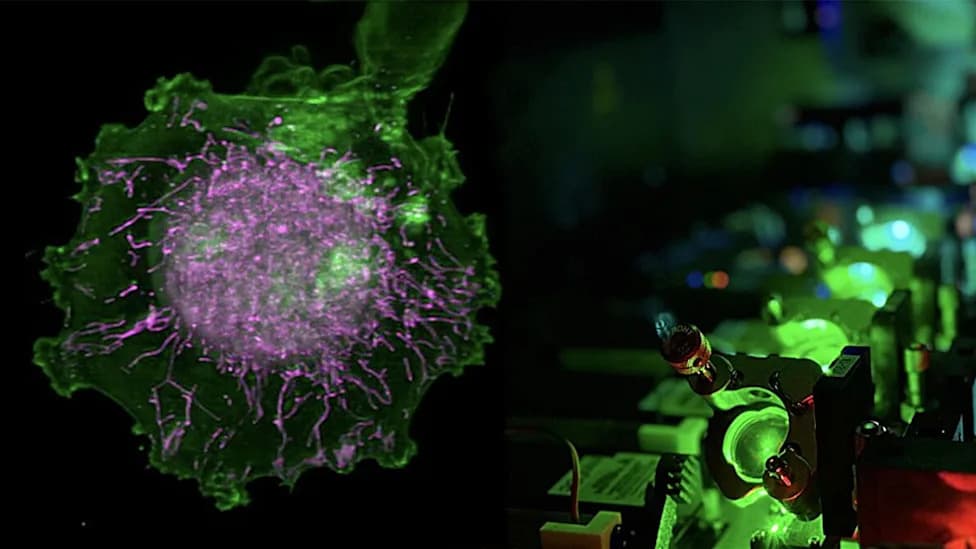
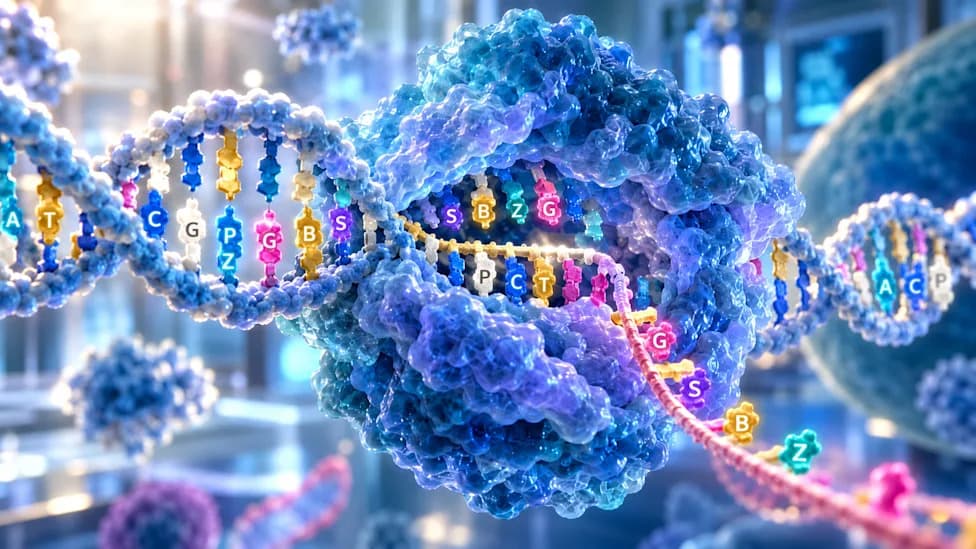
Researchers led by Dr. Zan Luthey‑Schulten built a 3D, time‑resolved digital model of the minimal bacterium JCVI‑syn3A (493 genes). The simulated 105‑minute cell cycle matched experimental observations to within two minutes and estimated DNA replication took ~51 minutes. By combining stochastic reactions, ODEs and Brownian dynamics—and using GPUs to accelerate replication—the model reproduced growth, division timing and resource allocation, but it remains computationally intensive and omits atomic‑level detail and some features such as polysomes.
Scientists Reconstruct a Whole Bacterial Cell in 3D — Simulation Mirrors Real Life Within Two Minutes
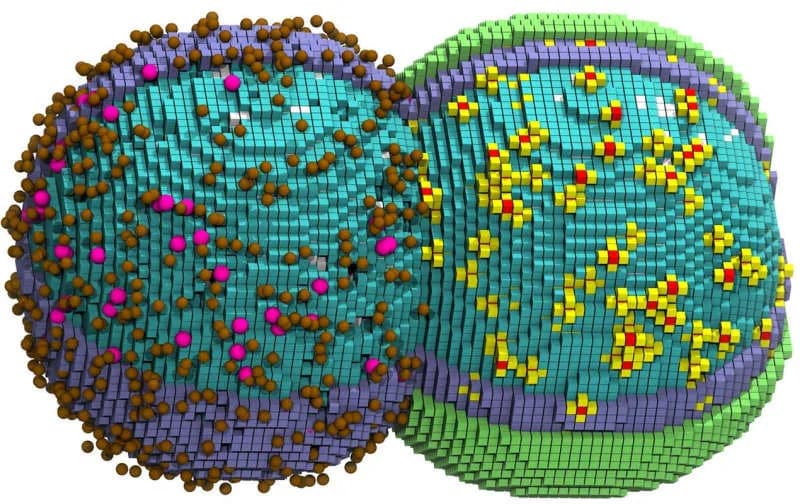
A simulated cell in the early stages of division. Left half shows cytoplasm (blue cubes), mRNA degradation machinery molecules (pink), and sugar transporters (brown). Right half adds the membrane (green) and ribosomes (yellow/red). (CREDIT: Zane Thornburg)
Researchers have produced one of the most detailed digital reconstructions of a living cell by simulating the complete life cycle of JCVI‑syn3A (Syn3A), a pared‑down bacterium with just 493 genes. The virtual cell reproduces DNA replication, gene expression, metabolism and physical changes that lead to cell division, and its predicted 105‑minute cycle matched observed biology to within two minutes.
What the Team Built
The project, led by Dr. Zan Luthey‑Schulten at the University of Illinois Urbana‑Champaign and reported in the journal Cell, created a three‑dimensional, time‑resolved kinetic model of Syn3A. This minimal organism—developed at the J. Craig Venter Institute—has a single circular chromosome with 493 genes, making it tractable for whole‑cell modeling while preserving core features of life.
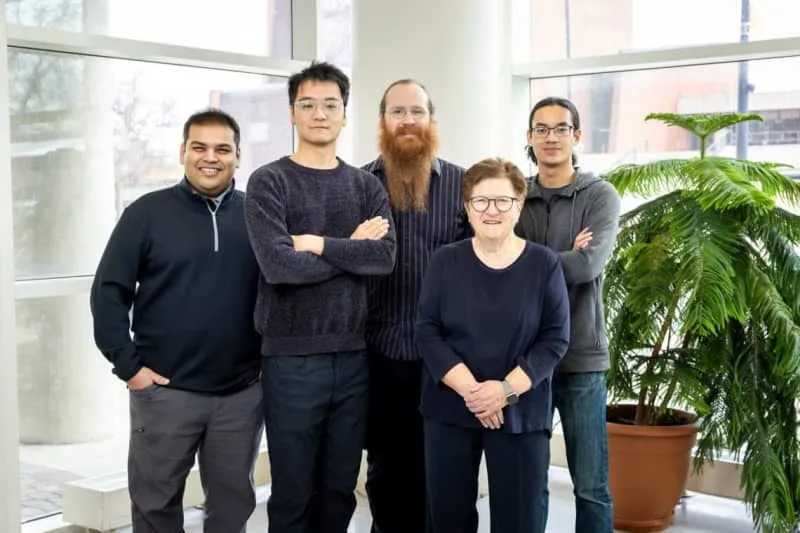
The research team included, from left, chemistry professor Angad Mehta, graduate student Enguang Fu, postdoctoral fellow Zane Thornburg, chemistry professor Zan Luthey-Schulten and graduate student Andrew Maytin. (CREDIT: Michelle Hassel)
How It Works
The model combines multiple computational approaches to capture both stochastic and continuous behaviors: stochastic reaction methods for some metabolic and molecular encounters, ordinary differential equations for bulk kinetics, and Brownian dynamics to simulate the motion of the DNA polymer and other large macromolecules. DNA was modeled as a flexible polymer that coils, replicates and segregates into two daughter chromosome sets; ribosomes assemble and diffuse through the cytoplasm; membrane proteins cluster as the cell grows and the cell elongates before dividing.
Performance and Validation
Simulating DNA replication was a major computational bottleneck. Graduate student Andrew Maytin sped things up by running the replication module on a dedicated GPU, enabling a full 105‑minute cell cycle to be simulated in roughly six days on two high‑performance GPUs. Across 50 simulated cells, the project consumed more than 15,000 GPU hours.
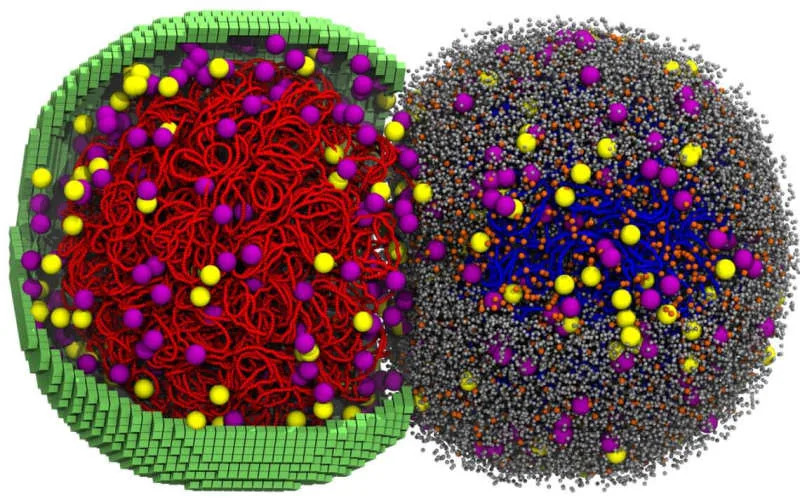
A simulated cell in the early stages of division. Left half shows membrane (green cubes), and ribosomes (yellow/purple) interwoven through in the cell’s chromosome (red). Right side shows all the proteins (grey) and RNA (orange) inside the cell with a small cutaway to show a second copy of the cell’s chromosome (blue). (CREDIT: Zane Thornburg)
The simulation reproduced multiple experimental measurements: membrane surface area doubled over the 105‑minute cycle, and DNA replication took about 51 minutes in the model. Imaging experiments by Angad Mehta and Taekjip Ha confirmed that Syn3A divides symmetrically and supported the model’s predictions of cellular shape and timing. Postdoctoral researcher Thornburg called the work “an incredible achievement” given the many moving parts in a 3D cell simulation.
Biological Insights
One striking finding was the coupling between metabolism and gene expression: transcription rates depend on the intracellular pool of nucleoside triphosphates (NTPs), producing bursts of transcription when NTPs are abundant and pauses as they are depleted. The model also estimated that ribosomes were actively translating about 55% of the time and that roughly 70% of RNA polymerases were engaged in transcription at given moments—numbers that illuminate the allocation of molecular resources during the cell cycle.
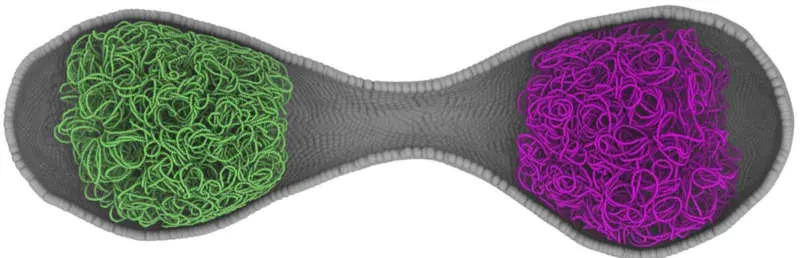
Example of a membrane shape generated using FreeDTS. The long neck was not observed in experimental imaging. Gray particles represent vertices of the triangulated surface. Green and magenta particles represent two chromosomes fitted into the FreeDTS membrane structure. (CREDIT: Cell)
Limitations
The researchers note several important limitations: the model does not track individual atoms, so molecular behaviors are averaged rather than resolved at atomic detail; some biological features remain unmodeled (for example, polysomes where multiple ribosomes translate the same mRNA); and the approach is computationally expensive—simulating a single cell cycle required 4–6 days on two GPUs.
Why It Matters
Even with its limits, the Syn3A digital cell provides an unprecedented, four‑dimensional view (three spatial dimensions plus time) of how genes, metabolism and physical organization interact across a full cell cycle. Such whole‑cell simulations may eventually predict how genetic changes alter cellular traits, guide design of synthetic organisms, and reveal general principles that govern living systems.
Read the original study in Cell for full methods and data; the Syn3A model serves as a stepping stone toward more complex, predictive virtual cells.
Help us improve.