Former Comptroller General David M. Walker acknowledges President Trump’s economic and security claims but argues the State of the Union failed to confront deep, long-term fiscal and structural problems. He notes weaker fourth-quarter growth after a 43-day shutdown, a trade imbalance unchanged despite tariffs, and a deficit reduced only by disputed tariff revenue. Walker urges a bipartisan fiscal commission with guaranteed congressional votes on Social Security and debt-reduction plans, and advocates a Fiscal Responsibility Constitutional Amendment or an Article V convention if Congress won’t act.
State of the Union: Accomplishments, Deep Divisions, and a Looming Fiscal Crisis
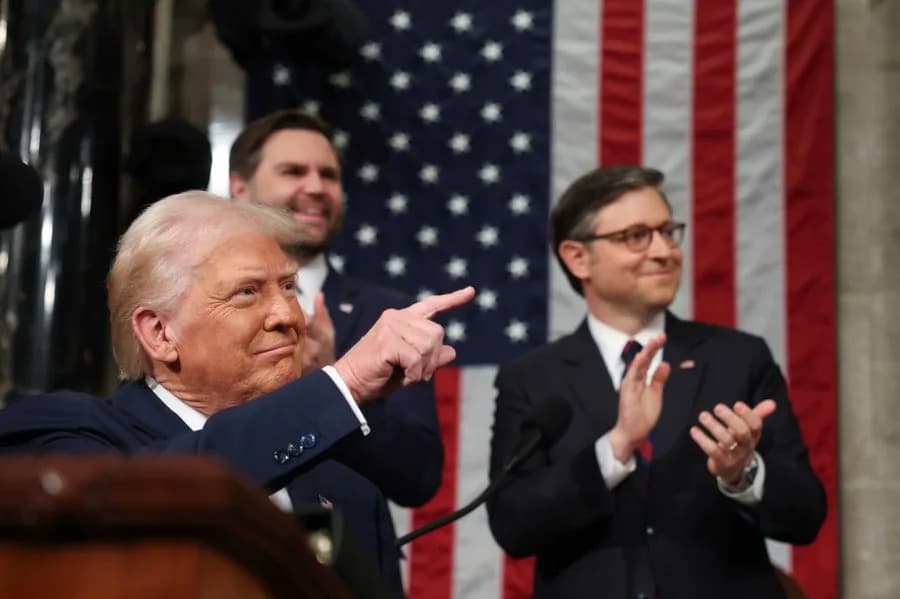
President Donald J. Trump delivered a lengthy State of the Union address on the evening of February 24, highlighting a range of economic and security accomplishments. While many of these achievements are real and deserve recognition, the speech fell short of offering a unifying vision or concrete plans to tackle long-term sustainability problems—most notably the nation’s growing fiscal imbalance.
What the President Highlighted
Mr. Trump cited tighter border control, declines in crime rates, lower core inflation and mortgage rates, restored economic growth, rising real wages, newly brokered international agreements, and record highs on stock markets. These are tangible outcomes that have benefited many Americans.
What the Data Still Say
That said, the Administration has occasionally overstated outcomes. Some consumer items, like eggs and gasoline, cost less than when Mr. Trump took office, but most goods and services are more expensive. Core inflation has eased and real wages have risen, but the economy showed a disappointing fourth-quarter performance—largely attributed to a 43-day federal government shutdown—which left overall growth lower and unemployment slightly higher than at the start of the Administration.
The nation’s trade imbalance was effectively unchanged in calendar 2025 versus 2024 despite new tariffs. The 2025 budget deficit appeared somewhat smaller only because it counted tariff revenues that the Supreme Court has since ruled unconstitutional; if those funds must be refunded, the deficit would return to roughly 2024 levels. The Congressional Budget Office now forecasts a weaker long-range fiscal outlook following passage of the One Big Beautiful Bill Act, and it projects a sooner and larger financing shortfall for Social Security.
Everyday Concerns and Social Stability
Consumer confidence has declined since Mr. Trump took office. Many Americans remain worried about the affordability of health care, electricity, insurance, and housing—issues that affect broad swaths of the population and demand specific policy responses. At the same time, the political environment is deeply polarized; partisan hate speech and politically motivated violence have risen and deserve unequivocal condemnation from leaders on both sides.
"An honest State of the Union must recognize both short-term results and long-term structural challenges."
What Should Be Done
Because the president alone is elected by the entire nation and uniquely occupies the bully pulpit, he should use that platform to press for long-overdue reforms Congress has failed to enact. The author urges several concrete steps:
- Convene a statutory, bipartisan fiscal commission charged with engaging the American people and producing two distinct recommendation packages that would receive guaranteed up-or-down votes in Congress.
- Prioritize one package to restore Social Security solvency and the other to reduce the debt-to-GDP ratio to a sustainable level over the next 10 to 15 years. A bipartisan bill to create such a process already exists.
- Pursue a Fiscal Responsibility Constitutional Amendment to bind current and future Congresses to disciplined fiscal rules; if obtaining two-thirds support in Congress proves unattainable, explore calling an Article V convention to advance the reform.
Why This Matters
Failing to address structural fiscal weaknesses risks a future debt crisis with severe consequences for the economy, national security, foreign relations, and domestic stability. While international cooperation is essential to solve shared environmental problems, our fiscal sustainability is our own responsibility—no other country will bail out the United States.
David M. Walker, former Comptroller General of the United States, is chair of the Federal Fiscal Sustainability Foundation.
Help us improve.