NASA researchers identify Martian ice and permafrost as top targets to preserve organic biosignatures, based on a 2025 Astrobiology study showing amino acids can survive in ice for ~50 million years. The Perseverance rover collected mudstone from Jezero Crater in 2025; early results published in Nature report possible organic carbon consistent with cold-adapted microbial chemistry. Definitive confirmation requires detailed laboratory analyses of the returned samples, and future missions may prioritize both icy deposits and ancient water sites with help from AI-driven exploration.
NASA: Search Martian Ice and Ancient Lakes to Find Traces of Life
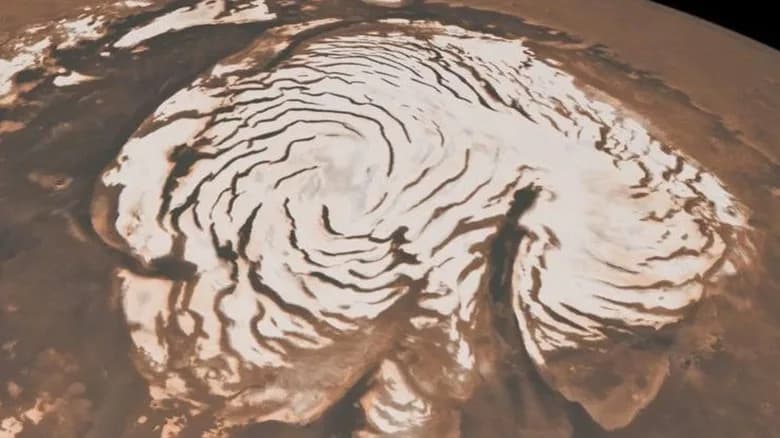
The northern ice ap of Mars seen from space - NASA/JPL-Caltech/MSSS
Humanity has long dreamed of finding life beyond Earth. Because Mars is the nearest planet we can realistically reach (potentially in the 2030s), it is the logical first place to search. Recent NASA research suggests that ice and permafrost are the most promising locations to find preserved chemical traces of past life.
Key study and what it showed
The 2025 study published in Astrobiology exposed dead Escherichia coli cells to gamma radiation to simulate cosmic-ray damage on the Martian surface. The experiments indicate that amino acids within those microbes could remain preserved in ice deposits for roughly 50 million years, making ice and permafrost (frozen soil, rock, and sediment) high-priority targets for biosignature hunting.
Why molecular signs still matter
Discovering intact microbial fossils would be astonishing, but even finding molecular building blocks or degraded biosignatures would be a major scientific breakthrough. Some researchers acknowledge that any indigenous Martian life may already be extinct; nonetheless, preserved organic compounds would offer powerful evidence about Mars’ past habitability and chemistry.
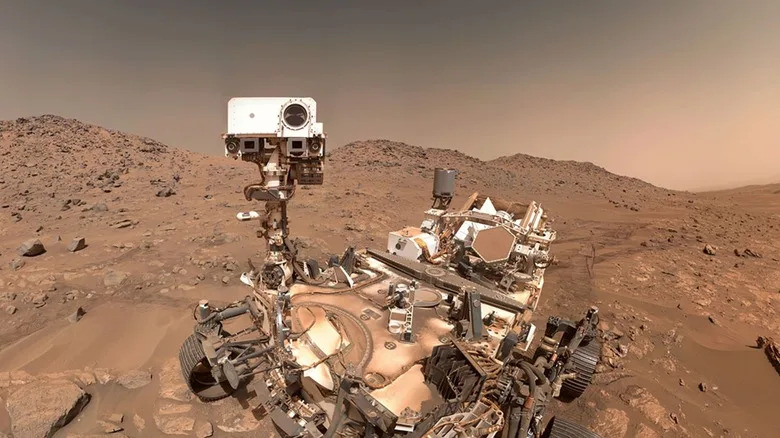
NASA Perseverence Rover with Mars landscape in background - NASA/JPL-Caltech/MSSS
Perseverance and Jezero Crater
In 2025, NASA reported that the Perseverance rover collected mudstone samples from Jezero Crater, a site thought to have once hosted a river channel or lake. Results described in Nature refer to “potential biosignatures” and report detection of organic carbon consistent with chemical reactions associated with cold-adapted microbial processes. Those findings are preliminary: detailed laboratory analysis of returned samples is required to verify their origin and rule out nonbiological explanations.
What comes next
If laboratory tests confirm biosignatures, future Mars missions will likely prioritize two classes of targets: preserved ice/permafrost and ancient aqueous deposits such as lakebeds and river channels. Autonomous systems and AI-enabled rover operations will be critical for reaching remote, high-value sites and making rapid, informed decisions about sampling.
Bottom line
Ice and ancient water-bearing rocks both offer strong opportunities to preserve evidence of past life on Mars. Ongoing sample analyses and future missions focused on these environments will shape our best chance to answer whether life ever arose on the Red Planet.
Help us improve.