Researchers report that horses produce biphonated whinnies using two separate mechanisms: vocal-fold vibration generates a low tone (fo), while an aerodynamic whistle inside the larynx produces a high tone (go). Helium tests on six excised larynges shifted only the high frequency upward (p < 0.0001), confirming an aerodynamic source. Endoscopy of 10 stallions showed arytenoid adduction at whistle onset (median go 1,619 Hz) followed by fo during the call climax (median fo 385 Hz). Clinical RLN cases further show fo can disappear while the whistle persists.
Hidden Whistle in a Horse’s Whinny: How Horses Produce Two Tones at Once
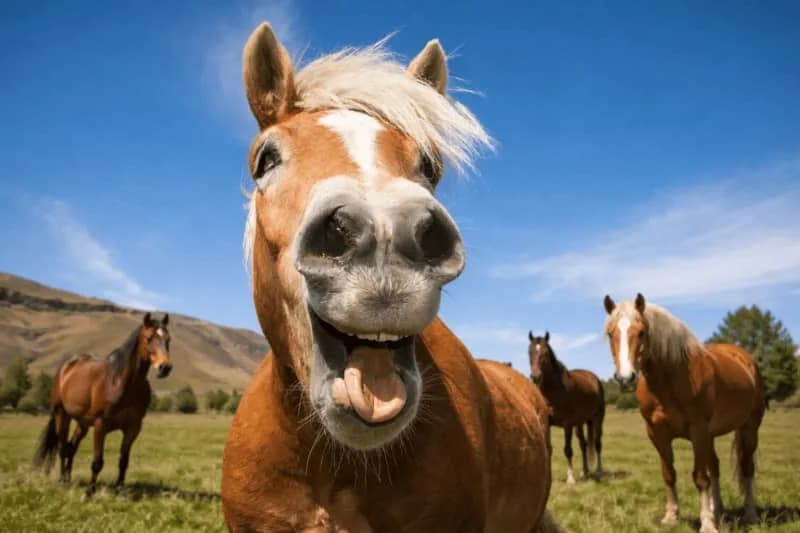
Horses whinny with two pitches at once, by vibrating vocal folds and whistling inside the larynx. (CREDIT: Wikimedia / CC BY-SA 4.0)
A horse’s whinny can sound like two simultaneous calls: a low, rough tone that resembles a typical mammal voice, and an unexpectedly high, piercing tone that seems impossible for a 500 kg animal to produce. A new study in Current Biology explains how horses create this striking dual-tone signal.
Two Separate Sound Sources
The researchers show that horses produce two independent frequencies at once (a phenomenon called biphonation) by using distinct mechanisms: vibrating vocal folds generate the low frequency (fo), while an aerodynamic whistle inside the larynx produces the high frequency (go). Previous work from the same group had shown these two frequencies carry different information about a horse’s emotional state; the new experiments identify the physical origins of each component.
“We now finally know how the two fundamental frequencies that make up a whinny are produced by horses,”says Elodie Briefer of the University of Copenhagen.
Definitive Helium Tests on Excised Larynges
To distinguish tissue vibration from aerodynamic whistles, the team ran airflow through six excised horse larynges and compared sounds produced in normal air versus helium. Because the speed of sound is higher in helium, whistle-like aerodynamic tones shift upward in frequency in helium while true tissue vibrations do not. The results were clear: the high-frequency go rose in helium (p < 0.0001), while the low-frequency fo did not change (Tukey post hoc: Z = −0.36, p = 0.98). In the excised-larynx trials, fo averaged 580 ± 458 Hz (range 41–1,254 Hz) and go averaged 1,879 ± 635 Hz (range 1,269–5,083 Hz).
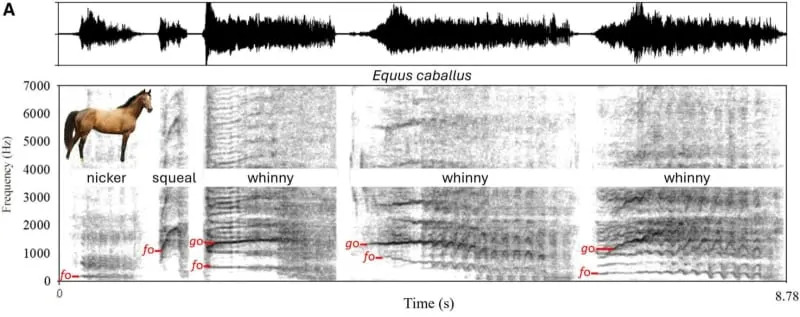
Domestic horses (Equus caballus; 11 different breeds) nicker and squeal (containing one fundamental frequency), as well as whinnies (containing two fundamental frequencies; n = 267 whinnies from 18 horses). (CREDIT: Current Biology)
Anatomy, CT Scans, and Model Estimates
CT scans of three excised larynges gave additional constraints. The mean vocal-fold length was 24 ± 5 mm; applying Titze’s string model the team estimated tissue-driven vibration could plausibly generate frequencies from roughly 24 Hz up to ~400 Hz, consistent with measured fo (about 399 ± 99 Hz) but far below typical go values (~1,500 Hz). Modeling suggested that producing a mean go of ~1,500 Hz by tissue vibration would require unrealistically high vocal-fold stress (~5.40 MPa), well above known physiological limits for mammals.
The scans also revealed anatomical features—an asymmetrical set of lateral ventricles and a small anterior bulla above the glottis (mean volume 192 ± 58 mm³)—that could help shape airflow or resonances for the whistle, but the exact resonator remains to be identified.
Endoscopy in Living Horses
To confirm what happens in vivo, the researchers recorded endoscopic video of 10 Franches-Montagnes stallions producing natural whinnies. At whinny onset, the arytenoid cartilages adducted (narrowing the glottis) and the whistle-like go began (median go = 1,619 Hz, IQR = 180 Hz). Later, the thyroid cartilage tilted and the vocal-fold-driven fo began (median fo = 385 Hz, IQR = 233 Hz). During concurrent production the arytenoids remained adducted, consistent with continued shaping of airflow for the whistle. fo and go showed only a weak correlation (Spearman’s R = 0.34, p = 0.003), supporting the idea of two parallel, largely independent sources.
Clinical Evidence From RLN Cases
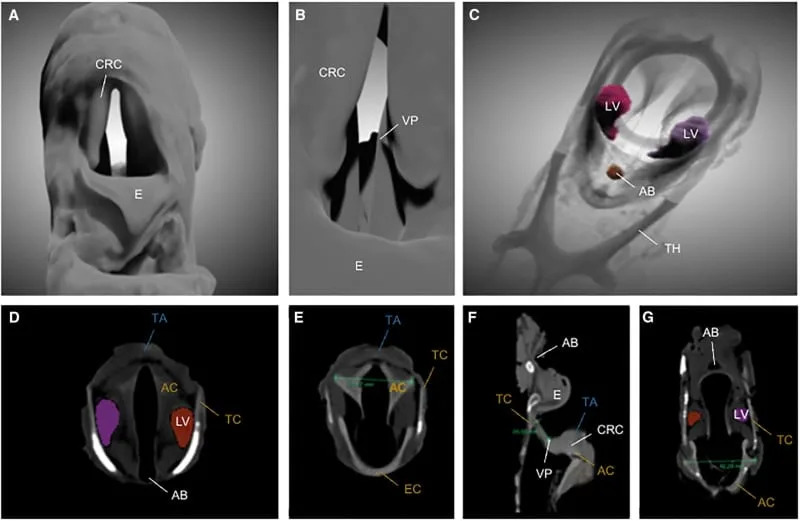
Three-dimensional representations (A–C) and coronal (D and E), sagittal (F), and transverse (G) plane CT scans. Labels identify the thyroid cartilage (TC), epiglottic cartilage (EC), arytenoid cartilage (AC), corniculate cartilage (CRC), transverse arytenoid (TA), vocal fold (V), epiglottis (E), vocal processes (VPs), lateral ventricles (LVs), and anterior bulla (AB). (CREDIT: Current Biology)
The team also examined horses with recurrent laryngeal neuropathy (RLN), which can partially or completely paralyze one vocal fold. Comparing calls from four RLN-affected horses with 11 controls, they found that fo was frequently fragmented or absent in RLN whinnies, while go persisted. Across RLN whinnies, fo was absent in 29% ± 46% of calls versus 3.03% ± 17.27% in controls (χ2 = 10.61, p = 0.001). The fraction of call time when fo and go overlapped dropped from 71% ± 30% in controls to 59% ± 23% in RLN cases (χ2 = 604.05, p < 0.0001). By contrast, the whistle-like go remained intact regardless of RLN, reinforcing the separation between the two mechanisms. Measures of nonlinear phenomena such as deterministic chaos were higher in RLN whinnies but not significantly so.
Comparative Context and Significance
Horses appear to be the first large mammals documented to produce a laryngeal whistle while simultaneously sustaining vocal-fold vibration. Other mammals that deviate from size-to-pitch expectations include koalas (velar vocal folds during inhalation) and some rodents that generate ultrasonic tones via laryngeal jets. Biphonation occurs broadly across vertebrates with diverse mechanisms; in horses, the combination likely offers communicative flexibility by allowing independent channels of information in a single call.
Limitations and Next Steps
The study’s excised-larynx tests used six larynges and maintaining stable low-frequency oscillation ex vivo was difficult, limiting sample size for some low-frequency measurements. The precise fluid dynamics (the site of vortex shedding) and the resonant structure that stabilizes the whistle remain uncharacterized. The authors suggest follow-up experiments such as targeted fluid-dynamic modeling, playback and propagation tests with modified or synthetic calls, and further anatomical studies to map the exact resonator.
Bottom Line: Multiple lines of evidence—helium shifts in excised larynges, CT and modeling constraints, endoscopy in live stallions, and clinical RLN comparisons—support the conclusion that horses produce biphonated whinnies using vocal-fold vibration for the low tone and an aerodynamic laryngeal whistle for the high tone.
Help us improve.